
| Disclosure: This post may contain affiliate links. As an Amazon Associate, I earn from qualifying purchases at no extra cost to you. |
Dark romance gets complicated fast.
Not because readers need another definition of what a morally gray hero is, but because two books can both be labeled dark romance and deliver completely different experiences.
One gives you a possessive mafia hero, consensual spice, violence outside the relationship, and a satisfying romantic payoff.
Another gives you captivity, sexual violence, psychological manipulation, an MMC who is genuinely dangerous to the FMC, and scenes that can be difficult even for experienced dark-romance readers.
Calling both books “dark” tells you almost nothing.
That is why I stopped thinking about dark romance on a single light-to-dark scale.
On Eerie Efficiency, I look separately at spice, darkness, obsession, psychological intensity, violence, emotional damage, trigger intensity, romance focus, and how strongly I recommend the book.
Because sometimes the question isn’t:
“How dark is it?”
It’s:
“What KIND of dark is it?”
That’s the question this guide is designed to answer.
If you want to explore individual tropes after this, start with my Dark Romance Tropes Explained guide, browse the Best Dark Romance Books of All Time, or go straight into specific flavors of chaos with Masked Men Dark Romance Books, Forced Marriage Dark Romance Books, or Dark Romance Books With Unhinged Heroes.
How Eerie Efficiency Rates Dark Romance Books
How these books are rated: Spice is scored from 1–5. Darkness, obsession, psychological intensity, violence, emotional damage, trigger intensity, romance focus, and overall recommendation are scored from 1–10. Ratings reflect content intensity, not literary quality. Read our complete Dark Romance Rating Methodology for detailed definitions.
These categories are separate on purpose.
A book can score:
- 5/5 Spice but only 4/10 Darkness
- 9/10 Darkness but 5/10 Violence
- 10/10 Obsession without being 10/10 Trigger Intensity
- 10/10 Psychological Intensity without needing graphic violence
- 6/10 Romance Focus because the thriller, revenge, crime, or suspense plot shares the spotlight
That distinction matters.
I have read recommendations described simply as “super dark” and then discovered the darkness wasn’t the kind I expected at all. That is exactly what I want these ratings to prevent.

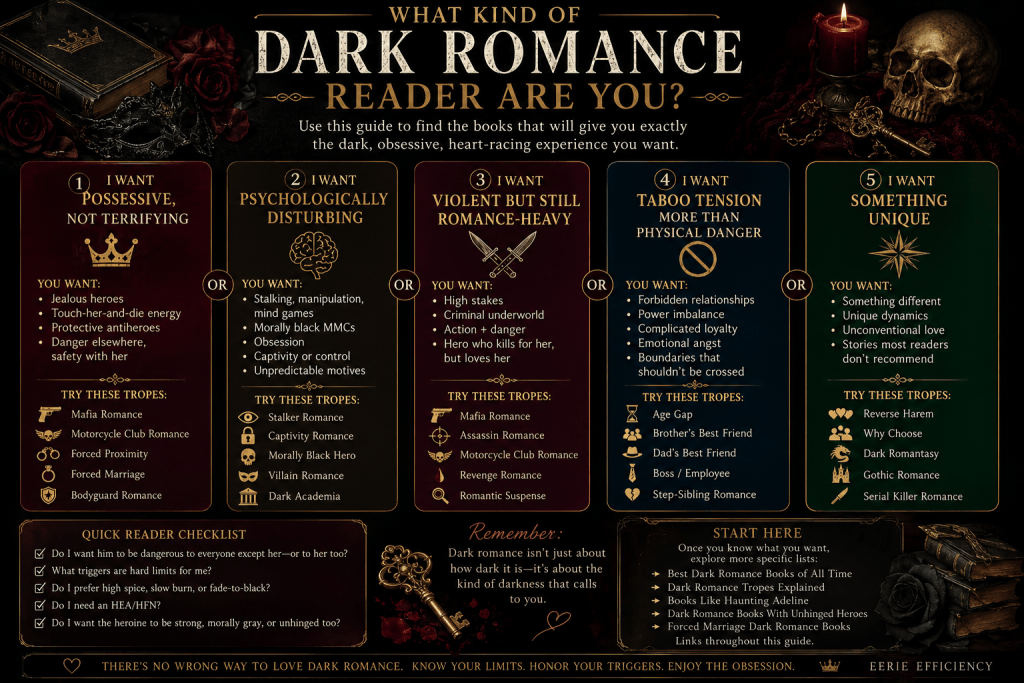
Start Here: What Kind of Dark Romance Reader Are You?
Before choosing a book, figure out what you actually want to feel.
You want possessive rather than terrifying
Look for:
- jealous heroes
- touch-her-and-die energy
- mafia romance
- protective antiheroes
- forced marriage
- obsession directed outward at threats rather than inward at the FMC
Try my dark romance books with antiheroes next.
You want psychologically disturbing
Look for:
- stalking
- manipulation
- captivity
- morally black MMCs
- obsession
- mind games
- unreliable motives
- heroes who are dangerous to the heroine herself
If Haunting Adeline is your reference point, my Books Like Haunting Adeline guide goes much deeper into that lane.
You want violent but still romance-heavy
Try:
- mafia
- motorcycle club
- criminal underworld
- revenge romance
- assassins
- romantic suspense
The violence may be extreme while the couple’s relationship remains comparatively safer.
You want taboo tension more than physical danger
Look for:
- age gap
- forbidden relationships
- power imbalance
- brother’s best friend
- dad’s best friend
- boss/employee
- complicated family loyalty
I write in this lane too. My free fiction What Breaks You leans into forbidden age-gap tension, while He Was My Brother’s Best Friend First goes after jealousy, history, family complications, and the particular disaster of wanting someone you absolutely should leave alone.
Dark Romance vs. Everything People Call Dark Romance
What actually makes a romance “dark”?
For me, darkness needs to meaningfully affect the relationship, characters, stakes, or emotional experience.
That might come from:
- violence
- coercion
- criminal activity
- obsession
- manipulation
- captivity
- revenge
- trauma
- taboo
- extreme power imbalance
- psychologically disturbing behavior
A hero being rude and tattooed is not enough.
Neither is putting a knife on the cover.
The darkness should change how the relationship works.
Is dark romance still romance?
Usually, yes.
The relationship should remain central enough that removing it would fundamentally change the book.
This is where readers sometimes talk past each other.
A novel can contain sex, obsession, an attractive dangerous man, and romantic feelings without functioning primarily as genre romance.
That distinction becomes especially important when readers expect a romantic payoff or HEA/HFN.
Does dark romance have to end happily?
Romance readers generally expect an emotionally satisfying romantic resolution, but books marketed around dark relationships sometimes blur genre boundaries.
If an unhappy ending is a hard limit for you, never assume “dark romance” guarantees the ending you want.
Check first.
Personally, I don’t think an ending warning ruins a dark romance nearly as much as getting emotionally invested for 400 pages and discovering you were reading a completely different kind of story than you thought.
Does dark romance have to be realistic?
No.
And this is one of the most important distinctions in the entire genre.
Dark romance frequently depends on exaggeration.
The possessiveness is bigger.
The danger is bigger.
The devotion is bigger.
The consequences are bigger.
A man who tracks your location, threatens anyone who looks at you, breaks into your house, eliminates your enemies, and decides you belong to him is horrifying dating advice.
He can still be compelling fiction.
Readers are capable of understanding the difference.
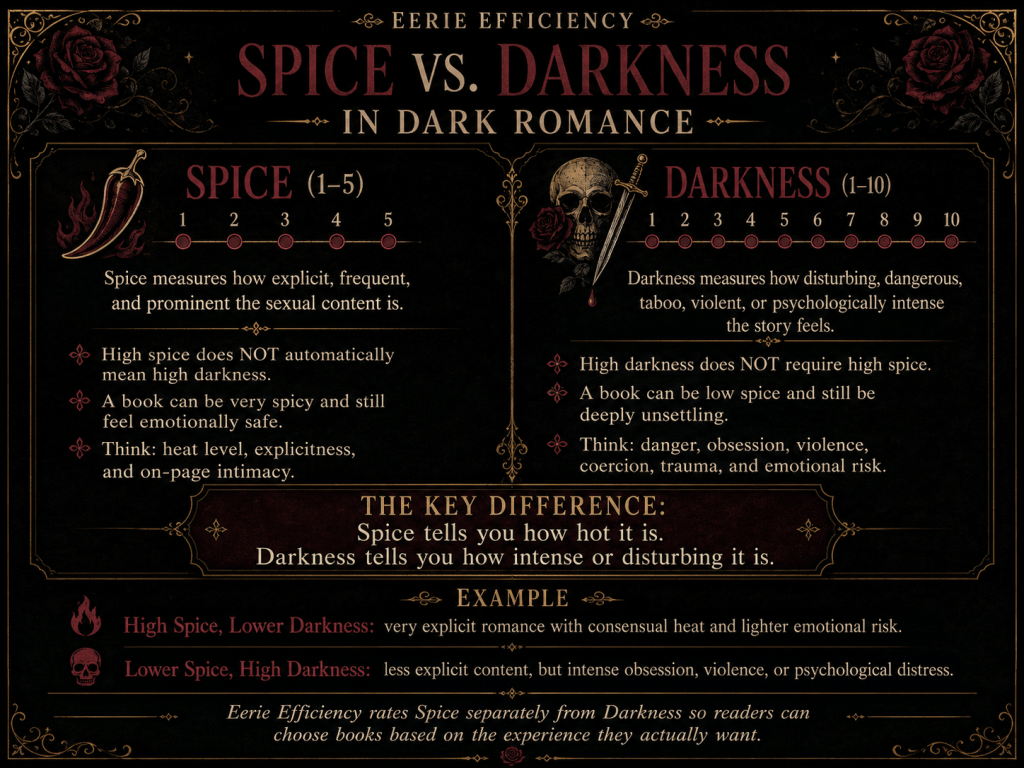
Spice Is Not Darkness
This deserves its own section because these terms get mixed together constantly.
Spice tells me how explicit and prominent the sexual content is.
Darkness tells me how disturbing, dangerous, morally extreme, taboo, violent, or psychologically difficult the story becomes.
Those things overlap sometimes.
They are not interchangeable.
A book can contain extremely explicit consensual sex and barely qualify as dark.
Another can be psychologically devastating with relatively little sexual content.
That is why I use Spice 1–5 and Darkness 1–10 independently.
The Difference Between Darkness, Trigger Intensity, and Emotional Damage
These are probably the three ratings most likely to look interchangeable until you encounter the right book.
Darkness
How far the story travels into disturbing, dangerous, taboo, violent, coercive, or morally extreme territory.
Trigger Intensity
How potentially difficult the content may be for readers with particular sensitivities.
A book involving graphic sexual violence will usually score differently here from a book whose darkness primarily comes from criminal activity.
Emotional Damage
How badly the story is likely to emotionally wreck you.
And no, the most violent book does not automatically win.
Grief, betrayal, abandonment, trauma, doomed relationships, family pain, helplessness, and characters making catastrophically human choices can hurt far more than body counts.
Some books make me wince.
Others make me stare at the wall.
Those are different experiences.
Obsession vs. Possessiveness vs. Protection
Dark romance uses these almost interchangeably. I don’t.
Protection says:
“I won’t let anyone hurt you.”
Possessiveness says:
“You are mine.”
Obsession says:
“I cannot stop thinking about you, watching you, wanting you, controlling you, pursuing you, or reorganizing my life around you.”
A character can be all three.
But the emotional experience changes depending on which one dominates.
A protective mafia hero may kill someone threatening the FMC but otherwise respect her independence.
An obsessive hero may be the threat.
That difference matters tremendously when choosing your next book.
Morally Gray vs. Morally Black Heroes
Another distinction I care about more than most recommendation lists seem to.
Morally gray MMC
He does bad things, but there are meaningful limits, motives, loyalties, contradictions, or boundaries.
You may understand him even when you wouldn’t defend him.
Morally black MMC
The story is not seriously asking you to pretend this man is secretly a nice guy.
He may stalk, manipulate, coerce, kill, terrorize, imprison, or psychologically dismantle people because he wants to.
The attraction comes from the fantasy and character—not from discovering he volunteers at the animal shelter every Saturday.
I actually prefer when a genuinely dark hero is allowed to remain dark instead of receiving an emergency personality transplant in the final hundred pages.
If you promised me a villain, let me have the villain.
Does “Touch Her and Die” Mean the Hero Is Safe?
Absolutely not.
This is one of the most useful things to know before choosing dark romance.
A man can slaughter anyone who threatens the heroine and still be deeply unsafe for the heroine herself.
Ask two questions:
Is he dangerous FOR her?
or
Is he dangerous TO her?
Some MMCs are both.
Those books create a completely different reading experience from the classic “terrifying to everyone except her” fantasy.
Consent Terms Dark Romance Readers Should Know
Dubcon
Dubious consent.
Consent may be pressured, compromised, manipulated, unclear, or complicated.
Noncon
Non-consensual sexual activity.
This is a major content warning and not simply “extra-dark spice.”
CNC
Consensual non-consent.
Characters agree to role-play or engage in scenarios designed to simulate loss of consent.
CNC and noncon are not the same thing.
Coercion
A character uses threats, leverage, circumstances, financial pressure, blackmail, authority, fear, captivity, or another form of power to obtain compliance.
These distinctions matter.
A recommendation that simply says “check triggers” isn’t enough when consent is the thing a reader is trying to avoid.
When Trigger Warnings Are Worth Spoilers
For me?
Almost always.
I’d rather know that a book contains something I absolutely cannot tolerate than preserve a surprise.
But readers differ.
A useful compromise is to give broad warnings in the recommendation and direct highly sensitive readers toward the author’s complete content-warning page.
Also remember that triggers are not a hierarchy.
Someone can happily read fictional murder and be unable to tolerate pregnancy loss.
Someone else can read dubcon but not cheating.
Neither reader is “more suited” to dark romance.
Your hard limits are your hard limits.
Beginner Dark Romance: Where Should You Actually Start?
This is where I disagree with the advice to simply start with whatever BookTok currently loves.
Popularity doesn’t equal beginner-friendly.
Start with the type of romance you already enjoy and move one step darker.
If you love:
Mafia romance
Start with danger, family politics, possessiveness, and external violence before jumping into captivity-heavy stories.
Romantic suspense
Choose dark romantic suspense where the relationship remains emotionally readable even while the external stakes escalate.
Gothic romance
Try atmospheric danger, isolation, secrets, obsession, or psychological unease.
Enemies to lovers
Choose an enemies-to-lovers book with clearly stated warnings instead of immediately selecting the cruelest bully romance available.
Forbidden romance
Start with taboo or power imbalance before moving into stories involving extreme coercion.
Your first dark romance should teach you something about your preferences.
It shouldn’t feel like an endurance test.
What Should Beginners Avoid?
Not because these tropes are “bad,” but because you should know your limits first:
- graphic noncon
- sexual torture
- extreme captivity
- sadistic MMCs
- severe humiliation
- intense body horror
- trafficking
- extreme abuse between the central couple
- heroes with essentially no emotional safety
You can always go darker later.
There is no prize for speed-running your trigger list.
Why Dark Romance Can Feel More Intense Than Regular Romance
Normal romance frequently asks:
Will they get together?
Dark romance can ask:
Should they get together?
Will they survive getting together?
Is he protecting her or controlling her?
Is this love, obsession, dependency, trauma, or some horrifying combination of all four?
That ambiguity creates pressure.
The best books don’t merely increase violence.
They make the relationship itself emotionally dangerous.
What Makes a Dark Romance GOOD Instead of Just Shocking?
This is one of my strongest opinions about the genre.
Darkness isn’t automatically depth.
A book doesn’t become psychologically sophisticated because more terrible things happen.
The dark books that stay with me usually have:
- character-specific obsession
- believable motives
- meaningful consequences
- an FMC with actual agency
- tension that exists beyond sex
- darkness that changes the characters
- an emotional reason the couple cannot simply walk away
- enough relationship development to understand why these two people specifically become consumed by each other
If you could swap the characters with two strangers and nothing important would change, the darkness probably isn’t doing enough.
Shock gets my attention.
Character makes me remember the book.
What Makes a Dark Romance Feel Mass-Produced?
The exact same unhinged billionaire in a different suit.
The exact same “feisty” heroine.
The exact same stalking scenes.
The exact same threats.
The exact same secret society with a slightly different mask.
The exact same claim that he has “never felt anything before her.”
Tropes aren’t the problem.
Dark romance is intensely trope-driven, and that’s part of why I love it.
The problem is when the characters exist only to perform the trope.
Give me a stalker hero.
Just tell me why this stalker is different from the thirty others on my Kindle.

Five Dark Romance Books That Show How Different “Dark” Can Feel
These were already part of this guide because they demonstrate something useful: dark romance doesn’t have one texture.
Rather than throwing fifty viral titles at you, here are five very different examples.
1. Wreck & Ruin by Emma Slate
Tarnished Angels Motorcycle Club #1
This is the recommendation I’d use to prove that a book can have genuine danger without relying primarily on a psychologically terrifying MMC.
Colt Weston is president of the Tarnished Angels Motorcycle Club, and the story brings motorcycle-club loyalty, danger, violence, family, and revenge into the romance.
Why readers love it
The attraction isn’t the only engine.
You also get the club itself, the feeling of finding belonging somewhere unexpected, and external danger that gives Colt’s protectiveness somewhere to go.
What makes it different
Compared with the psychologically darker books below, Wreck & Ruin puts more of its danger around the couple rather than making the central romance the sole source of fear.
That distinction makes it much more approachable for readers who want a dangerous world without immediately choosing the most boundary-destroying hero possible.
My take
This is the kind of book I would hand to someone who says, “I want darker than mainstream romance, but please don’t throw me directly into the abyss.”
The motorcycle-club world gives you stakes without requiring every scene between the leads to feel like psychological warfare.
Who should read it
Readers who want:
- motorcycle club romance
- dangerous protective MMC
- external violence
- loyalty
- found-family energy
- an easier bridge into darker romance
Who should avoid it
Skip it if motorcycle-club culture doesn’t interest you or you’re specifically looking for stalking, captivity, extreme psychological manipulation, or a truly morally black central hero.
Eerie Efficiency Ratings
Spice: 4/5
Darkness: 6/10
Obsession: 7/10
Psychological Intensity: 5/10
Violence: 8/10
Emotional Damage: 6/10
Trigger Intensity: 7/10
Romance Focus: 8/10
Overall Recommendation: 8/10
Trigger Warnings
Violence, gun violence, death, blood, kidnapping, injury, sexual-harassment themes, drug-related content, and other motorcycle-club/criminal-world violence.
Check the author’s complete content information before reading if any of these are hard limits.
Best for readers who liked…
Dangerous protective heroes, MC romance, found family, criminal-world romance, and stories where the MMC’s capacity for violence is primarily directed at external threats.
2. Loving the Wicked by Rebecca Johnpee
The Wicked Trilogy #2
See Loving the Wicked on Amazon
Important reading-order note: This is Book 2 of The Wicked Trilogy. I would not choose this as a random standalone starting point.
It combines dark mafia romance with heist-thriller energy and continues Elio and Zahra’s story.
Why readers love it
Obsession here feels active.
The characters aren’t sitting around discussing how intensely they feel. Their relationship collides with danger, criminal stakes, past history, and choices that keep creating consequences.
What makes it different
This recommendation has more thriller momentum than the books on this list that rely primarily on internal psychological darkness.
If you need plot with your obsession, this is the one I would look at first.
My take
I like dark romance much more when the dangerous man actually exists inside a dangerous story.
Give him something to do.
Give the heroine something to lose.
Give their obsession consequences.
That’s what makes this recommendation useful here.
Who should read it
Choose this if you want:
- mafia romance
- obsession
- second-chance complications
- revenge
- danger beyond the bedroom
- a stronger external plot
Who should avoid it
Don’t start here if you haven’t read the preceding book in the trilogy.
Also skip it if you want a self-contained romance with minimal criminal-plot complexity.
Eerie Efficiency Ratings
Spice: 4/5
Darkness: 7/10
Obsession: 9/10
Psychological Intensity: 7/10
Violence: 7/10
Emotional Damage: 8/10
Trigger Intensity: 8/10
Romance Focus: 8/10
Overall Recommendation: 8.5/10
Trigger Warnings
Mafia violence, criminal activity, stalking-related themes, obsession, revenge, trauma, and other dark relationship/crime themes.
Check the author’s complete warnings before reading.
Best for readers who liked…
Mafia romance with an actual plot, second-chance obsession, heist/thriller elements, and relationships where emotional history matters as much as physical attraction.
3. Darkest Sin by Sheridan Anne
This is where the list gets significantly darker.
The heroine is imprisoned and auctioned before ending up with Killian DeLorenzo, head of the Romanian Mafia.
That premise alone should tell you this is not my “try dark romance and see whether you like it” recommendation.
Why readers love it
It commits to its premise.
This isn’t mafia wallpaper surrounding a conventional romance.
The criminal world, captivity, power imbalance, violence, and heroine’s vulnerability fundamentally shape the reading experience.
What makes it different
Compared with Wreck & Ruin, the heroine herself is placed much closer to the darkest material.
That changes everything.
External danger can be exciting.
Personal vulnerability is harder to emotionally distance yourself from.
My take
This is exactly why a single Darkness rating is never enough for me.
A reader who happily handles gunfights and murder may struggle much more with trafficking, sexual violence, captivity, or loss of autonomy.
Two “8/10 dark” books can hit completely differently.
Who should read it
Experienced dark-romance readers looking for:
- mafia captivity
- extreme power imbalance
- very high stakes
- heavy content
- a substantially darker emotional experience
Who should avoid it
Skip this if sexual violence, trafficking, captivity, torture, abuse, or loss of bodily autonomy are hard limits.
I would not recommend this as someone’s first dark romance.
Eerie Efficiency Ratings
Spice: 5/5
Darkness: 10/10
Obsession: 9/10
Psychological Intensity: 9/10
Violence: 10/10
Emotional Damage: 9/10
Trigger Intensity: 10/10
Romance Focus: 8/10
Overall Recommendation: 8.5/10 — for the right reader
Trigger Warnings
Sexual assault, rape, trafficking, torture, kidnapping, confinement, murder, abuse, stalking, violence, gore, blood, and psychological trauma.
This is not an exhaustive list. Check complete author warnings before reading.
Best for readers who liked…
Pitch-black mafia romance, captivity plots, extremely dangerous MMCs, and books that refuse to keep the darkest material comfortably outside the main relationship.
4. The Wicked Games We Play by W.A. Marlow
See The Wicked Games We Play on Amazon
This recommendation previously appeared in this guide under the wrong authors. The correct author is W.A. Marlow.
It is Book 1 in The Wicked Games We Play series and is marketed as a dark reverse-harem romance.
Why readers may love it
This is here for readers who specifically want the multiple-love-interest/why-choose side of dark romance rather than the single obsessive MMC setup that dominates many recommendation lists.
What makes it different
The relationship structure itself changes the tension.
Possessiveness, jealousy, loyalty, danger, and sexual dynamics work differently when the central relationship isn’t simply one woman and one dangerous man.
That makes it useful in a guide intended to show how broad dark romance can actually be.
My take
Why-choose dark romance deserves better than being treated as “regular dark romance, but add more men.”
The group dynamic changes everything—from jealousy to safety to who holds power in a scene.
That’s the reason this belongs here.
Who should read it
Readers who want:
- dark reverse harem
- why-choose dynamics
- multiple MMCs
- explicit content
- a less conventional central relationship
Who should avoid it
Skip it if you strongly prefer monogamous romance or want a polished mainstream-style dark-romance experience.
This is also one where I would check the book’s complete content warnings carefully before buying.
Eerie Efficiency Ratings
Spice: 5/5
Darkness: 7/10
Obsession: 7/10
Psychological Intensity: 7/10
Violence: 7/10
Emotional Damage: 7/10
Trigger Intensity: 8/10
Romance Focus: 8/10
Overall Recommendation: 7/10
Trigger Warnings
Explicit sexual content, violence, dark relationship dynamics, strong language, and other mature material. Consult the complete book warnings before reading.
Best for readers who liked…
Dark why-choose romance, reverse-harem dynamics, multiple possessive love interests, and darker ensemble relationships.
5. Hate Like Ours by Nikita
The Hate/Love Duet #1
This is the recommendation for readers who think “dark” has to mean mafia assassinations, underground auctions, or masked stalkers.
It doesn’t.
Cruelty can be emotional.
Why readers love it
The central hate is personal.
This is bully/enemies-to-lovers territory with a step-sibling complication and a hero whose hostility causes genuine damage.
What makes it different
The darkness is much more interpersonal than criminal.
That means someone who easily tolerates fictional murder may actually find this one harder to read.
Humiliation and sustained emotional cruelty hit differently.
My take
This is another category I think gets underrated on darkness scales.
Readers see “bully romance” next to mafia torture and automatically assume the bully book is lighter.
Not necessarily.
Physical danger and emotional degradation are different axes.
Depending on your boundaries, the “less violent” book may be far more upsetting.
Who should read it
Readers looking for:
- genuine enemies-to-lovers hostility
- bully romance
- step-sibling taboo
- emotional angst
- cruel hero
- high spice
- relationship-centered darkness
Who should avoid it
Skip it if bullying, humiliation, emotional cruelty, step-sibling romance, or self-destructive behavior are hard limits.
Eerie Efficiency Ratings
Spice: 5/5
Darkness: 8/10
Obsession: 8/10
Psychological Intensity: 9/10
Violence: 5/10
Emotional Damage: 10/10
Trigger Intensity: 9/10
Romance Focus: 9/10
Overall Recommendation: 8/10
Trigger Warnings
Bullying, emotional abuse, humiliation, cruel behavior, step-sibling relationship, self-destructive behavior, and other heavy themes.
Check the author’s full content warnings before reading.
Best for readers who liked…
Brutal enemies-to-lovers, emotionally vicious bully romance, taboo family complications, and books where emotional pain matters more than body count.
Darkness Ranking: These Five Books From Least to Most Intense
| Rank | Book | Darkness |
|---|---|---|
| 1 | Wreck & Ruin | 6/10 |
| 2 | Loving the Wicked | 7/10 |
| 3 | The Wicked Games We Play | 7/10 |
| 4 | Hate Like Ours | 8/10 |
| 5 | Darkest Sin | 10/10 |
But do not use this chart without considering the type of darkness.
Hate Like Ours may be less physically violent than Wreck & Ruin while being substantially more emotionally difficult for a reader sensitive to humiliation or bullying.
Spice Ranking
| Book | Spice |
| Wreck & Ruin | 4/5 |
| Loving the Wicked | 4/5 |
| Darkest Sin | 5/5 |
| The Wicked Games We Play | 5/5 |
| Hate Like Ours | 5/5 |
Again: high spice does not automatically mean high darkness.
Reader Decision Guide: Which One Should You Start With?
Start with Wreck & Ruin if:
You want danger, violence, motorcycle-club loyalty, and a protective MMC without immediately jumping into extreme psychological darkness.
Start with Loving the Wicked if:
You already enjoy mafia romance and want obsession combined with plot.
Just read the trilogy in order.
Start with Hate Like Ours if:
Emotional warfare is your weakness and you want the relationship itself to create most of the pain.
Start with The Wicked Games We Play if:
You specifically want a darker why-choose/reverse-harem setup.
Start with Darkest Sin if:
You already know extreme dark romance works for you and your hard limits do not include its major warnings.
Do not choose Darkest Sin simply because you want “the darkest one.”
Choose it because you actually want that type of darkness.
If You Loved Book X, Read This Next
If you loved Haunting Adeline…
Start with my full Books Like Haunting Adeline guide rather than assuming every violent romance will recreate that particular stalker/psychological experience.
If you loved The Ritual…
Go straight to 15 Dark Romance Books Like The Ritual for secret societies, dangerous initiations, power, and men who should not be entrusted with anyone’s emotional wellbeing.
If you loved God of Malice…
Read my Books Like God of Malice guide for books where obsession and psychological danger matter more than simply giving the hero a gun.
If you loved Quicksilver…
Try Books Like Quicksilver if you want your dangerous men with magic, fantasy stakes, and romantasy worldbuilding.
If you loved Butcher & Blackbird…
Read Books Like Butcher & Blackbird for dark humor, morally questionable people, crime, and relationships that feel more playful than pitch-black captivity romance.
Books People Think Belong in Dark Romance—But Don’t Always
This gets messy because readers use “dark romance” conversationally much more broadly than publishers or genre purists do.
Two commonly confused examples are You by Caroline Kepnes and Verity by Colleen Hoover.
Both can appeal to dark-romance readers.
Both contain disturbing relationship material.
Neither is my ideal example for explaining the dark-romance genre to a beginner.
Why?
Because dark content + attraction does not automatically equal dark romance.
Psychological thrillers can contain obsession.
Horror can contain sex.
Erotic fiction can contain dangerous relationships.
Crime fiction can contain romantic subplots.
When I’m deciding whether something belongs on an Eerie Efficiency romance list, I ask:
If I removed the relationship, would I destroy the central structure of the book?
If not, I start questioning whether I’m actually recommending romance or simply recommending something dark that romance readers may also enjoy.
Common Dark Romance Misconceptions
“The darker the book, the better it is.”
No.
Darkness is content intensity.
It is not literary quality.
That’s precisely why my Darkness score and Overall Recommendation score are separate.
A 10/10 Darkness book can receive a 6/10 recommendation.
A 5/10 Darkness book can be one of my favorite reads.
“A morally gray hero is basically a villain.”
Not necessarily.
Morally gray characters usually still have meaningful limits.
A genuinely villainous romantic lead may have very few.
Calling every possessive man “morally gray” eventually makes the term meaningless.
“All dark romance contains noncon.”
It doesn’t.
Plenty of dark romances derive their darkness from murder, criminal worlds, revenge, trauma, external threats, taboo, supernatural horror, or psychological intensity while maintaining consent between the central couple.
“Mafia romance is automatically dark romance.”
No.
Some mafia romances are extremely dark.
Others use the mafia primarily as setting and provide a comparatively conventional central relationship.
Genre labels tell you where to look.
They don’t replace content information.
“Possessive means abusive.”
Not automatically in fictional classification.
Possessiveness exists on a huge spectrum, from jealous territorial behavior to complete coercive control.
That’s why “possessive hero” alone is not enough information for me.
“If I like fictional stalking, I secretly want to be stalked.”
No.
Readers understand imagination.
You can enjoy haunted houses without wanting a demon in your basement.
We should extend romance readers the same intellectual courtesy.
FAQ: Choosing Dark Romance Based on Your Actual Preferences
What should I read if I want a hero who is dangerous to everyone except her?
Search for:
- touch her and die
- protective antihero
- possessive mafia hero
- bodyguard romance
- morally gray protector
These are generally better searches than simply “dark romance.”
What if I want the hero to be dangerous to her too?
Search:
- morally black hero
- stalker romance
- captivity romance
- villain romance
- bully romance
- coercive dark romance
Then check warnings carefully because those labels cover an enormous range.
What if I want obsession without constant violence?
Look for psychological obsession, stalking, forbidden fixation, jealous/possessive heroes, manipulative relationships, and slower-burn psychological dark romance.
Honestly, this is one of my favorite areas because the hero does not need to stab someone every 40 pages to feel dangerous.
What if I want violence but clear consent?
Look for mafia, assassin, MC, romantic suspense, vigilante romance, or external-danger stories and verify the individual book warnings.
The source of darkness matters more than the broad subgenre.
What if I hate bullying?
Don’t assume that avoiding books labeled “bully romance” completely solves the problem.
Cruelty can appear in stalker, mafia, academy, enemies-to-lovers, and captive romance too.
Search reviews and warnings for humiliation, degradation, emotional abuse, bullying, and cruelty from MMC to FMC.
What if cheating is my hard limit?
Check it separately.
Darkness level tells you almost nothing about cheating.
Some of the most violent dark romances are fiercely monogamous.
Other comparatively mild romances contain infidelity.
What if pregnancy is a hard limit?
Again, search it separately.
Pregnancy, miscarriage, fertility issues, reproductive coercion, and breeding kink are specific content concerns that a general trigger-intensity number can’t completely communicate.
What if I don’t like virgin heroines?
Search recommendations by FMC characterization rather than only trope.
Dark romance contains dangerous heroines, sexually experienced heroines, killers, survivors, mothers, criminals, wealthy heroines, older heroines, and women who are every bit as morally questionable as the men.
I want more of them.
What if I want the heroine to be dangerous too?
Try:
- morally gray heroine
- female assassin
- female serial killer
- revenge heroine
- villain couple
- criminal couple
- dark romantic suspense with female antihero
The genre gets much more interesting once the woman stops existing solely to be shocked by the hero.
Why Some Dark Romance Heroes Work—and Others Just Annoy Me
Possession isn’t a personality.
Neither is violence.
The MMCs I remember tend to have contradictions.
He may be terrifying but patient with one particular vulnerability.
He may be obsessively controlling yet have one boundary he refuses to cross.
He may think he understands the heroine completely and discover that he doesn’t.
He may be brilliant about everyone except her.
The important part is specificity.
Why her?
Not because the trope requires it.
Not because she has “something different in her eyes.”
Why does this exact woman dismantle this exact man?
When a book answers that convincingly, I’ll forgive an extraordinary amount of fictional insanity.
What Makes a Dark Romance Hero Too Far for Me?
Not a specific act.
Context.
I can sometimes tolerate worse behavior from a book that understands exactly how disturbing its hero is than from a milder book that insists his behavior is completely healthy.
Framing matters.
Consequences matter.
The heroine’s agency matters.
And tone matters.
I don’t need every dark romance to condemn its fantasy.
But I do want the book to know what fantasy it is selling me.
Why Heroine Agency Matters Even in Captivity Romance
Agency doesn’t mean the heroine must physically overpower a captor.
It means she remains a character rather than an object the plot drags around.
Agency can look like:
- strategy
- resistance
- negotiation
- manipulation
- escape planning
- emotional choices
- withholding information
- choosing when to trust
- using the hero’s obsession against him
- redefining what she wants
A heroine can be trapped and still have agency.
A heroine can also be technically free and feel completely passive.
Those aren’t the same thing.
Are Trigger Warnings Spoilers?
Sometimes.
I still prefer them.
The trick is layering information.
A casual reader can read:
Trigger Warnings: captivity, violence, dubcon, trauma
and stop there.
Someone who needs specifics can consult the author’s complete list.
That gives both readers a choice.
What Does “Check Your Triggers” Actually Mean?
It should mean more than throwing a generic disclaimer above an article.
Check:
- Who commits the act?
- Who experiences it?
- Is it on-page?
- How graphic is it?
- Is it repeated?
- Does it occur between the romantic leads?
- Does the story treat it as traumatic, erotic, romantic, horrific, or some combination?
“Contains violence” doesn’t tell me nearly enough.
What Does “Safe Hero” Mean in Dark Romance?
Usually a hero who may be dangerous in general but maintains certain boundaries with the heroine.
Reader definitions vary.
Someone might mean:
- no cheating
- no sharing
- no physical abuse of FMC
- no noncon between MCs
- no humiliation
- unwavering loyalty
- protective rather than predatory toward her
Never assume everyone uses “safe” the same way.
Ask what they mean.
What Is an Unsafe Hero?
A hero whose danger extends directly toward the heroine.
That may involve:
- stalking
- kidnapping
- coercion
- manipulation
- physical violence
- sexual violence
- blackmail
- isolation
- psychological abuse
Unsafe heroes are a deliberate fantasy preference for many dark-romance readers.
But recommending one as though he is a protective cinnamon roll with a knife collection does readers no favors.
What Is “Pitch Black” Romance?
There is no universal mathematical cutoff.
When I use the term, I mean romance approaching the extreme end of multiple categories:
- very high darkness
- severe triggers
- intense psychological material
- extreme power imbalance
- graphic or disturbing content
- very unsafe characters
A book shouldn’t become “pitch black” simply because the author uses the phrase in marketing.
The content has to earn it.
What Does “Dark but Not Too Dark” Mean?
Usually:
“I want the fantasy of danger without crossing my personal hard limits.”
That could mean:
- murder is fine, noncon isn’t
- stalking is fine, humiliation isn’t
- mafia violence is fine, torture isn’t
- morally gray is fine, morally black isn’t
- obsession is fine, captivity isn’t
So instead of asking someone how dark they want a book, ask:
What don’t you want in it?
That question is far more useful.
Can Dark Romance Be Funny?
Absolutely.
And when dark humor works, it can actually make extreme premises more accessible.
But comedy changes the emotional texture.
Murder played with absurdity feels completely different from murder framed as psychological horror.
Same act.
Different reading experience.
This is exactly why numerical darkness ratings need context.
Can Dark Romance Be Gothic?
Yes—and gothic darkness is one of my favorite alternatives to the endless criminal-billionaire pipeline.
Give me:
- the house with a locked room
- the family everyone whispers about
- an isolated estate
- old grief
- inherited secrets
- obsessive love
- a man who may be dangerous
- a heroine who isn’t sure whether she should run from him or the building
Atmosphere can create darkness without requiring constant violence.
Can Dark Romantasy Count as Dark Romance?
Absolutely, when the romance remains central.
Dark fantasy romance can include:
- monsters
- vampires
- demons
- cruel fae
- forced bargains
- magical captivity
- war
- morally gray immortals
- enemies-to-lovers
- supernatural power imbalance
If that is your preferred flavor, Books Like Quicksilver is a good place to continue.
Can Dark Romance Be Low Spice?
Yes.
This is another reason I hate seeing flames used as a proxy for darkness.
Psychological obsession, gothic dread, violence, trauma, and manipulation don’t require explicit sex.
If anything, a low-spice psychological romance can sometimes feel more unsettling because there is no erotic release valve.
Can Dark Romance Have a Sweet Relationship?
Yes.
Some books create a very dark world around a surprisingly tender couple.
That contrast can be fantastic.
A man can be objectively terrifying and still make her coffee exactly how she likes it.
Dark romance lives for contradictions.
EE Expertise: My Rule for Evaluating Dark Romance
When I evaluate a book for Eerie Efficiency, I ask five questions before worrying about whether it is viral:
1. Where does the darkness come from?
The MMC?
The FMC?
The world?
Their history?
Crime?
Trauma?
Sex?
Power?
2. Who is actually at risk?
The heroine?
The hero?
Both?
Everyone outside the relationship?
3. What happens if I remove the dark elements?
Does the story collapse?
If not, the darkness may just be decoration.
4. Why are these characters obsessed with EACH OTHER?
I don’t want generic chemistry.
I want specificity.
5. Who should absolutely skip this book?
A recommendation becomes more trustworthy the moment I’m willing to tell someone not to read it.
That’s why every major Eerie Efficiency recommendation now includes both:
Who should read it
and
Who should avoid it.
I would rather help you avoid the wrong book than convince you every book belongs on your TBR.
Final Dark Romance FAQ
Is it okay to DNF dark romance?
Yes.
Your Kindle does not issue medals for suffering.
Does loving dark romance mean I want unhealthy relationships?
No.
Fiction isn’t a dating application.
Can someone enjoy noncon fiction and oppose sexual violence?
Yes.
Fictional fantasy and real-world ethics are not interchangeable.
Can I love dark romance and hate certain dark tropes?
Of course.
Most experienced dark-romance readers become more selective, not less.
Is stalking always one of the darkest tropes?
No.
The execution matters.
Some stalker romances are playful or highly stylized.
Others are genuinely disturbing.
Is mafia romance a good beginner subgenre?
Often.
Especially if the hero’s violence is directed mostly outside the relationship.
Check individual warnings.
Is bully romance beginner-friendly?
It depends heavily on your tolerance for humiliation and emotional cruelty.
I would not use “low body count” as evidence that a bully book is emotionally mild.
Is captivity romance beginner-friendly?
Usually not my first recommendation.
Loss of autonomy creates an intensity that can be much harder to distance yourself from than external violence.
What if I liked one dark romance and hated another?
Good.
You just learned something useful.
Write down what you loved and hated.
Don’t simply conclude that you do or don’t like dark romance.
Maybe you love obsession and hate humiliation.
Maybe you love morally black heroes but hate noncon.
Maybe you love mafia violence and hate bullying.
That information makes your next recommendation dramatically better.
How do I find better dark romance recommendations?
Stop searching only by genre.
Search by emotional experience.
Instead of:
best dark romance books
try:
dark romance with obsessive hero but no cheating
dark mafia romance with protective hero
dark romance with morally gray heroine
stalker romance with happy ending
psychological dark romance without noncon
dark romance with high obsession low violence
The more specific your request becomes, the better your TBR becomes.
Where to Go Next
If you want to explore the genre by trope rather than randomly adding whatever goes viral, these are better starting points:
- Best Dark Romance Books of All Time
- Dark Romance Tropes Explained
- Dark Romance Books With Unhinged Heroes
- Masked Men Dark Romance Books
- Forced Marriage Dark Romance Books
- Dark Romance Books With Antiheroes
- Books Like Butcher & Blackbird
- Books Like Haunting Adeline
- Books Like The Ritual
- Books Like God of Malice
- Books Like Quicksilver
And if you’d rather read obsession than read another list about it:
What Breaks You — forbidden age gap, slow-burn tension, complicated loyalty, and the particular kind of emotional disaster that happens when two people know exactly why they shouldn’t cross the line.
He Was My Brother’s Best Friend First — jealousy, old feelings, family complications, possessiveness, and a man who is considerably less over her than he wants anyone to know.
Final Thoughts
The longer I spend around dark romance, the less useful the question “Is this book dark?” becomes.
Tell me instead:
Is he obsessed?
Is she afraid of him?
Is the violence inside or outside the relationship?
Does she have agency?
Is the darkness psychological or physical?
Will it emotionally destroy me?
Is the romance still the heart of the book?
And—probably most importantly—
What kind of reader should stay far away from it?
That’s the information I want before I commit hours of my life to a book.
Dark romance is too broad to flatten into “mild, medium, extreme.”
A 10/10 violent book can be easier for one reader than a 7/10 bully romance.
A stalker can feel safer than a husband.
A villain can become more romantic than a supposedly respectable man.
A five-alarm red flag can somehow become the character you’re rooting for.
That contradiction is part of what makes the genre so addictive.
Just know what kind of darkness you’re walking into.
Then pick the one that’s actually yours.