Dark romance keeps the love story at the centre, but brings in danger, obsession, taboo subjects or characters who make some very questionable choices. Sometimes the danger comes from the world around the couple. Sometimes it comes from the relationship itself.
The confusing part is that two books can both be called dark romance and have almost nothing else in common. One might give you a possessive criminal hero and a fairly gentle love story. Another might involve stalking, captivity or non-consent. The label alone won’t tell you which you’re getting.
That’s what this guide is for: understanding the tropes, checking the content that matters to you, and finding the kind of dark romance you actually want to read. You don’t need to start with the most extreme book or enjoy every part of the genre.
What Actually Makes a Romance Dark?
Darkness usually comes from some combination of the relationship, the characters, the premise and the events surrounding them.
Common elements include:
Obsession: attraction becomes fixation, surveillance, possession or an inability to let the other character go.
Stalking: one character follows, watches, tracks or secretly gathers information about another.
Kidnapping or captivity: a character’s freedom is deliberately restricted.
Manipulation: affection, information, circumstances or vulnerabilities are deliberately used to control someone.
Coercive control: one character exerts power over another’s choices, freedom or behavior.
Dubious consent: meaningful consent is unclear, pressured, compromised or otherwise ambiguous.
Non-consent: consent is absent.
Violence: violence may happen between the romantic leads, around them, or as part of the world they inhabit.
Organized crime: mafia, cartel, Bratva and other criminal settings can introduce violence, power and moral compromise.
Revenge: a relationship may begin inside a plan to punish, manipulate or destroy someone.
Trauma: past or ongoing trauma may substantially shape the characters and relationship.
Taboo relationships: the premise intentionally crosses social, moral or cultural boundaries.
Extreme power imbalances: one character may have dramatically more physical, financial, institutional or social power.
Morally gray or morally black protagonists: the romantic lead may make choices conventional romance would normally assign to its villain.
Psychological manipulation: gaslighting, fear, emotional dependency and deliberate destabilization may become part of the romantic conflict.
Dangerous relationship dynamics: the romance itself—not merely an outside villain—can be a source of threat.
A book does not need all of these.
And dark romance does not automatically mean non-consensual sexual content.
If you want to explore these dynamics individually, the Every Dark Romance Trope Explained guide goes much deeper into what the major tropes actually mean.
Dark Romance Exists on a Spectrum
“Dark” sounds like a single measurement.
Two books can both be accurately described as dark romance and provide almost unrecognizable reading experiences.
A softer dark romance might have a possessive antihero, criminal setting and threatening atmosphere while keeping the central relationship relatively consensual and emotionally accessible.
A moderate dark romance may introduce more manipulation, violence, stalking, captivity, coercion or psychological instability.
A very dark romance might make those elements central to the relationship itself.
At the extreme or transgressive end, a story may intentionally confront material many readers consider deeply disturbing.
These are useful descriptions, not standardized industry categories. There is no official governing body assigning books Dark Romance Level Seven certificates.
Darkness Isn’t a Ladder. It’s More Like a Control Panel.
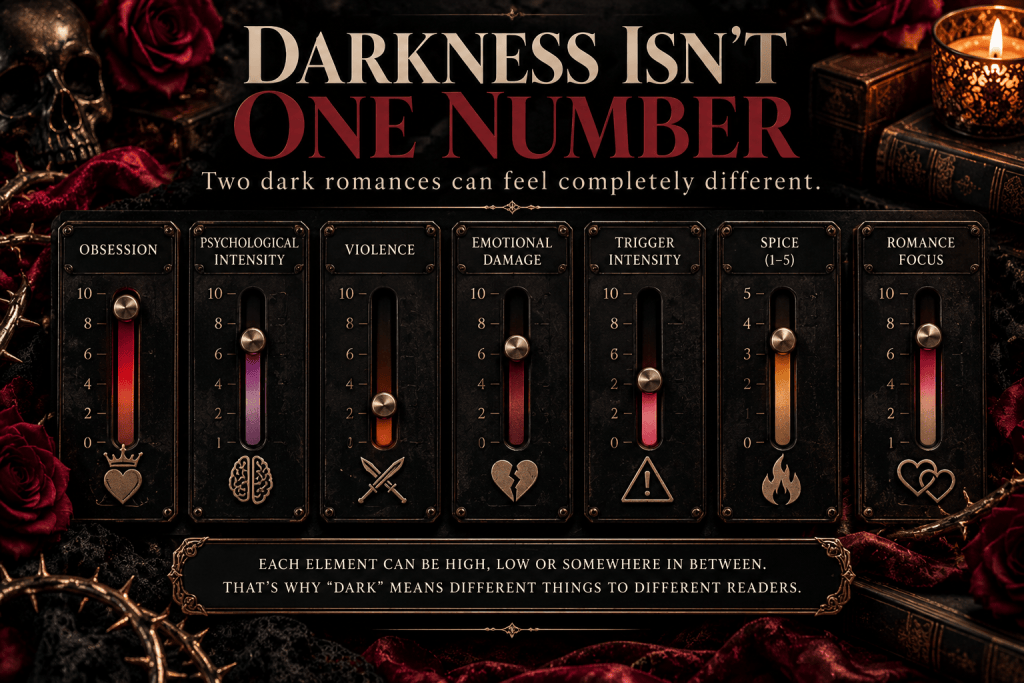
This is one of the biggest ideas behind how Eerie Efficiency approaches dark romance.
Imagine several controls:
Obsession
Psychological intensity
Violence
Emotional damage
Trigger intensity
Sexual explicitness
Romance focus
Now imagine that every book can move those controls independently.
One book could be intensely psychological with relatively little physical violence.
Another could contain graphic violence without creating the same emotional devastation.
A third could have extreme obsession but moderate overall darkness.
And a fourth could be sexually explicit from beginning to end while barely qualifying as dark at all.
That is why Eerie Efficiency doesn’t make one number do all the work.
Spice is scored from 1–5. Darkness, Obsession, Psychological Intensity, Violence, Emotional Damage, Trigger Intensity and Romance Focus are scored separately from 1–10.
These are subjective editorial ratings, not a measure of literary quality or a guarantee of how a book will affect you. Use them alongside specific content warnings. An unknown boundary means it hasn’t been verified; it doesn’t mean the book is free of that content.
You can see the full definitions in the Dark Romance Rating Methodology.
And this is where dark-romance taste gets much more interesting than “How dark can you handle?”
Two readers can both love very dark books while having almost nothing else in common.
One wants obsession cranked to ten but avoids graphic violence.
Another loves violent criminal worlds but doesn’t want stalking.
Someone else wants psychological warfare and emotional devastation but very little sexual content.
“Very dark” hasn’t told us enough about any of them.
Eerie Editor’s Take
Darkness only works for me when it actually does something to the story. Making a book more violent, more shocking or more taboo doesn’t automatically make it more compelling. I want the obsession, danger or psychological darkness to affect the characters and the relationship—not feel like increasingly outrageous scenes were added just to prove how dark the book can get.
That’s also why I don’t think “darker” automatically means “better.” Give me the right combination of obsession, tension, danger and emotional payoff over a book trying to win an imaginary award for traumatizing me.
Is Dark Romance the Same as Toxic Romance?
No—but the two can overlap.
A dark romance may deliberately portray behavior that would be unhealthy, controlling, abusive or dangerous in a real relationship. In some books, that is exactly where the darkness comes from.
That does not make “toxic romance” and “dark romance” interchangeable genre labels.
Dark romance is a category of fiction. “Toxic” is a judgment about a relationship dynamic.
A fictional couple can behave terribly and still be fascinating to read about.
The page is not a relationship advice manual.
Calling a fictional relationship compelling also does not require pretending that stalking, coercion, kidnapping or extreme control would become desirable because an attractive character did it.
Readers are capable of holding both ideas at once:
I would never want this to happen to me.
and
I absolutely want to know what happens next.
That distinction matters whenever people start treating fictional preference as a personality test.
Why Do People Read Dark Romance?
Different readers may be attracted to:
emotional intensity;
extremely high stakes;
taboo scenarios;
suspense and danger;
obsessive devotion;
morally complicated characters;
revenge;
unpredictability;
power fantasies;
extreme emotional situations;
curiosity about uncomfortable subjects;
fictional scenarios they would reject completely in real life.
Sometimes the appeal is the fantasy of being wanted with unreasonable intensity.
Sometimes it is the suspense.
Sometimes it is the villain.
Sometimes it is the heroine who turns out to be every bit as dangerous as he is.
Sometimes a reader simply wants fiction capable of making them think:
Oh, this is a terrible idea. Keep going.
None of those explanations should be treated as universal.
Dark-romance readers are not one psychological type, and enjoying a fictional scenario doesn’t tell you that someone secretly wants the literal real-world version.
Eerie Editor’s Take
One of the strangest assumptions about dark romance is that enjoying something on the page means you’d enjoy experiencing it.
I can enjoy reading an obsessive MMC without wanting a man tracking my location. I can find fictional possessiveness entertaining while recognizing that controlling someone’s real friendships, money or movements is not romantic. Those ideas aren’t contradictory.
For me, part of the appeal of dark romance is that fiction can go places real life absolutely should not. The fact that I want to know what a fictional character does next doesn’t mean I want him showing up at my house.
That separation between fantasy and endorsement shouldn’t require an apology.
Is Liking Dark Romance Normal?
Yes.
Enjoying fictional material involving danger, taboo, villains, morally questionable decisions or unhealthy relationships does not by itself establish that someone wants those things to happen in real life.
Fiction gives people room to encounter scenarios without having to turn them into personal goals.
That doesn’t mean every reader experiences dark fiction in the same way, and it doesn’t mean every possible claim about the psychological effects of fiction should be accepted without evidence.
It means your bookshelf is not a confession.
You can enjoy an obsessive fictional character and still consider real-world stalking terrifying.
You can enjoy mafia fiction without wanting organized crime in your neighborhood.
You can love villain romance while maintaining the deeply controversial real-world position that murder is bad.
Fiction and life are capable of occupying different categories in your head.
Is Dark Romance Always Spicy?
No.
Darkness and spice measure different things.
Spice describes sexual explicitness.
Darkness describes the intensity of disturbing, dangerous, morally complicated or psychologically difficult material.
A hypothetical book could be:
Darkness: 9/10
Spice: 2/5
Another could be:
Darkness: 3/10
Spice: 5/5

Dark romance spice versus darkness ratings showing that spicy books are not necessarily darker
Calling the second book “darker” simply because it contains more explicit sex would tell you almost nothing useful about the reading experience.
The reverse mistake happens too. A book can contain severe violence, trauma, psychological manipulation or captivity without being particularly explicit sexually.
If spice is the part you’re trying to decode, the Dark Romance Spice Scale explains what the different levels mean.
Does Dark Romance Have to Have a Happy Ending?
Romance Writers of America defines genre romance by its central love story and an optimistic, satisfying romantic ending. Dark romance follows that expectation too, even when the characters’ idea of happiness is unconventional.
In reader language, you’ll usually see that romantic resolution described as an HEA or HFN.
HEA — Happily Ever After: the story presents the couple’s relationship as a lasting romantic resolution.
HFN — Happy For Now: the relationship ends positively, but the story offers less certainty about forever.
Dark romance can make that expectation look strange from the outside because its version of happiness may be wildly unconventional.
The characters do not need to transform into models of healthy conflict resolution.
The villain does not need to begin volunteering on weekends.
An ending can function as an HEA inside the story even if nobody outside that relationship should be copying their choices.
Where things become messy is around cross-genre fiction, continuing series, cliffhangers, tragic love stories and books marketed as dark romance even though their endings don’t satisfy every reader’s definition of genre romance.
So I would not use “marketed as dark romance” as automatic proof of an HEA.
If endings are a hard limit for you, check.
The HEA vs HFN guide breaks down the distinction without requiring you to become a romance-taxonomy scholar first.
Eerie Editor’s Take
I think ending information matters more in dark romance than people sometimes realize.
When I’ve already agreed to follow characters through obsession, violence, betrayal, manipulation or emotional destruction, whether the payoff is an HEA, an HFN, a cliffhanger or something genuinely tragic can completely change whether I want to start the book.
I don’t consider that “spoiling the ending.”
For readers who care about romantic resolution, HEA status is useful book data.
Dark Romance vs Other Genres
Dark romance overlaps with several neighboring genres. The easiest way to separate them is to ask two questions:
What creates the darkness?
and
What is the story fundamentally asking me to care about?
| Genre | Central Focus | Where the Darkness/Tension Usually Comes From | Romance Required? |
| Dark romance | Central romantic relationship | Relationship dynamics, characters, taboo themes, danger or surrounding world | Yes |
| Contemporary romance | Central romantic relationship | Usually interpersonal or emotional conflict | Yes |
| Erotic romance | Central romantic relationship with sexual interaction integral to its development | Sexual and relationship conflict varies | Yes |
| Romantic suspense | Romance plus substantial suspense or danger plot | Usually external threat, crime, mystery or danger | Yes |
| Psychological thriller | Psychological suspense, danger, deception or instability | Threat, manipulation, mystery or unreliable perception | No |
| Gothic romance | Romance shaped by Gothic atmosphere, secrets, isolation or dread | Setting, history, mystery or supernatural possibility | Usually central or significant |
| Horror romance | Horror and romance substantially intersect | Horror threats, supernatural or human terror | Varies by classification |
| Dark fantasy romance | Romance within a dark speculative world | Magic, monsters, political danger, violence or morally dark fantasy elements | Romance is usually central when classified as fantasy romance |
Dark Romance vs Regular or Contemporary Romance
These labels can overlap. Contemporary describes a modern setting, so a book can be both contemporary romance and dark romance. Here, the comparison is with contemporary romance that isn’t marketed as dark.
The difference is not that contemporary romance is automatically wholesome and dark romance automatically contains abuse.
Dark romance deliberately gives disturbing, taboo, dangerous or morally compromised material a substantial role in the romantic experience.
Contemporary romance can deal with grief, trauma, difficult families, illness and painful subjects without becoming dark romance.
Sad is not automatically dark.
Dark Romance vs Erotic Romance
Sexual explicitness does not create dark romance.
Erotic romance uses strong, often explicit sexual interaction as an integral part of the love story and character or relationship development.
That tells us what the sexual material is doing.
It does not tell us how dark the book is.
A consensual erotic romance can be extremely explicit and not dark.
A dark romance can be disturbing without being especially explicit.
Dark Romance vs Romantic Suspense
Ask where the danger lives.
In romantic suspense, an external threat may be trying to kill the couple.
In dark romance, one half of the couple may be the reason the other should probably change their locks.
That isn’t a perfect rule, but it is a useful one.
The genres can overlap when a dark relationship develops inside a suspense plot.
Dark Romance vs Psychological Thriller
The biggest difference is usually narrative priority.
A psychological thriller may contain obsession, manipulation, stalking, violence and sexual relationships. That doesn’t automatically make it dark romance.
If psychological danger, mystery or survival is the central engine and the love story is secondary—or intentionally denied a romance-style resolution—psychological thriller may be the better classification.
If you’re constantly wondering where this boundary sits, read Dark Romance vs. Psychological Thriller.
Dark Romance vs Gothic Romance
Gothic romance tends to draw darkness from atmosphere: isolation, old houses, secrets, dread, haunting histories, danger and sometimes supernatural uncertainty.
Dark romance does not need Gothic atmosphere at all.
A book can be both.
But candles and a crumbling mansion do not automatically make the romantic relationship dark.
For the moodier branch of the family tree, Eerie has a separate guide to Gothic Dark Romance Books.
Dark Romance vs Horror Romance
Horror wants to frighten, disturb or horrify.
Romance wants the central relationship to deliver the emotional romantic payoff.
Horror romance intentionally combines those engines.
Dark romance may be horrifying without actually functioning as horror, while horror can contain a love story without qualifying as romance.
Dark Romance vs Dark Fantasy Romance
Dark fantasy romance introduces speculative elements: magic, monsters, supernatural worlds, brutal fantasy politics or other impossible elements.
Dark romance doesn’t require any of that.
The categories can overlap when a central romance is both romantically dark and set inside dark fantasy.
If these labels are starting to multiply faster than your TBR, the Complete Guide to Dark Romance Subgenres sorts them out.
Common Dark Romance Tropes
A trope tells you what kind of story mechanism you’re getting. It does not tell you the book’s total intensity.
Stalker romance: one love interest watches, follows or tracks the other, usually with obsession central to the attraction or conflict.
Mafia romance: organized crime shapes the characters, power structure and danger.
Captor/captive: one romantic lead controls or participates in the other’s confinement.
Kidnapping: abduction becomes part of the premise and may overlap with captor/captive romance.
Enemies to lovers: characters begin in genuine opposition before attraction or love develops.
Forced marriage: at least one character enters the marriage without freely choosing the arrangement.
Arranged marriage: outside forces arrange the match. Unlike forced marriage, this does not automatically mean the participants lack meaningful choice.
Forced proximity: circumstances prevent the characters from easily avoiding each other.
Revenge: punishment or retaliation drives the relationship, conflict or initial reason the characters become involved.
Blackmail: information, threats or leverage are used to compel another character’s behavior.
Bully romance: cruelty, humiliation, intimidation or social power forms part of the romantic conflict.
Age gap: a meaningful age difference shapes the relationship or power dynamic.
Forbidden romance: outside rules, loyalties or circumstances make the relationship prohibited or dangerous.
Secret societies: hidden organizations, rituals, hierarchy and power create part of the danger.
Obsessive MMC: the male main character’s interest becomes fixation rather than ordinary attraction.
Possessive MMC: his romantic attachment is heavily territorial, jealous or centered on the idea that the other character is his.
Touch-her-and-die: threatening or harming the love interest triggers extreme retaliation.
Morally gray hero: the romantic lead makes ethically questionable choices without fitting neatly into conventional hero or villain categories.
Villain romance: the character who might traditionally occupy the villain role becomes the romantic lead.
Antihero romance: the romantic lead lacks many conventional heroic qualities and may be selfish, criminal, ruthless or morally compromised.
Why choose/reverse harem: one central protagonist has multiple romantic partners rather than ultimately choosing only one. Terminology varies between reader communities.
Some of these tropes can be relatively mild. Others can become extremely dark depending on how they are written.
A stalker romance, for example, tells you that stalking is part of the romantic dynamic. It does not tell you whether the book contains graphic violence, non-con, a high spice level or an HEA.
That is why tropes work best as one layer of book information rather than a complete intensity rating.
If one of these dynamics is exactly what you’re looking for, Eerie Efficiency has deeper guides including stalker dark romance, forced marriage, blackmail romance, enemies to lovers, touch-her-and-die romance and unhinged heroes.
Dark Romance and Consent
Consent is one of the areas where beginners can get into trouble by assuming “dark romance” tells them everything they need to know.
It doesn’t.
A dark romance can contain a fully consensual sexual relationship. Another can involve coercion. Another may include dubious consent. Another may contain explicit non-consent. Some books move between different consent dynamics over the course of the story.
Consensual: The characters freely agree to sexual activity and can change their minds.
Coercion: Pressure, threats, manipulation, leverage or circumstances interfere with someone’s ability to make a genuinely free choice.
Dubious consent, or dub-con: The situation intentionally creates uncertainty or ambiguity around whether consent is freely and meaningfully given.
Non-consent, or non-con: Sexual activity occurs without consent.
Consensual non-consent, or CNC: Consenting adults agree in advance to role-play a scenario involving the appearance or performance of non-consent. The underlying agreement is what separates CNC from actual non-consent.
That last distinction is particularly important. A scene that looks coercive inside a negotiated fantasy is not automatically the same thing as a fictional scene in which a character genuinely has not consented.
And none of these should be assumed simply because a book is labeled dark romance.
If consent dynamics matter to you, check the individual book.
The Dub-Con vs Non-Con guide goes deeper into those distinctions, while the Every Dark Romance Trigger Warning Explained guide covers the broader content-warning landscape.
Eerie Editor’s Take
I don’t think “it’s dark romance” is enough information when consent is involved.
There is an enormous difference between reading about an obsessive man who would burn down the world for her and reading a scene involving sexual non-consent. A reader may enthusiastically want one and absolutely not want the other.
Neither reaction makes someone more or less of a dark-romance reader.
This is exactly why specific content information is more useful than simply stamping DARK across a book and leaving readers to figure out what that means.
Trigger Warnings in Dark Romance
Trigger warnings and content warnings are especially useful in dark romance because two books with similar marketing can contain completely different material.
Common warnings can involve subjects such as:
stalking;
kidnapping or confinement;
physical violence;
murder;
torture;
sexual assault;
dub-con or non-con;
coercion;
domestic abuse;
emotional abuse;
self-harm;
suicide;
substance use;
pregnancy-related content;
child abuse or childhood trauma;
death or grief;
animal harm;
eating disorders;
religious trauma.
That list is not a description of every dark romance.
It is a collection of categories readers may encounter across the genre.
More importantly, seeing the words violence or stalking still doesn’t tell you how prominent, graphic or emotionally intense that material is.
That’s why Eerie Efficiency also uses a Trigger Intensity rating from 1–10.
A content warning tells you what is present.
Trigger Intensity helps describe how heavily that kind of material affects the reading experience overall.
A reader who wants to understand specific warnings can use Every Dark Romance Trigger Warning Explained before choosing a book.
You don’t have to avoid everything on a trigger list.
You just deserve enough information to make that decision yourself.
Eerie Editor’s Take
I don’t see trigger warnings as spoilers.
If knowing that a book contains stalking, non-con, animal harm or another specific trigger changes whether someone wants to read it, that’s useful information—not something that should be hidden to preserve the surprise.
And a warning by itself still isn’t perfect. “Violence” could mean one scene or something that dominates the entire book.
That’s why I care about both what is there and how intense it is.
Dark Romance Character Types
Dark romance has its own recurring character language, and several labels sound more interchangeable than they actually are.
Morally Gray MMC
A morally gray male main character operates somewhere between conventional hero and outright villain.
He may lie, manipulate, commit crimes, use violence or make deeply questionable choices while retaining limits, loyalties, motivations or redeeming qualities that complicate a simple “good versus evil” label.
Morally Black MMC
A morally black MMC goes substantially further.
His behavior may be intentionally cruel, violent, remorseless or villainous without the story trying very hard to make him conventionally heroic.
Calling a character morally black is still partly an editorial judgment. There isn’t an official morality test hidden in the back of the book.
Antihero
An antihero occupies the protagonist or romantic-hero role without possessing many traits traditionally associated with a heroic character.
He may be selfish, criminal, brutal or ethically compromised while still functioning as someone the story asks us to follow.
Villain Hero
This is the man who could have been the villain in somebody else’s book.
Sometimes he effectively is.
The romance doesn’t necessarily redeem him into a conventional hero. Instead, the story makes the villainous character the romantic focus.
Obsessive Hero
His interest goes beyond attraction.
He may think about the other character constantly, arrange his life around her, gather information, watch her, interfere in her life or become incapable of accepting separation.
Obsession can exist without possessiveness, although the two frequently overlap.
Possessive Hero
Possessiveness centers more heavily on mine.
He may become jealous, territorial, controlling or intensely protective of the relationship.
Protective Hero
Protection is about keeping the other character safe.
That distinction matters because a protective character doesn’t automatically need to control her.
Dark romance, naturally, enjoys making those lines considerably messier.
Unhinged Hero
“Unhinged” is reader shorthand rather than a clinical diagnosis.
It generally describes a character whose behavior is so extreme, unpredictable, obsessive, violent or morally unconstrained that “morally gray” starts sounding suspiciously polite.
Dangerous Heroines and Morally Gray FMCs
Dark romance doesn’t belong exclusively to dangerous men.
Female main characters can be killers, manipulators, criminals, vigilantes, antiheroes, villains or morally gray characters in their own right.
And frankly, a heroine doesn’t have to exist merely to demonstrate how unhinged the MMC is.
If character type is one of the biggest factors in whether you’ll enjoy a book, the Dark Romance Hero and Character Archetypes guide compares these labels in much more detail.
Eerie Editor’s Take
“Morally gray” has become such a broad label that it can tell you almost nothing by itself.
One reader’s morally gray hero is another reader’s full-blown villain.
I’m much more interested in what the character actually does. Is he possessive? Manipulative? Protective? Violent? Obsessive? Does he have lines he won’t cross, or did he lose sight of the line three felonies ago?
Give me that information and I can make a much better decision than I can from morally gray alone.
How Dark Is Too Dark?
A reader’s tolerance for dark content isn’t necessarily one number.
Someone may be completely comfortable with fictional violence but hate stalking.
Another reader might actively seek obsessive stalker romance but avoid non-con.
Someone else may tolerate severe psychological manipulation but refuse to read animal harm.
A reader can be fine with kidnapping and captivity but have one specific trigger that ends the book immediately.
This is another reason I don’t think darkness works as a ladder.
If one book contains extreme violence and another contains comparatively little violence but intense non-consent and psychological manipulation, which one is “darker”?
There isn’t always an objective answer.

The useful question isn’t:
What’s the darkest book I can handle?
It’s:
Which kinds of darkness do I actually enjoy reading, and which ones ruin the experience for me?
It’s also why Eerie Efficiency separates Darkness, Obsession, Psychological Intensity, Violence, Emotional Damage, Trigger Intensity, Spice and Romance Focus instead of asking one Darkness score to explain everything.
And when you’re looking at an individual title, Can I Handle This Book? is designed around the same idea: knowing that something is “dark” isn’t nearly as useful as knowing what you’re actually walking into.
Eerie Editor’s Take
I don’t believe there is a trophy for reading the darkest book in the room.
If you love a Darkness 10/10 book, great.
If your perfect dark romance sits around a 4/10 but gives you obsessive devotion, tension and exactly the character dynamic you wanted, also great.
The goal isn’t to prove how much you can tolerate.
The goal is to find books you actually want to read.
That sounds obvious, but dark-romance conversations can sometimes turn intensity into a competition. I think that’s backwards.
How to Start Reading Dark Romance
If you’re completely new to dark romance, you do not need to start with whatever book TikTok has collectively decided will traumatize you this month.
Start with what you already know you enjoy.
1. Pick a Trope You Already Like
If you already love enemies to lovers, try a darker version.
Love possessive heroes?
Start there.
Interested in mafia stories, forbidden relationships, Gothic settings or morally gray characters?
Those are all potential entry points.
A familiar trope gives you something you already enjoy while you figure out how much darkness you want around it.
2. Figure Out Your Hard Limits
Start with any subjects you already know you want to avoid.
Just identify the things you absolutely don’t want.
Maybe that’s non-con.
Maybe it’s cheating.
Maybe it’s animal harm.
Maybe pregnancy is a hard no.
Maybe nothing bothers you except one very specific subject.
Knowing that before you start is much more useful than choosing a book because somebody called it “beginner dark.”
3. Check Content Information
Don’t rely on the cover.
Don’t rely on the word dark.
And definitely don’t assume two books with the same trope contain the same content.
Look at trigger warnings and, when possible, how intense those elements actually are.
4. Separate Your Spice Preference From Your Darkness Preference
You can want:
low spice + high darkness
or
high spice + low darkness
or
high everything
or
low everything with one gloriously obsessive man causing problems.
Those are all legitimate reading preferences.
5. Start Lower If You Aren’t Sure
There is nothing wrong with beginning with softer dark romance and moving darker as you discover what works for you.
You can always go further.
Starting with the most extreme title you can find tells you less about whether you like the genre than people sometimes think.
6. Don’t Assume Viral Means Beginner-Friendly
Popularity and accessibility are not the same measurement.
A book can become enormously popular because it is shocking, controversial, intense or unusual.
That doesn’t automatically make it the best introduction to the entire genre.
7. Stop Reading If You Hate It
You are allowed to DNF a dark romance.
You are allowed to discover that a trope sounds better in theory than it feels on the page.
You are allowed to love one kind of dark romance and hate another.
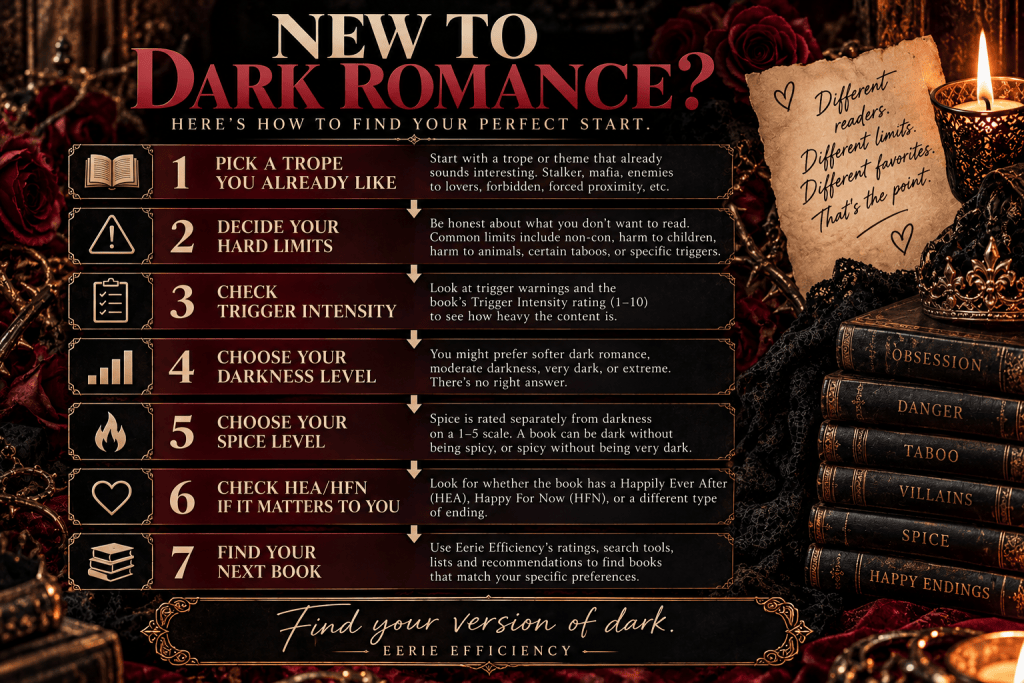
If you want an easier starting pool rather than jumping straight into the deep end, use the Soft Dark Romance Books Beginner List.
Eerie Editor’s Take
I don’t think the most famous dark romance should automatically become everybody’s first dark romance.
Your first book should be chosen because something about that kind of story appeals to you.
If stalking makes you curious, start there.
If mafia power dynamics sound better, start there.
If you want obsession without the most extreme triggers, look for that combination.
A good introduction to dark romance isn’t the book that proves you can survive the genre.
It’s the book that makes you want another one.
Best Types of Dark Romance for Beginners
There isn’t one universally safe beginner category because individual books vary too much.
But certain areas can provide easier entry points.
Romantic Suspense With Darker Elements
This can work well for readers who want danger and high stakes while preferring much of the threat to come from outside the central relationship.
Lower-Trigger Mafia Romance
Mafia romance can provide criminal heroes, possessiveness, danger and power without every title reaching extreme levels of relationship darkness.
Do not assume “mafia” automatically means mild, though. Individual books vary enormously.
If organized-crime romance is your thing, Eerie’s Mafia Romance Books guide gives you a deeper route into the subgenre.
Morally Gray Romance
This can be a useful bridge for readers who like characters who do questionable things but aren’t ready for a love interest with absolutely no moral brakes.
Lighter Stalker Romance
Stalker romance is inherently going to cross boundaries.
But the intensity, consent dynamics, violence and tone can differ dramatically between titles.
A reader fascinated by obsessive devotion may prefer starting toward the lighter end rather than assuming the most extreme stalker romance is mandatory reading.
Gothic Romance
If what attracts you is atmosphere, secrets, danger and psychological unease, Gothic romance can be a useful doorway into darker romantic fiction.
Obsessive or Protective MMC Romance
This is especially useful for readers whose real interest is intensity of devotion.
You may discover that what you wanted from “dark romance” wasn’t maximum violence at all.
You wanted:
He is absolutely, irrationally, catastrophically obsessed with her.
Eerie has dedicated guides for possessive male leads, jealous possessive heroes and dark romance antiheroes if that’s your particular weakness.
Dark Romance Terms Beginners Should Know
Dark-romance discussions contain enough abbreviations to make your first trip through BookTok comments look like you’ve accidentally joined a classified government operation.
Here’s the translation.
| Term | Meaning |
| HEA | Happily Ever After |
| HFN | Happy For Now |
| MMC | Male Main Character |
| FMC | Female Main Character |
| MC | Main Character |
| POV | Point of View |
| Dual POV | The story is told from two characters’ perspectives, often both romantic leads |
| RH | Reverse Harem, a term still commonly used for a relationship involving one central character and multiple partners |
| Why Choose | A romance in which the protagonist does not have to choose only one romantic partner |
| OTT | Over the top; often used for extremely possessive, obsessive or exaggerated behavior |
| Morally gray | A character whose ethics and behavior mix sympathetic qualities with seriously questionable actions |
| Morally black | Reader shorthand for a character whose actions are considerably more villainous or ethically extreme |
| Dub-con | Dubious consent; consent is unclear, compromised or pressured |
| Non-con | Non-consensual sexual activity |
| CNC | Consensual non-consent; a negotiated consensual scenario that role-plays non-consent |
| TW/CW | Trigger Warning / Content Warning |
| KU | Kindle Unlimited |
| Touch her and die | A protective or possessive trope in which threatening the love interest provokes extreme retaliation |
| Alphahole | Reader slang for an aggressively dominant “alpha” character whose behavior crosses into arrogance or assholery |
| Stalker romance | Romance in which stalking or surveillance forms part of the central romantic dynamic |
| Spice rating | A scale used to communicate the degree of sexual explicitness in a book |
Terminology varies somewhat between communities, authors and reviewers, so context still matters.
The important thing is that these labels are shortcuts.
They should help you understand a book.
They shouldn’t require another dictionary to understand the shortcuts.
How to Find Dark Romance You’ll Actually Like
“I like dark romance” isn’t actually very specific.
Imagine five readers saying it.
Reader one means:
High obsession + low violence + HEA.
Reader two means:
Mafia + possessive MMC + high spice.
Reader three means:
Psychologically dark + emotional devastation + low romance focus.
Reader four means:
Extreme darkness + absolutely no cheating.
Reader five means:
Morally black MMC + stalking + maximum obsession, but non-con is a hard limit.
Those readers do not need the same recommendations.
That’s the problem Eerie Efficiency is built around.
Instead of treating books as interchangeable members of one giant “dark romance” bucket, you can use the Browse Dark Romance Books database to narrow what you’re looking for.
And once you start getting more specific, the other discovery tools become much more useful.
Reader DNA helps identify patterns behind what you actually enjoy.
Can I Handle This Book? helps you evaluate intensity and content before committing.
Book vs Book lets you compare two titles rather than guessing which better matches your mood.
More Like This helps you continue from something that already worked.
Trope discovery lets you start with the dynamic you want instead of a random bestseller.
And the separate Eerie ratings let you distinguish things that broad genre labels can’t.
Maybe you don’t want “dark romance recommendations.”
Maybe tonight you want:
Obsession 9+
Spice 4–5
Moderate violence
HEA
Possessive MMC
No cheating
Eerie Editor’s Take
This is the reason I don’t think another giant list of “100 Dark Romance Books You Need to Read” solves the real discovery problem.
Once you know the genre exists, you don’t need somebody to keep telling you which books are dark.
You need to know which dark books are right for you.
That’s the difference I’m trying to build into Eerie Efficiency.
The more specific we can make the information—spice, obsession, violence, psychological intensity, triggers, romance focus, tropes, character types and ending—the less often readers have to choose their next book based on a cover, a viral quote and somebody on TikTok screaming that it destroyed them.
Sometimes “it destroyed me” is exactly what you’re looking for.
I’d just like to know how first.
Dark Romance FAQ
What Is Considered Dark Romance?
Dark romance is romance fiction in which disturbing, dangerous, taboo, morally complicated or psychologically intense material substantially shapes the central romantic relationship or story.
There is no universally standardized checklist. A book may earn the label through obsession, stalking, captivity, coercion, violence, criminality, taboo relationships, extreme power imbalances, psychological manipulation or other dark material.
It does not need to contain every one of those elements.
What Makes Dark Romance Different From Regular Romance?
Both dark romance and conventional romance center a romantic relationship.
Dark romance differs because darker themes, behaviors or relationship dynamics play a significant role in the romantic experience itself. Those elements may include obsession, violence, manipulation, coercion, criminality, captivity or morally extreme protagonists.
A romance can deal with serious or sad subjects without necessarily becoming dark romance.
Is Dark Romance Always Toxic?
No.
Some dark romances intentionally feature relationships that would be unhealthy, controlling, abusive or dangerous in real life, but dark romance and “toxic relationship” are not interchangeable terms.
The source and intensity of darkness vary significantly from book to book.
Is Dark Romance Always Spicy?
No.
Spice and darkness measure different things.
Spice describes sexual explicitness. Darkness describes the intensity of disturbing, dangerous, morally complicated or psychologically difficult content.
A book can therefore be extremely dark and relatively low-spice—or extremely spicy and only mildly dark.
Does Dark Romance Always Contain Non-Con?
No.
Dark romance can contain consensual sex, coercion, dubious consent, non-consent, consensual non-consent or combinations of different consent dynamics.
Never assume non-con is present simply because a book is marketed as dark romance. Check the individual book’s content information if consent dynamics matter to you.
Does Dark Romance Have to Have an HEA?
Genre romance traditionally centers a love story and ends with an emotionally satisfying and optimistic romantic resolution, commonly described by readers as an HEA (Happily Ever After) or HFN (Happy For Now).
Dark-romance labeling can become less clear around cross-genre fiction, cliffhangers, unfinished series and books marketed as dark romance despite unconventional endings.
If an HEA is important to you, check before reading rather than assuming.
What Is the Difference Between Dark Romance and Erotic Romance?
Darkness and sexual explicitness are separate characteristics.
Dark romance centers a romantic relationship shaped by dark themes or dynamics. Erotic romance integrates explicit sexual interaction into the development of the central romantic relationship.
A book can be both dark and highly erotic, but being sexually explicit does not automatically make a book dark romance.
Why Are Dark Romance Books Popular?
Readers may enjoy dark romance for many different reasons, including emotional intensity, obsessive devotion, danger, suspense, taboo scenarios, morally complicated characters, high stakes and the ability to explore extreme fictional situations at a distance.
There is no single explanation that applies to every dark-romance reader.
What Is the Darkest Type of Romance?
There is no universally agreed “darkest” type of romance.
Extreme or transgressive dark romance may contain particularly intense material, but even those labels don’t describe one standardized content level.
A book can also be extreme in one dimension and comparatively moderate in another. Severe violence, non-consent, psychological manipulation and emotional devastation create different kinds of darkness.
That’s why an overall darkness rating should never be the only information you use.
What Is a Morally Gray MMC?
A morally gray MMC is a male main character whose actions fall somewhere between conventionally heroic and outright villainous.
He may lie, manipulate, commit crimes, use violence or behave unethically while retaining motivations, loyalties, limits or sympathetic qualities that make his morality difficult to classify as simply good or evil.
What Does “Touch Her and Die” Mean?
“Touch her and die” describes an intensely protective or possessive romantic dynamic in which threatening or harming the love interest provokes extreme retaliation from the other character.
The phrase describes character energy or a trope rather than one standardized type of plot.
If that’s exactly the energy you’re after, Eerie has a dedicated guide to Dark Romance Books With “Touch Her and Die” Energy.
What Does Dub-Con Mean?
Dub-con means dubious consent.
It describes fictional sexual situations in which consent is intentionally unclear, compromised, pressured or ambiguous.
Dub-con should not automatically be treated as another word for non-con. If that distinction affects what you’re comfortable reading, check the book’s specific content information.
Can Beginners Read Dark Romance?
Absolutely.
You don’t need previous experience with the genre, and you don’t need to begin with an extreme book.
Starting with familiar tropes, identifying your hard limits and choosing lower-intensity books can make it much easier to discover which parts of dark romance you actually enjoy.
How Do I Know If a Dark Romance Is Too Dark for Me?
Look beyond the book’s overall darkness label.
Check its specific triggers and consider the types of content you personally avoid. Violence, stalking, captivity, non-con, psychological manipulation, animal harm and other subjects can affect readers very differently.
Your limit can also vary by category. You might enjoy extreme obsession while avoiding non-con, for example.
That’s why Eerie Efficiency separately considers Darkness, Obsession, Psychological Intensity, Violence, Emotional Damage and Trigger Intensity.
What Should I Read for My First Dark Romance?
Start with the dynamic you already find appealing, rather than automatically choosing the most famous or extreme dark-romance book.
If you like morally gray heroes, begin there. If you want obsessive devotion, look for that. If Gothic atmosphere appeals to you, try darker Gothic romance. If organized crime and possessiveness sound interesting, consider lower-trigger-intensity mafia romance.
The Soft Dark Romance Books Beginner List is designed specifically for readers looking for an easier entry point.
Finding your next read
Start with the things you enjoy, then check the things you want to avoid. You might love obsessive devotion and hate captivity, or want a violent setting with a caring relationship at its centre. Those preferences are useful. You don’t have to work your way up to darker books.
For a starting point, try the Soft Dark Romance Books Beginner List. The trope guide and subgenre guide can help you narrow it down, or you can browse the book database using your own preferences.
Check the ending and the specific content warnings before you commit. If information about one of your boundaries is unknown, it still needs checking—even if the rest of the book sounds perfect.