
You finish the last chapter. The couple is together. Nobody is walking away. Technically, things are good.
But are they Happily Ever After good?
Or are they merely Happy For Now?
That tiny distinction matters far more to romance readers than it sounds like it should—especially in dark romance, where a book may spend hundreds of pages convincing you that these two people are catastrophically bad for each other before asking you to believe they have somehow found their version of happiness.
Here is the simplest answer:
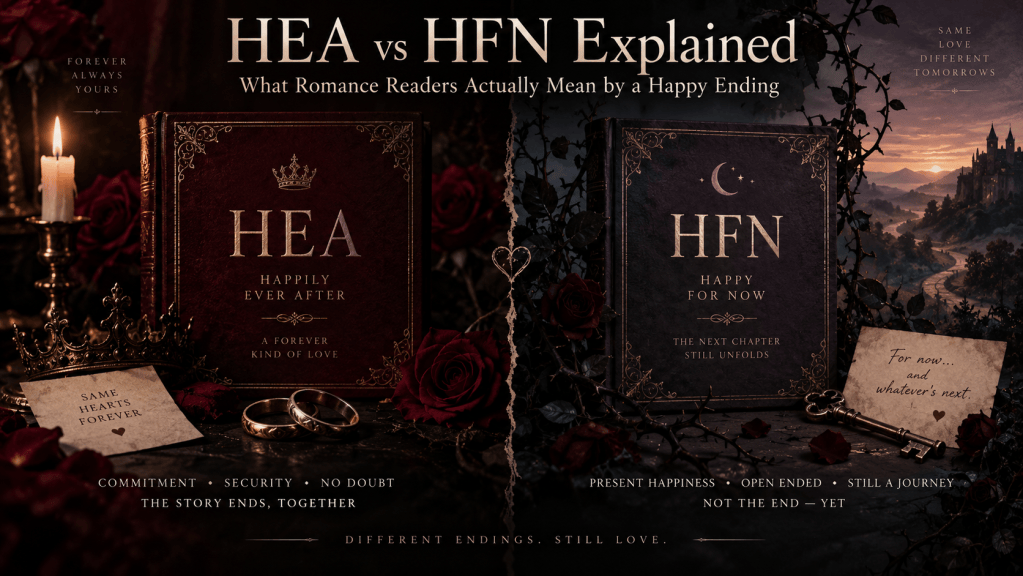
HEA means Happily Ever After: the central romantic relationship ends with enough emotional and relational certainty that the reader is meant to believe the couple intends to remain together long-term.
HFN means Happy For Now: the central romantic relationship ends positively, but the future is less settled. The couple chooses each other in the present without the story giving the same level of long-term certainty.
Both can qualify as emotionally satisfying endings in genre romance. Romance Writers of America, for example, describes romantic narrative as having a central love story and an emotionally satisfying ending that is “happily ever after or happily for now.”
But HEA and HFN do not feel interchangeable to every reader.
And that is where this gets interesting.
HEA vs HFN at a Glance
| Ending | What It Means | Relationship Status | Future Certainty | Typical Reader Feeling |
|---|---|---|---|---|
| HEA | Happily Ever After | Together and committed | High | “These two are it for each other.” |
| HFN | Happy For Now | Together and happy | Moderate | “They’re choosing this relationship, but the future is still unfolding.” |
| Open/Ambiguous Ending | Future deliberately unresolved | Unclear or uncertain | Low | “Wait…are they actually staying together?” |
| Bittersweet Ending | Some emotional resolution but significant loss or uncertainty remains | Varies | Varies | “That was meaningful, but I would not call it conventionally happy.” |
| Tragic Ending | Romantic relationship does not receive a happy resolution | Not happily together | None | “This was a love story, but not a genre-romance HEA.” |

The most important line in that table is between HFN and ambiguous.
HFN does not mean:
maybe they are together.
It means:
they are together, and that is currently a happy outcome—but the book stops short of promising forever.
That difference gets blurred constantly.
The Easiest Way to Tell an HEA From an HFN
Forget weddings.
Forget babies.
Forget proposals.
Forget whether the epilogue jumps fifteen years into the future.
Ask one question:
Does the ending expect me to believe these characters have made a lasting choice, or only that they have chosen each other right now?
If the answer is clearly lasting, I would classify it as HEA.
If the answer is essentially “we don’t know exactly what comes next, but we’re going to try this together”, that is much closer to HFN.
And if you’re still wondering whether they’re actually going to stay together at all?
That is not what I would personally label an HFN.
That is an ambiguous ending.
That distinction matters because some romance readers deliberately avoid HFN books because uncertainty itself ruins the emotional payoff. Discussions among romance readers repeatedly come back to exactly this point: for some people, seeing the characters happy together at the end is enough; for others, the ending needs to communicate that the couple believes the relationship will last.
HEA Does Not Mean Marriage, Babies, or a White-Picket Fence
This is probably the biggest misconception surrounding HEAs.
A Happily Ever After is an emotional promise, not a checklist.
A couple can have an HEA without:
- getting married;
- becoming engaged;
- having children;
- buying a house;
- combining finances;
- moving in together;
- appearing in a ten-years-later epilogue.
Likewise, an epilogue featuring marriage and babies does not automatically make the romantic resolution better.
The real issue is commitment.
Imagine two fictional endings.
Ending A: The characters marry on the final page even though they have spent the entire climax questioning whether they can trust each other.
Ending B: There is no proposal whatsoever, but both characters clearly choose a shared life together and the narrative leaves no meaningful doubt that this is permanent.
Ending B may actually feel more convincingly HEA.
Book Riot has made a similar point about how the meaning of HEA has evolved beyond the older assumption that happiness must equal marriage and children.
That matters particularly in contemporary romance because there is no single correct version of “forever.”

So What Actually Makes an Ending an HEA?
For me, a convincing HEA usually contains three things.
The Romantic Conflict Has Been Resolved
The book does not need to solve every problem in the characters’ lives.
Someone can still have family problems.
They can still be grieving.
A criminal empire does not suddenly become an OSHA-compliant workplace because two people fell in love.
The outside world can remain messy.
What should feel resolved is the central romantic question.
If the entire book asks:
Can these two people trust one another?
then the ending should answer it.
If it asks:
Will he choose her over power?
the ending should answer it.
If it asks:
Can she ever feel safe with him?
the ending should answer it.
An HEA does not mean no future problems exist.
It means the reader is no longer supposed to question whether the relationship itself will survive them.
The Characters Make a Genuine Choice
This is especially important in dark romance.
Possession is not automatically commitment.
Obsession is not automatically intimacy.
Refusing to let someone leave is definitely not the same thing as earning an HEA.
A convincing dark-romance ending needs some indication—within the morally complicated rules of that particular story—that the relationship has reached its intended emotional destination.
That destination may be deeply unconventional.
It may even be horrifying to anyone outside the relationship.
But the narrative should establish why these characters regard it as their version of happiness.
The Ending Looks Forward
An HEA creates a sense of continuation.
Not necessarily:
They will never fight again.
More like:
Whatever happens next, they intend to face it as a unit.
That is the “ever after.”
What Makes an Ending HFN Instead?
HFN is subtler.
These characters can be completely in love.
The ending can be romantic.
They can be exclusive.
They can even make substantial commitments.
What is different is the degree of certainty the narrative offers about the distant future.
Imagine an ending where two characters finally admit they love each other, decide to stay together, and agree to figure out their complicated lives one step at a time.
That can be extremely satisfying.
But the story has not necessarily told you:
These two have reached the permanent destination of their relationship.
Instead it says:
They have reached a good place, together.
That’s HFN.
HFN is especially natural when characters are at a life stage where promising forever would feel artificially tidy, or when a continuing series deliberately leaves room for the relationship to evolve.
Romance readers themselves often describe HFN in precisely that way: the relationship is real and positive, but the “long haul” is not yet presented with the same certainty as an HEA.
HFN Is Not a Bad Ending
I think the phrase Happy For Now accidentally makes the ending sound temporary.
Almost like:
“They’re happy until Thursday.”
That undersells it.
A good HFN can actually feel more emotionally truthful than an HEA when the characters have only just reached a point where a healthy—well, healthy-ish, depending on what corner of dark romance we’re visiting—relationship is possible.
Sometimes I would rather see:
We’re choosing each other and learning how to do this
than have an author bolt a wedding and pregnancy onto the final ten pages simply because romance readers supposedly require visual proof of permanence.
The problem is not HFN.
The problem is mislabeling HFN when readers specifically want an HEA.
Those readers are not being overly picky.
Ending preference is part of reading preference.
Some people will happily read 400 pages of kidnapping, psychological manipulation, stalking, revenge, bloodshed, morally indefensible behavior and enough red flags to stock an airport runway—but draw the line at uncertainty on the final page.
I understand it.
Dark romance may be chaotic.
The emotional contract with the reader doesn’t have to be.
HEA vs HFN Matters Even More in Dark Romance
In lighter romance, the difference between HEA and HFN can sometimes feel almost academic.
In dark romance, it can fundamentally change how the entire story lands.
Why?
Because readers have often tolerated considerably more emotional discomfort before reaching the ending.
The relationship may have involved:
- obsession;
- coercive dynamics;
- manipulation;
- captivity;
- violence;
- betrayal;
- extreme possessiveness;
- morally gray or outright villainous behavior;
- damaged trust;
- severe emotional trauma.
The darker the journey becomes, the more important the ending can feel.
You have effectively spent the entire novel asking:
How on earth is the author going to make this relationship work?
An HEA answers:
Like this.
An HFN answers:
It’s working now.
Those are not identical emotional experiences.
And neither darkness nor spice tells you which one you are getting.

Ending Type Is Not the Same Thing as an Eerie Rating
This is an important distinction for Eerie Efficiency because ending security and content intensity measure completely different things.
A book could theoretically have:
Darkness: 10/10
and still deliver an extremely firm HEA.
Another could have:
Darkness: 3/10
and end HFN.
Likewise:
Spice: 5/5 tells you absolutely nothing about ending security.
This is one reason I don’t like reducing dark-romance recommendations to a single “how dark is it?” number.
A reader deciding whether they can emotionally handle a book may need several separate pieces of information:
How disturbing is the journey?
How explicit is the sexual content?
How psychologically intense is the relationship?
And after all of that—how emotionally secure is the ending?
Those are different questions.
An HEA Can Still Leave You Emotionally Destroyed
This deserves its own section because “HEA” sometimes gets interpreted as:
Nothing terrible happens.
Absolutely not.
A book can put its characters—and you—through emotional hell and still end HEA.
Characters can experience enormous loss.
Relationships with family can remain broken.
Trauma does not magically disappear.
Past actions cannot always be undone.
The HEA label answers one fairly narrow question:
Does the central romantic relationship reach a lasting, emotionally positive resolution?
It does not promise that everything else becomes painless.
That distinction is particularly important for readers using HEA as a safety signal.
If your actual question is:
Will this book emotionally wreck me?
HEA alone cannot answer it.
That is exactly why trigger intensity, psychological intensity and emotional damage deserve separate consideration.
A Dark Romance HEA Does Not Have to Look Healthy From the Outside
Here is where judging dark-romance endings by conventional romance standards can get messy.
Suppose two fictional characters are mutually obsessive, morally compromised and enthusiastically determined to ruin anyone who interferes with their relationship.
They end the story blissfully committed.
Would a therapist approve?
Perhaps not.
Would I recommend using them as a model for conflict resolution?
Also no.
Can it still be a fictional HEA?
Yes.
Because the HEA designation is describing narrative resolution, not certifying a relationship as psychologically healthy.
This distinction is crucial.
Calling something HEA does not mean:
Eerie Efficiency endorses everything these people did.
It means:
The story concludes by presenting this relationship as the characters’ lasting romantic outcome.
Those statements are nowhere near the same thing.
Can a Villain Get an HEA?
Absolutely.
Redemption is not required for happiness.
That is one reason villain romance works.
A story does not necessarily have to turn a dangerous character into a morally respectable person before allowing that character a lasting relationship.
Sometimes the ending is:
He became good for her.
Sometimes it is:
He became good to her.
And sometimes it is essentially:
They’re both terrible. They found each other. Everyone else should probably relocate.
All three can produce a narrative HEA if the relationship itself receives lasting romantic resolution.
If villainous heroes are precisely your thing, my guide to Dark Romance Books With Villain Heroes digs much further into what separates an actual villain hero from a standard morally gray lead.
HEA Does Not Erase What Happened Before It
This is one place I think romance discussion sometimes becomes too simplistic.
Two characters ending happily together does not retroactively make everything that happened between them romantic.
If manipulation happened, it happened.
If consent was violated, an epilogue does not reverse it.
If one character caused enormous emotional damage, a declaration of love doesn’t magically delete that history.
The ending tells us where the narrative leaves the relationship.
It does not rewrite the path taken to get there.
That is especially worth remembering when browsing categories like Taboo Dark Romance Books or books featuring intensely jealous and possessive heroes.
HEA describes the destination.
It does not sanitize the journey.
What Is Not an HFN?
This is where I would be stricter than some casual uses of the term.
“Maybe They’ll Get Back Together Someday”
Not HFN.
That’s hope.
“They Love Each Other but Separate”
Not HFN simply because the separation is emotionally meaningful.
That may be romantic fiction.
It may be bittersweet.
It may be beautiful.
But “happy for now” requires the romantic resolution itself to be happy.
“The Ending Is Open to Interpretation”
Also not automatically HFN.
If half the readers think the couple stays together and half think they don’t, the narrative has not provided a clear happy romantic resolution.
“One Character Says They’ll Try”
This depends heavily on context.
“We’re scared, but we’re doing this together” can be HFN.
“I guess maybe we can see what happens” after an entire book of instability may be too uncertain.
HFN still requires resolution.
It just offers less future certainty than HEA.
What About Cliffhangers?
Cliffhangers create another problem because individual books and complete romantic arcs are not always the same thing.
Imagine a trilogy following one couple.
Book one ends with them separated.
Book two ends with one disappearing.
Book three ends with permanent romantic commitment.
The series may ultimately have an HEA.
Books one and two individually do not suddenly acquire HEAs simply because everything works out later.
That matters when recommending books.
A reader asking:
“Does this have an HEA?”
may really mean:
“Will I feel emotionally secure when I finish this particular book tonight?”
Saying “eventually” without mentioning a cliffhanger is not especially helpful.
Romance communities have debated exactly this problem with multi-book relationships and whether readers should be warned when individual installments do not provide an HEA/HFN even though the larger series eventually does.
My preference is simple:
Label the book and the complete series separately.
For example:
Book ending: cliffhanger / unresolved
Series ending: HEA
That tells readers what they actually need to know.
Does an HEA Require an Epilogue?
No.
An epilogue is evidence.
It isn’t certification.
I love a good glimpse into the future when I’ve become attached to a couple.
Sometimes I want the house.
The dog.
The wedding.
The criminal empire operating surprisingly smoothly.
Whatever their version of domestic bliss happens to be.
But a story can establish permanent romantic commitment before the epilogue ever arrives.
Likewise, an epilogue cannot rescue an emotionally unconvincing romantic resolution.
If the final conflict feels unresolved and then the book jumps forward five years to:
Anyway, they’re married now.
I know technically what the author is communicating.
Emotionally?
I may still have questions.
Why Some Readers Strongly Prefer HEA
For many romance readers, knowing the ending will be happy is not a spoiler.
It is the entire point.
That does not mean they don’t want tension.
It doesn’t mean they want predictable plots.
It means the uncertainty they enjoy is:
How will these people ever get there?
—not—
Will the author let them get there at all?
That distinction is fundamental to the genre-reading experience for a lot of people.
Romance-community discussions show how strongly some readers feel about this: unexpected non-HEA endings can completely change their experience of a book, and communities sometimes explicitly require warnings when recommending romantic stories without HEA/HFN endings.
Dark romance makes that preference particularly understandable.
If I have already survived the masked stalker, questionable basement, three betrayals, two attempted murders and an MMC who urgently needs several professionals to intervene, I may want my emotional payoff.
Why Some Readers Actually Prefer HFN
HFN has its own appeal.
For some readers it feels:
- more organic;
- less artificially tidy;
- better suited to very young protagonists;
- better suited to couples still rebuilding trust;
- more believable after extremely traumatic events;
- ideal for continuing series;
- emotionally hopeful without pretending every problem disappeared.
There is also something appealing about a romance ending with:
This is worth choosing.
rather than needing:
This is guaranteed forever.
Neither preference is more sophisticated.
They’re simply different reader needs.
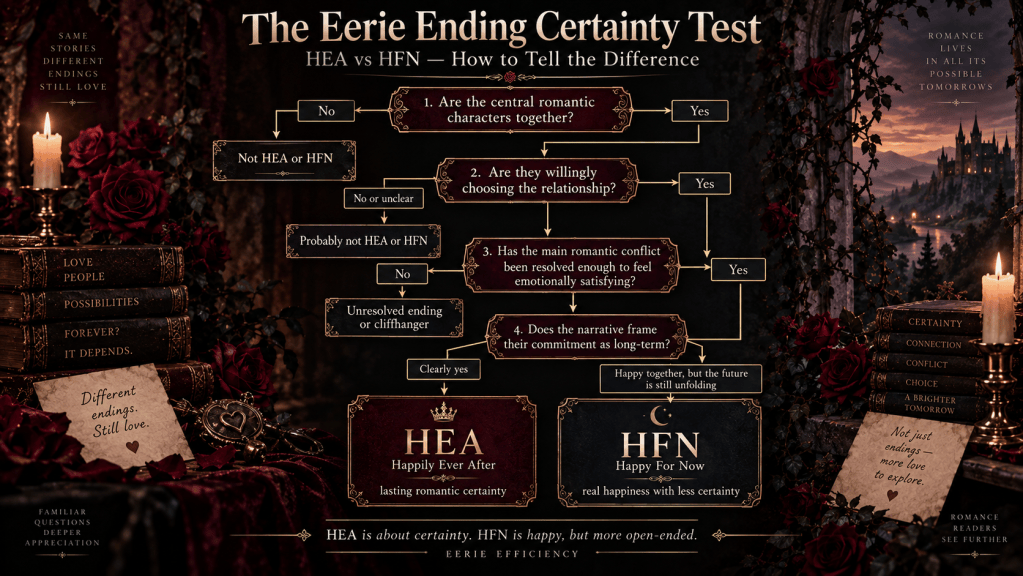
The Eerie Ending Certainty Test
If I were trying to classify an ending without relying on someone else’s label, this is the test I would use.
Question 1: Are the central romantic characters together?
No: not HEA/HFN.
Yes: continue.
Question 2: Are they willingly choosing the relationship at the end?
No or unclear: probably not HEA/HFN.
Yes: continue.
Question 3: Has the main romantic conflict been resolved enough for the ending to feel emotionally satisfying?
No: possibly an unresolved ending or cliffhanger.
Yes: continue.
Question 4: Does the narrative frame their commitment as long-term?
Clearly yes: HEA.
Not necessarily, but they’re genuinely happy together: HFN.
Question 5: Would a reasonable reader still wonder whether they’ll be together next month?
Yes: I would question the HFN label.
No: HFN or HEA depending on long-term certainty.
That is considerably more useful than looking for a wedding ring.
“But They Didn’t Say Forever.”
They don’t have to.
Authors communicate permanence in dozens of ways.
Shared plans.
Sacrifice.
Trust.
Choosing the relationship when leaving would be easier.
Building a life.
Accepting previously rejected vulnerability.
Integrating families.
Choosing a home.
Changing priorities.
Or simply reaching a point where the entire emotional structure of the story says:
These two are done running from each other.
Narrative certainty matters more than literal vocabulary.
Common Misconceptions About HEA and HFN
“HFN Means They’re Probably Going to Break Up”
No.
HFN doesn’t predict failure.
It simply provides less long-term certainty.
“HEA Means the Couple Gets Married”
No.
Commitment can exist without marriage.
“An HEA Means Nothing Bad Happens at the End”
Also no.
A romance can resolve happily while other parts of the story remain painful.
“Dark Romance Doesn’t Need an HEA Because It’s Dark”
Darkness changes the journey, not automatically the genre’s expectations.
RWA’s description of romantic narrative still centers an emotionally satisfying HEA or HFN ending.
“If They Love Each Other, It’s Romance”
A love story and a genre romance are not automatically the same thing.
Stories about love can end tragically.
Genre-romance expectations are narrower.
“HEA Means the Relationship Is Healthy”
Definitely not.
Particularly around here.
HEA vs HFN vs Bittersweet: The Difference Readers Really Need
These three labels often get mashed together even though they promise very different experiences.
HEA
They choose each other, and the narrative asks you to believe this lasts.
HFN
They choose each other, they’re happy, and the future remains somewhat open.
Bittersweet
The ending contains meaningful happiness alongside significant loss, separation, sacrifice or sadness.
That last category needs care.
“Hopeful” does not automatically equal HFN.
“Beautiful” does not automatically equal HEA.
And “I cried but in a good way” tells me virtually nothing.
If ending type matters to you, ask specifically.
Reader Decision Guide: Which Ending Do You Actually Want?
Choose HEA if:
- romantic uncertainty makes you anxious;
- you primarily read romance for emotional security;
- you want permanent commitment clearly established;
- you dislike open endings;
- you need substantial payoff after very dark content;
- “they’re together right now” isn’t enough.
Choose HFN if:
- you enjoy realistic uncertainty;
- you don’t need marriage or permanent commitment;
- you’re comfortable imagining the couple’s future yourself;
- the relationship being stable and happy at the end is sufficient;
- you enjoy continuing relationship arcs across multiple books.
Approach ambiguous or bittersweet endings cautiously if:
- you specifically use romance as emotional comfort;
- surprise separation ruins books for you;
- character death is a hard limit;
- you do not want to guess what happens after the final page.
Knowing your ending preference is every bit as legitimate as knowing your spice or trigger preferences.
If You Read Dark Romance Specifically, Ask These Three Questions
Before starting a particularly intense book, I would want to know:
1. Does the book itself have an HEA/HFN, or only the completed series?
2. Is the romantic ending secure even if the surrounding story remains dark?
3. Are there content warnings I need independently of the happy ending?
That third question is essential.
A guaranteed HEA is not a content warning substitute.
Always check author-provided warnings when you have specific triggers or hard limits.
How to Ask About the Ending Without Getting the Whole Book Spoiled
This is surprisingly useful.
Instead of asking:
“How does this book end?”
ask:
“HEA, HFN, cliffhanger or neither? No other spoilers please.”
For a series:
“Does each book have its own HEA/HFN, or only the final book?”
For extra reassurance:
“Is the ending emotionally secure, or technically HFN but still uncertain?”
For dark romance:
“I don’t need plot spoilers—just tell me whether the central couple ends together and committed.”
Those questions usually get you the information you need without somebody responding with the romantic equivalent of an autopsy report.
What Romance Readers Mean When They Say “Guaranteed HEA”
Usually:
You can safely emotionally invest in this relationship because the story will not ultimately punish you for doing so.
Not:
Nothing painful will happen.
Not:
Nobody gets hurt.
Not:
The couple behaves well.
And definitely not:
The MMC has suddenly discovered ethics.
It is a promise about romantic destination.
That promise is one of the reasons romance can go remarkably dark while remaining emotionally comforting to readers who would never tolerate the same content in a thriller with an uncertain ending.
You know where the emotional train is supposed to arrive.
You just have absolutely no idea what it is going to hit on the way there.
A Note About Eerie Efficiency’s Own Fiction
Ending expectations matter in fiction just as much as they matter when I’m talking about published dark romance, because readers deserve to know what kind of emotional experience they’re choosing.
If you’d rather move from terminology into an actual story, you can read Eerie Efficiency’s fiction directly:
He Was My Brother’s Best Friend First
and
And if you’re looking for books rather than definitions, the Best Dark Romance Books of All Time guide is the broader place to start.
Frequently Asked Questions About HEA and HFN
What does HEA mean in romance books?
HEA means Happily Ever After. The central romantic relationship ends happily with enough commitment and narrative certainty that readers are meant to believe the couple intends to remain together long-term.
What does HFN mean in romance?
HFN means Happy For Now. The couple ends the story happily together, but the narrative offers less certainty about their distant future than a traditional HEA.
Is HFN still considered a happy ending?
Yes. HFN is generally treated as a form of emotionally satisfying romantic ending, including in Romance Writers of America’s description of romantic narrative.
The important word is still happy.
An uncertain separation is not the same thing.
Does an HEA require marriage?
No.
Marriage can signal commitment, but HEA is about enduring romantic resolution rather than a specific legal or domestic arrangement.
Can a dark romance have a real HEA?
Absolutely.
A book can contain extremely dark subject matter while still resolving its central romance with lasting commitment.
Darkness describes what happens in the story.
HEA describes how the romantic arc ends.
Can an HEA still be sad?
Yes.
Characters may still experience grief, trauma, loss or consequences while the central romantic relationship ends happily and securely.
Is a cliffhanger an HFN?
Usually not if the romantic relationship itself remains unresolved.
A later installment may eventually provide the HEA, which is why I prefer identifying book ending and series ending separately.
Does HFN mean the couple eventually breaks up?
No.
HFN simply means the story does not provide the same level of long-term certainty as HEA.
You may personally imagine them staying together forever.
The narrative just hasn’t insisted upon it.
The Difference Between HEA and HFN Comes Down to One Word: Certainty
HEA and HFN are both happy endings.
The difference is not:
marriage vs dating.
It is not:
babies vs no babies.
It is not:
epilogue vs no epilogue.
It is certainty.
An HEA says:
These people have chosen their forever.
An HFN says:
These people have chosen each other now, and that’s enough for this story.
And sometimes “now” is exactly the right ending.
But if you need forever?
There is absolutely nothing wrong with wanting the author to make you believe it.