
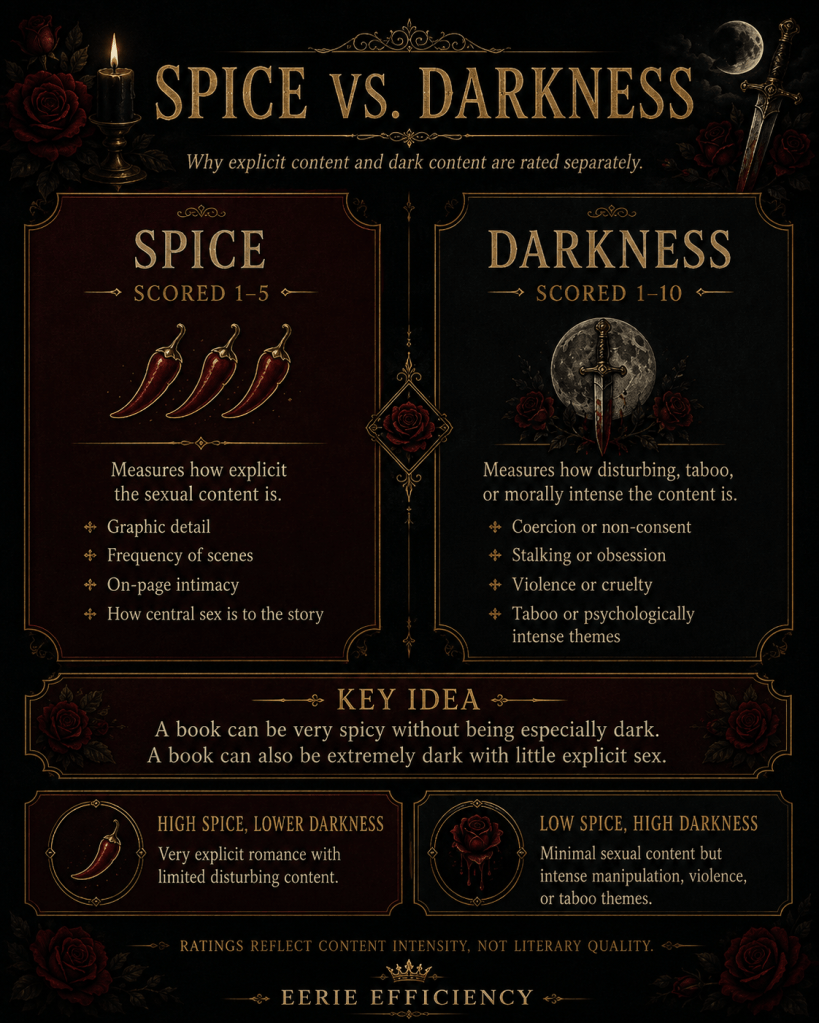
A book can be full of explicit scenes and still feel fairly light. Another can have very little sex and leave you rattled by its stalking, manipulation or violence. One number cannot tell you both things.
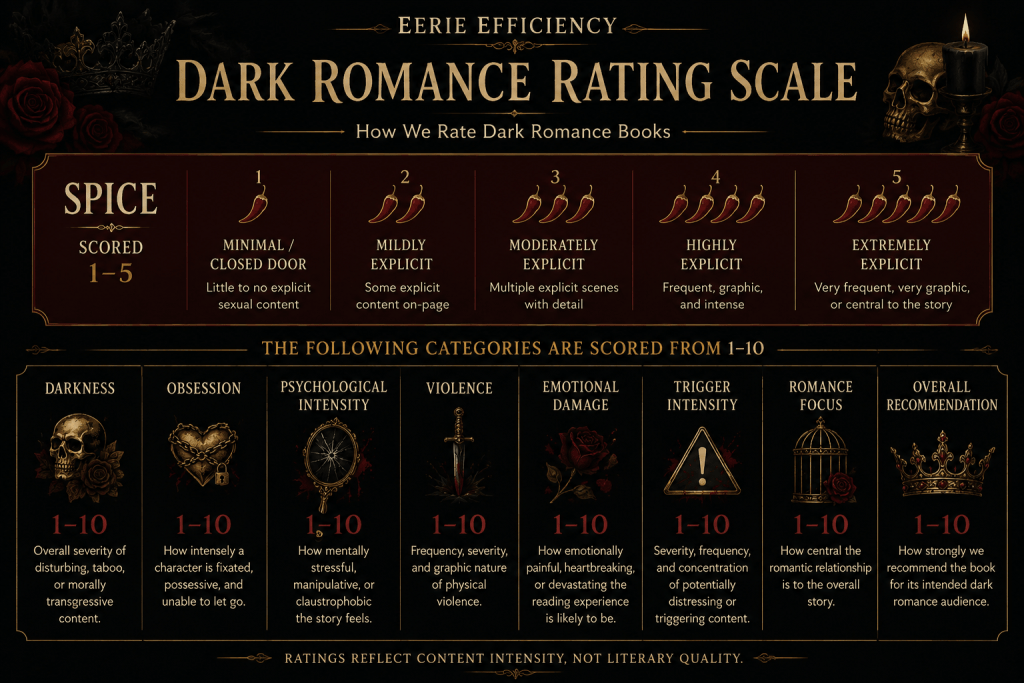
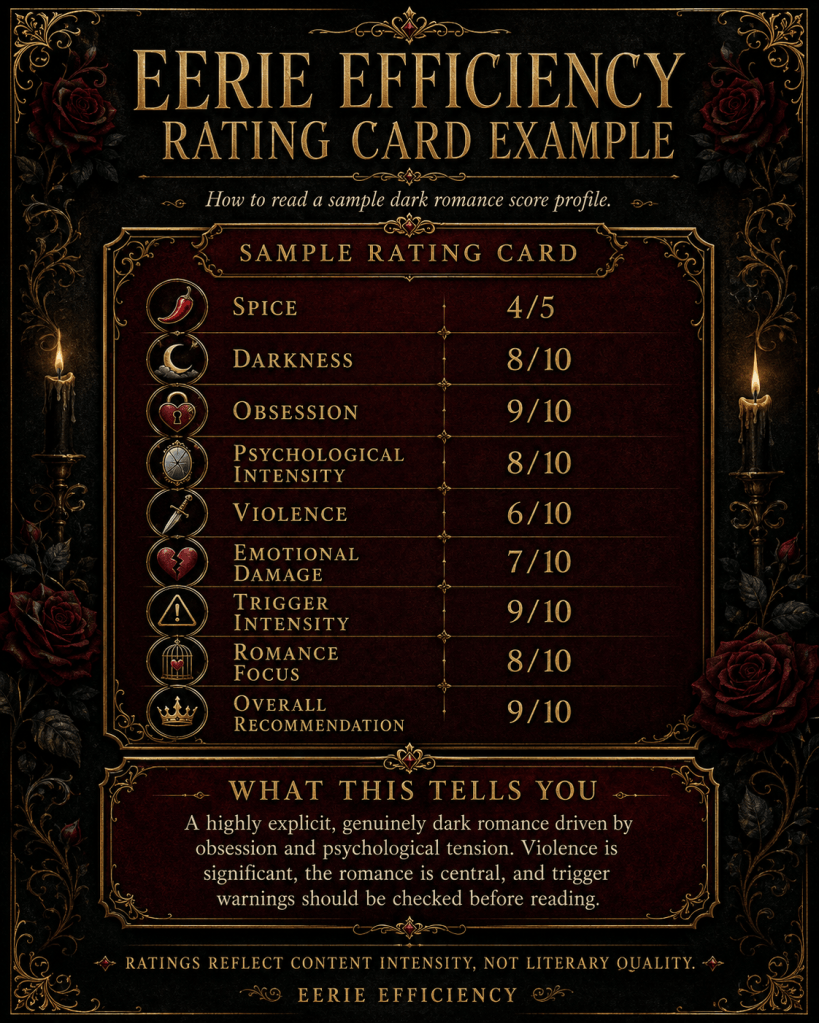
Eerie Efficiency uses separate ratings so you can look for the kind of dark romance you enjoy and spot the content you would rather avoid. Spice runs from 1–5. The other eight categories run from 1–10.
Most scores describe content or intensity. Romance Focus describes how much the relationship drives the story. Overall Recommendation is the editorial judgment: how strongly Eerie recommends the book for its intended readers. A higher darkness score does not mean a better book.
The Ratings at a Glance
| Category | What it tells you |
|---|---|
| Spice · 1–5 | How explicit, frequent and prominent the sexual content is. |
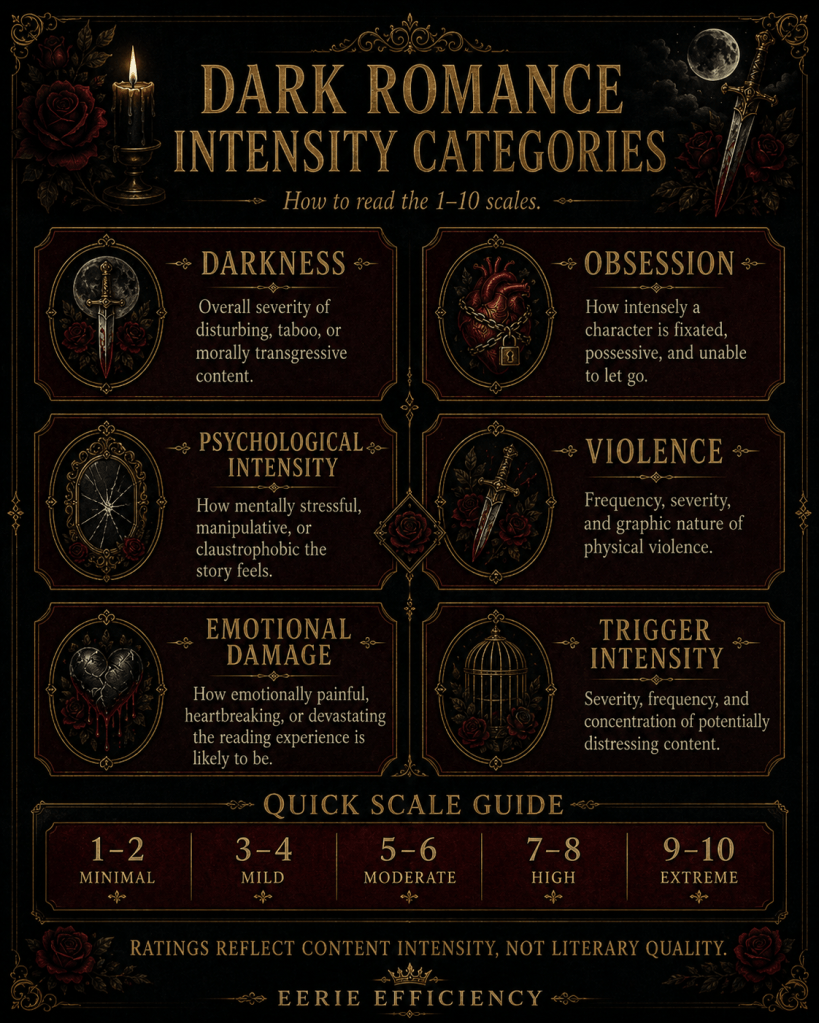
| Darkness · 1–10 | How disturbing, threatening or morally transgressive the material is. |
| Obsession · 1–10 | How strongly a romantic character fixates on the other person. |
| Psychological Intensity · 1–10 | How much manipulation, fear, control or sustained mental tension shapes the story. |
| Violence · 1–10 | How frequent, severe and graphic the physical violence is. |
| Emotional Damage · 1–10 | How much heartbreak, grief or emotional distress the story carries. |
| Trigger Intensity · 1–10 | How severe, frequent and concentrated the potentially distressing material is. |
| Romance Focus · 1–10 | How central the romantic relationship is to the plot. |
| Overall Recommendation · 1–10 | How well the book delivers its intended experience, in Eerie’s editorial assessment. |
Spice: 1–5
Spice considers detail, frequency, language and the amount of space sexual content takes up. It does not measure chemistry or how attractive you find the characters.
| Score | What to expect |
|---|---|
| 1 · Minimal or closed-door | Sex is absent, implied or largely off-page. Kissing, tension and references to sex may still appear. |
| 2 · Mildly explicit | Some on-page intimacy, with limited detail or frequency. |
| 3 · Moderately explicit | Clearly explicit scenes that play a noticeable part in the relationship. |
| 4 · Highly explicit | Frequent, graphic or especially intense scenes; sex is a substantial part of the reading experience. |
| 5 · Extremely explicit | Extensive detail, very frequent scenes, or sexual content that is particularly prominent or intense. |
A high spice score does not tell you whether scenes are consensual, and kink alone does not determine the score. Consent concerns belong in the specific content warnings and may also affect Darkness and Trigger Intensity.
Darkness: 1–10
Darkness covers the disturbing material across the story: coercion, captivity, stalking, abuse, exploitation, threats, cruelty and harmful relationship dynamics. Violence contributes, but a book built around manipulation can be very dark without much physical brutality.
| Score | What to expect |
|---|---|
| 1–2 · Light edge | Morally questionable characters or troubling behavior, with relatively limited dark content. |
| 3–4 · Mild | Possessiveness, threats, criminal activity or power imbalances, usually less sustained or severe. |
| 5–6 · Moderate | Substantial manipulation, stalking, coercion, kidnapping, violence or other disturbing material. |
| 7–8 · Very dark | Severe content is central to the story, potentially including captivity, abuse or sexual boundary violations. |
| 9–10 · Extreme | Exceptionally disturbing material, such as prolonged abuse, torture, intense control or severe non-consensual situations. |
These bands describe the content, not what you should be able to tolerate. A lower-scoring book can still contain your hard limit.
Obsession: 1–10
Obsession measures fixation within the romantic dynamic. It may show up as jealousy, surveillance, stalking, possessiveness, intrusive attention or attempts to control whether the other person can leave. The length of the fixation and how much it drives the plot also matter.
| Score | What to expect |
|---|---|
| 1–2 · Ordinary attraction | Interest or protectiveness without pronounced fixation. |
| 3–4 · Strong attachment | Jealousy or possessiveness appears but remains comparatively restrained. |
| 5–6 · Clearly obsessive | Persistent fixation, monitoring or efforts to keep the other person close. |
| 7–8 · Extreme fixation | Obsession strongly shapes decisions, potentially involving surveillance, isolation or manipulation. |
| 9–10 · Consuming obsession | Much of the character’s life revolves around watching, possessing, protecting or keeping the love interest. |
Stalking does not automatically mean 10/10. The score depends on its extent and role in the story. Obsession also differs from Romance Focus: a character can be fixated on someone in a book mainly driven by suspense.
Psychological Intensity: 1–10
This category covers sustained mental pressure: gaslighting, mind games, coercive control, paranoia, uncertainty, fear, isolation and psychological captivity. It describes the tension in the story rather than predicting how every reader will react.
| Score | What to expect |
|---|---|
| 1–2 · Low | Little sustained psychological pressure. |
| 3–4 · Noticeable | Tension, manipulation or uncertainty appears without dominating. |
| 5–6 · Strong | Fear, control or manipulation is an important part of the story. |
| 7–8 · Severe | Sustained psychological pressure, potentially involving gaslighting, intimidation or isolation. |
| 9–10 · Relentless | Exceptionally intense or prolonged psychological control and distress. |
Violence: 1–10
Violence considers what happens, how often it happens and how graphically it is described. It can involve the romantic partners, other characters or the wider crime, fantasy or suspense plot.
| Score | What to expect |
|---|---|
| 1–2 · Minimal | Little physical violence; threats or brief altercations may appear. |
| 3–4 · Moderate | Some violent incidents with relatively limited detail. |
| 5–6 · Significant | Repeated violence, injuries or moderately graphic scenes. |
| 7–8 · Graphic or frequent | Regular violence or substantial detail, potentially including torture, executions or severe injuries. |
| 9–10 · Extreme | Exceptionally graphic, prolonged or frequent physical brutality. |
A violent setting does not automatically create a high Psychological Intensity score. A story can contain shootings and murder without sustained mind games between the leads.
Emotional Damage: 1–10
“Emotional Damage” is Eerie’s shorthand for the story’s emotional weight. It considers grief, betrayal, abandonment, heartbreak, separation and character suffering. It is an editorial estimate, not a clinical measure or a promise about how you will feel.
| Score | What to expect |
|---|---|
| 1–2 · Low | Little sustained heartbreak or emotional distress. |
| 3–4 · Mild | Sadness or relationship conflict that is relatively brief or contained. |
| 5–6 · Moderate | Meaningful grief, betrayal or emotional suffering. |
| 7–8 · Heavy | Repeated or substantial emotional pain. |
| 9–10 · Devastating | Exceptionally severe or sustained heartbreak and suffering. |
This is separate from psychological tension. A tense cat-and-mouse story may not be particularly heartbreaking; a grief-heavy romance may hurt without relying on manipulation.
Trigger Intensity: 1–10
Trigger Intensity describes the concentration and presentation of potentially distressing material. It considers severity, detail, repetition, whether events happen on-page and whether they involve the central relationship.
| Score | What to expect |
|---|---|
| 1–2 · Limited | Relatively little identified distressing material. This does not mean none. |
| 3–4 · Some significant material | Upsetting topics appear but are limited in frequency or detail. |
| 5–6 · Substantial | Several significant topics or a particularly serious recurring one. |
| 7–8 · Heavy | Serious material appears explicitly or repeatedly. |
| 9–10 · Extreme | Exceptionally severe, graphic, frequent or concentrated distressing content. |
Always read the specific warnings. A single brief scene can matter more to you than a high overall score. Neither a low number nor a missing warning confirms that a book is free of a particular subject.
Warnings may cover sexual assault, coercion, abuse, stalking, captivity, torture, trafficking, pregnancy-related trauma, harm to children or animals, self-harm, addiction, grief and other sensitive material. Lists cannot anticipate every reader’s limits.
Romance Focus: 1–10
Romance Focus measures how much the relationship drives the story. It does not score chemistry, relationship health, writing quality or whether the ending is happy.
| Score | What to expect |
|---|---|
| 1–2 · Secondary | A romantic element appears, but another storyline dominates. |
| 3–4 · Significant subplot | The relationship matters alongside a larger crime, fantasy, horror or suspense plot. |
| 5–6 · Balanced | The romance and external plot receive broadly comparable attention. |
| 7–8 · Romance-driven | The relationship drives much of the conflict and character development. |
| 9–10 · Relationship-dominant | The central relationship is the overwhelming focus. |
A low score may point to a book with a romantic subplot rather than a genre romance. Check the description and ending information instead of relying on this number alone.
Overall Recommendation: 1–10
This is the evaluative score. It considers the premise, pacing, chemistry, character development, emotional payoff and how well the book delivers what it promises its intended audience.
| Score | What it means |
|---|---|
| 1–2 · Difficult to recommend | Major issues weaken the experience even for readers interested in the premise. |
| 3–4 · Limited appeal | May suit a narrow preference, but stronger alternatives exist. |
| 5–6 · Worth considering | A worthwhile option for readers drawn to its particular setup, with some weaknesses. |
| 7–8 · Strong recommendation | Delivers well for the readers its tropes and style are aimed at. |
| 9 · Exceptional recommendation | One of the stronger choices within its niche. |
| 10 · Standout | An especially successful example of the experience it promises; not a claim of universal perfection. |
Overall Recommendation is not an average of the other scores. A mild book can earn a strong recommendation. An extreme book can earn a weak one. More violence, more sex or more obsession does not earn extra credit by itself.
How to Read the Scores Together
Compare the categories that matter to you. These two fictional examples would lead to very different reading experiences:
| Category | Example A | Example B |
|---|---|---|
| Spice | 5/5 | 2/5 |
| Darkness | 4/10 | 9/10 |
| Obsession | 7/10 | 9/10 |
| Psychological Intensity | 4/10 | 10/10 |
| Violence | 2/10 | 8/10 |
| Emotional Damage | 3/10 | 9/10 |
| Trigger Intensity | 4/10 | 10/10 |
| Romance Focus | 9/10 | 6/10 |
Example A suggests an explicit, relationship-focused book with pronounced fixation and relatively less violence. Example B suggests a much harsher psychological and emotional experience despite having less explicit sexual content. Adding the scores together would hide those differences.
What a Rating Cannot Tell You
Ratings are subjective editorial assessments. They help with comparison; they cannot guarantee your reaction or replace a detailed description. Two readers may give the same book very different darkness scores because different subjects affect them.
An HEA or HFN label is separate from all nine ratings. A happy romantic ending does not mean the preceding story is mild, and a high Romance Focus score does not confirm a happy ending. For a continuing series, check whether the ending information applies to the individual book or the completed series.
Use author content warnings, publisher notes and the book’s front matter alongside Eerie’s information. Reader reviews can add context, but may include spoilers or describe material differently. Treat missing or unconfirmed information as unknown, never as an assurance that a subject is absent.
The Principles Behind the Ratings
The categories stay separate because they answer different questions. Explicitness is not darkness, violence is not psychological pressure, and a romance-heavy book is not necessarily a strong recommendation.
A rating should be supported by information about the book’s content. Marketing labels such as “the darkest romance yet” are not enough on their own. The aim is useful comparison, without presenting an editorial judgment as a scientific measurement.
You do not need to work your way toward higher scores. If you want obsession without graphic violence, or high spice with less emotional distress, the point of the system is to help you find that combination.
The Short Rating Explanation Used in Eerie Guides
How these books are rated: Spice is scored from 1–5; the other Eerie categories use 1–10. Intensity scores describe content, Romance Focus describes the relationship’s place in the story, and Overall Recommendation is an editorial assessment. Check individual content warnings and ending information alongside the numbers.


28 Responses