Disclosure: This post may contain affiliate links. As an Amazon Associate, I earn from qualifying purchases at no extra cost to you.
There is a very specific fantasy behind a good prison dark romance, and simply giving the hero a criminal record does not create it.
The appeal is the barrier.
He is on one side of a locked door. She is supposed to know better. Every conversation is monitored, every touch has consequences, and attraction develops in a place specifically designed to keep dangerous people away from everyone else.
That changes the tension completely.
A prison nurse falling for an inmate does not have the same dynamic as a heroine kidnapped by a criminal. A psychologist becoming fascinated with the man she is evaluating creates a different kind of danger than a woman exchanging letters with someone on death row. And a journalist interviewing a convicted murderer can be compelling even when almost none of the romance looks traditionally romantic.
That is why I did not build this as another enormous dark-romance list.
These are the prison romances worth considering based on what kind of danger you actually want.
How these books are rated: Spice is scored from 1–5. Darkness, obsession, psychological intensity, violence, emotional damage, trigger intensity, romance focus, and overall recommendation are scored from 1–10. Ratings reflect content intensity, not literary quality. Read the complete Dark Romance Rating Methodology for detailed definitions.
First: What Kind of Prison Romance Are You Actually Looking For?
This is the distinction I wish more prison-romance lists made.
There are really three different reading experiences hiding under the same label.
| If You Want… | Look For… | Start With |
|---|---|---|
| Maximum forbidden tension inside an actual correctional facility | inmate + prison employee | Toxic |
| A dangerous criminal psychologically dismantling the professional assigned to him | psychologist + inmate | Imprisoned |
| Protective obsession rather than pure predator energy | nurse + convicted killer | Trust |
| Death-row tension with very little illusion that the hero is safe | reporter/interviewer + inmate | Wishing Well |
| Fast, outrageous criminal fantasy rather than realism | hostage situation + death-row mob enforcer | Ravished By the Inmate |
| The prison relationship beginning through correspondence | prisoner pen-pal dynamic | Branded |
| Maximum psychological chaos where incarceration is the beginning rather than the entire setting | serial-killer pen pal | I Will Break You |
The important question is not merely, “Do I want a criminal hero?”
It is:
Do you want the prison itself to create the sexual tension, or do you want imprisonment to explain why this man is dangerous?
Those are different books.
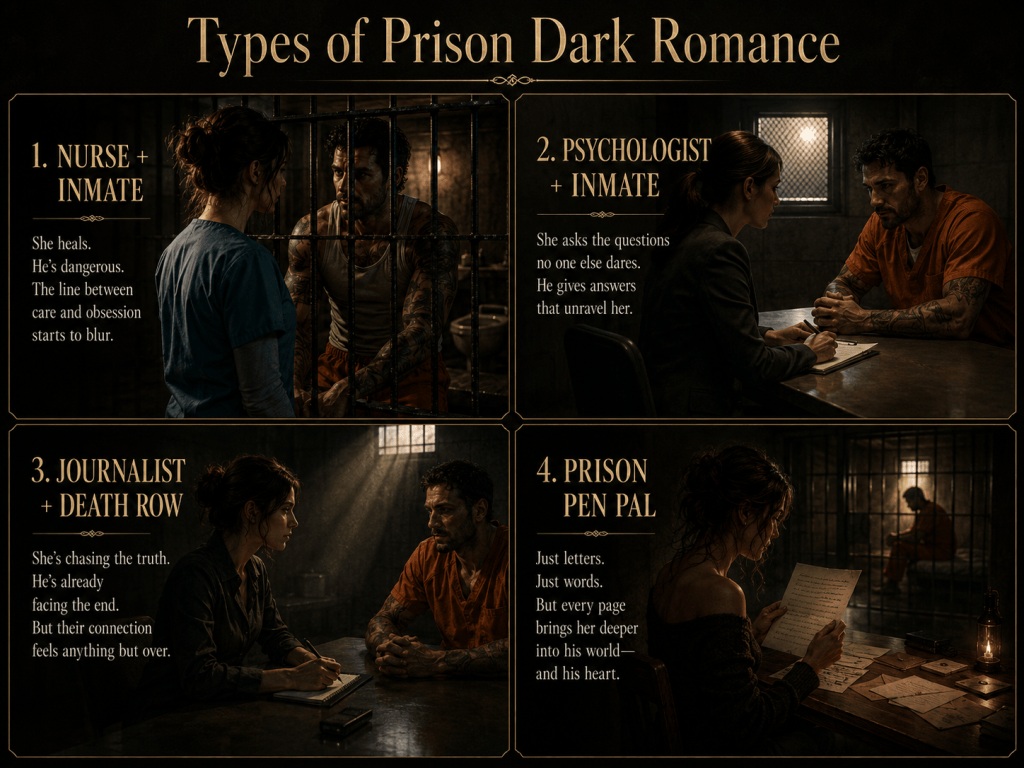
The Books Where the Prison Walls Actually Matter
These are the strongest choices if you want incarceration to affect the relationship rather than function as backstory.
Toxic by Nicole Blanchard
Best for: Readers who want the purest version of the prison nurse/dangerous inmate fantasy.
Tessa works as a nurse in a correctional facility and becomes involved with an inmate who is very clearly not supposed to become the solution to anything happening in her life. He is violent, obsessive, morally compromised, and frightening—but he also notices the abuse she is hiding.
That combination is what makes Toxic uncomfortable in an interesting way.
The attraction is not simply good woman inexplicably likes bad man. Tessa is already living inside one dangerous relationship, and then another dangerous man becomes the person who actually sees what is happening to her. The book keeps pushing on the question of whether being protected by a monster is substantially different from being controlled by one.
The prison setting works because King cannot simply pursue her normally. Their access to one another is restricted. The professional boundary is obvious. His criminality is not theoretical. He is literally incarcerated while the attraction develops. (authornicoleblanchard.com)
Why readers love it: The fantasy is extreme but easy to understand: the inmate everyone else fears becomes fixated on the woman who is supposed to remain professionally detached.
What genuinely stands out: The most effective tension is not “Will she discover he is dangerous?” She already knows. The question is why his particular form of danger begins feeling safer than the life she has outside the prison.
Who should read it: Readers who want obsession, violence, forbidden workplace boundaries, possessiveness and a hero who is not softened into an ordinary misunderstood bad boy.
Who should avoid it: Readers uncomfortable with domestic abuse themes, violent relationships or romances in which the distinction between protector and threat becomes intentionally messy.
Eerie Ratings
- Spice: 4/5
- Darkness: 9/10
- Obsession: 9/10
- Psychological Intensity: 8/10
- Violence: 9/10
- Emotional Damage: 9/10
- Trigger Intensity: 10/10
- Romance Focus: 8/10
- Overall Recommendation: 9/10
Trigger warnings: Domestic violence, physical violence, kidnapping, abuse, disturbing relationship dynamics and explicit sexual content. Check the book’s full content-warning list before reading.
Best for readers who liked: dangerous protector energy where “he is worse than the person hurting her” somehow becomes part of the attraction.

Imprisoned by Selena Winters
Best for: Readers who want psychological manipulation more than physical intimidation.
Willow is a newly licensed psychologist. Axel Morrison is the dangerous inmate she is supposed to evaluate.
That setup could easily turn into a generic “therapist falls for patient” romance. What makes Imprisoned fit this list is that the power struggle never belongs entirely to the person with the professional credentials.
Willow enters the room believing she is there to study Axel.
Axel starts studying her.
Their sessions gradually become the relationship.
The fascination comes from watching the person who should have institutional authority lose control of the emotional dynamic while the man without physical freedom gains psychological power over the room. The publisher description explicitly frames Axel as a violent, highly dangerous inmate and the attraction as a professional boundary Willow knows she should maintain. (romance.io)
That makes this one much more interesting for readers who prefer mind games to straightforward possessive-alpha behavior.
Why readers love it: The seduction feels intellectual before it feels physical. Axel gets access to Willow primarily by making her curious.
What makes it different: The central threat is not simply “dangerous inmate might hurt woman.” It is the possibility that the professional studying him may be less emotionally protected than she believes.
Eerie-specific verdict: This is the book I would choose over Toxic if your favorite part of prison romance is the question, “Who actually has the power here?”
Who should read it: Readers who enjoy psychological manipulation, blurred ethical boundaries, dangerous charisma and obsession that grows through conversation.
Who should avoid it: Anyone who needs a strong professional boundary between therapist and patient to remain intact or who dislikes manipulative heroes.
Eerie Ratings
- Spice: 5/5
- Darkness: 8/10
- Obsession: 9/10
- Psychological Intensity: 10/10
- Violence: 7/10
- Emotional Damage: 8/10
- Trigger Intensity: 8/10
- Romance Focus: 8/10
- Overall Recommendation: 8.5/10
Trigger warnings: Psychological manipulation, violence, dark sexual themes and therapist/patient boundary violations. Review the author’s complete warning list before reading.
Best for readers who liked: romances where the MMC’s most dangerous weapon is his ability to understand exactly what the heroine does not want him to see.
Trust by Kathy Lockheart
Best for: Readers who want a convicted killer but still need a stronger emotional reason to root for the relationship.
Knox Blackwood is incarcerated. The woman he becomes obsessed with is a prison nurse recovering from an abusive relationship.
Yes, that overlaps superficially with Toxic.
The emotional experience is different.
Trust leans harder into the dangerous-protector fantasy. Knox notices the evidence of what has been done to her and begins deliberately finding reasons to enter the infirmary so he can see her. His impending parole also gives the relationship a countdown: violence may protect her, but violence could also destroy his chance of ever leaving prison. (kathylockheart.com)
That creates something prison romance does especially well: love with administrative consequences.
He cannot simply beat the villain and ride off with the heroine.
One violent decision could change the rest of his life.
Why readers love it: The obsession comes with vulnerability because Knox actually has something significant to lose.
What surprised me about the setup: His imprisonment does not merely make him forbidden. It limits his ability to protect her, which makes his possessiveness more desperate.
Who should read it: Readers who love “who hurt you?” heroes, touch-her-and-die energy and incarcerated MMCs who still have an emotional life beyond being frightening.
Who should avoid it: Readers looking specifically for a remorseless villain hero. Knox’s appeal is more dangerous protector than pure predator.
Eerie Ratings
- Spice: 4/5
- Darkness: 7/10
- Obsession: 9/10
- Psychological Intensity: 7/10
- Violence: 8/10
- Emotional Damage: 8/10
- Trigger Intensity: 8/10
- Romance Focus: 9/10
- Overall Recommendation: 9/10
Trigger warnings: Violence, murder, stalking, domestic violence, fire and references to abuse. The author provides a fuller content-warning list. (kathylockheart.com)
Best for readers who liked: dangerous men whose protectiveness becomes the mechanism by which they risk everything.
When You Want Death Row Instead of a Traditional Prison Romance
Death-row romance changes the fantasy again.
The question is no longer merely whether the relationship is forbidden.
It becomes: What kind of future could these people possibly have?
Wishing Well by Lily White
Best for: Readers who want their prison romance to feel like psychological warfare.
Journalist Meadow Graham interviews death-row inmate Vincent Mercier, a wealthy hotel owner convicted of killing four people—including her twin sister.
That sentence alone should tell you why Wishing Well belongs here.
This is not a “maybe he is secretly sweet” setup.
Meadow has personal reasons to hate the man sitting across from her. Vincent has his own reasons for controlling the story she is hearing. The interview becomes a battle over truth, memory, attraction and manipulation. (spicyreads.com)
If your favorite dark romances are the ones that make you suspicious of every emotional reaction you are having, this is the stronger choice.
Why readers love it: The attraction is genuinely inconvenient. Meadow does not walk into the story looking for danger or volunteering to romanticize a criminal.
What makes it different: Most prison romances ask whether the heroine can love a dangerous inmate.
This one has a nastier question:
Can she desire the man connected to the worst thing that ever happened to her?
Who should read it: Readers who prefer psychological suspense, manipulation and morally uncomfortable attraction.
Who should avoid it: Readers looking for comfort, easy swooning or a conventional possessive hero fantasy.
Eerie Ratings
- Spice: 4/5
- Darkness: 9/10
- Obsession: 8/10
- Psychological Intensity: 10/10
- Violence: 8/10
- Emotional Damage: 10/10
- Trigger Intensity: 9/10
- Romance Focus: 7/10
- Overall Recommendation: 9/10
Trigger warnings: Murder, manipulation, grief, coercive dynamics, BDSM/dark sexual themes and psychological distress.
Best for readers who liked: dark romances that feel dangerously close to thrillers.
Ravished By the Inmate by Julie Thorn
Best for: Readers who want prison fantasy turned all the way up rather than carefully realistic.
A reporter arrives to cover the execution of death-row inmate Wesley “Trigger” Balzaretti.
He is a dangerous mob enforcer.
Then he takes her hostage.
The book itself is described as deliberately over-the-top, and that is important context because reading it as realistic prison romantic suspense would miss the point entirely. It is a short, exaggerated, high-heat criminal fantasy with instalove and a guaranteed HEA. (books.google.com)
That makes it useful on this list precisely because it offers the opposite experience from Wishing Well.
Wishing Well wants you uncomfortable.
Ravished By the Inmate wants you entertained.
Why readers love it: It does not pretend the premise is subtle.
What makes it different: Death row becomes the launchpad for an intentionally outrageous hostage romance rather than a slow psychological interrogation.
Who should read it: Readers who enjoy fast, filthy, exaggerated dark-romance fantasy and do not need realism.
Who should avoid it: Anyone looking for nuanced prison procedure, careful character psychology or slow-burn moral conflict.
Eerie Ratings
- Spice: 5/5
- Darkness: 6/10
- Obsession: 8/10
- Psychological Intensity: 5/10
- Violence: 6/10
- Emotional Damage: 4/10
- Trigger Intensity: 6/10
- Romance Focus: 9/10
- Overall Recommendation: 7/10
Trigger warnings: Hostage situation, criminal violence, death-row themes, explicit sexual content and exaggerated dark themes.
Best for readers who liked: unapologetically OTT dangerous-man romance.
When the Prison Letters Are More Important Than the Cell
This is where I draw a line many recommendation lists do not.
A book can absolutely scratch the prison-romance itch even when most of the relationship does not happen inside a prison.
But readers deserve to know that before starting it.
Branded by Saffron A. Kent
Best for: Readers who want prison pen-pal obsession with a larger romance waiting outside the walls.
The relationship begins through letters sent to a penitentiary.
The problem?
They were not exactly hers to begin with.
The convicted cowboy she becomes attached to eventually gets out—and the identity deception that felt manageable while separated by prison walls becomes much more dangerous when he can stand directly in front of her. (goodreads.com)
That transition is the reason Branded works particularly well for readers who find prison correspondence sexy but do not necessarily want an entire novel set inside a correctional facility.
The prison creates fantasy.
Release creates consequences.
Why readers love it: Letters provide emotional intimacy before ordinary physical access exists.
What makes it different: The heroine has time to construct an idea of the man she is writing to before having to confront the reality of him.
Who should read it: Pen-pal romance readers, cowboy-romance readers curious about darker territory and anyone who likes deception becoming impossible to maintain.
Who should avoid it: Readers specifically looking for guard/inmate or nurse/inmate scenes inside a prison.
Eerie Ratings
- Spice: 4/5
- Darkness: 7/10
- Obsession: 8/10
- Psychological Intensity: 7/10
- Violence: 6/10
- Emotional Damage: 7/10
- Trigger Intensity: 7/10
- Romance Focus: 9/10
- Overall Recommendation: 8/10
Trigger warnings: Criminal violence, deception, obsessive behavior and darker sexual/relationship themes. Check the author’s current warning list for specifics.
Best for readers who liked: “I fell for the version of you I knew through letters, and now I have to survive meeting the actual man.”
I Will Break You by Gigi Styx
Best for: Readers who want the prison-pen-pal idea to spiral into something much stranger and darker.
The opening premise is fantastic:
Her prison pen pal has been executed.
So why is he still contacting her?
From there, I Will Break You becomes less “traditional prison romance” and more psychological nightmare involving a serial killer, stalking, unreliable perception, obsession and a heroine who has her own serious darkness.
The author explicitly positions it as a dark psychological thriller romance with unreliable narrators and extensive trigger warnings, and the first book ends on a cliffhanger. (books.google.com)
That cliffhanger matters.
Do not pick this because you want a tidy standalone where a prison nurse falls for one hot inmate.
Pick it because the idea of becoming emotionally attached to someone on death row is only the beginning of the problem.
Why readers love it: There is no comfortable “normal” character anchoring the relationship.
What makes it different: Prison does not contain the monster. It introduces him.
Who should read it: Readers chasing genuinely unhinged protagonists, serial-killer romance, stalking and psychological horror mixed into their dark romance.
Who should avoid it: Readers who need a standalone, clear reality, moderate triggers or a conventionally sympathetic MMC.
Eerie Ratings
- Spice: 5/5
- Darkness: 10/10
- Obsession: 10/10
- Psychological Intensity: 10/10
- Violence: 10/10
- Emotional Damage: 9/10
- Trigger Intensity: 10/10
- Romance Focus: 8/10
- Overall Recommendation: 9/10 for the right reader
Trigger warnings: Serial murder, stalking, psychological manipulation, disturbing violence, unreliable perception and extensive dark themes. The book contains multiple pages of author-provided warnings. (books.google.com)
Best for readers who liked: the idea of asking, “What if the locked-up man was never the only dangerous person in this relationship?”
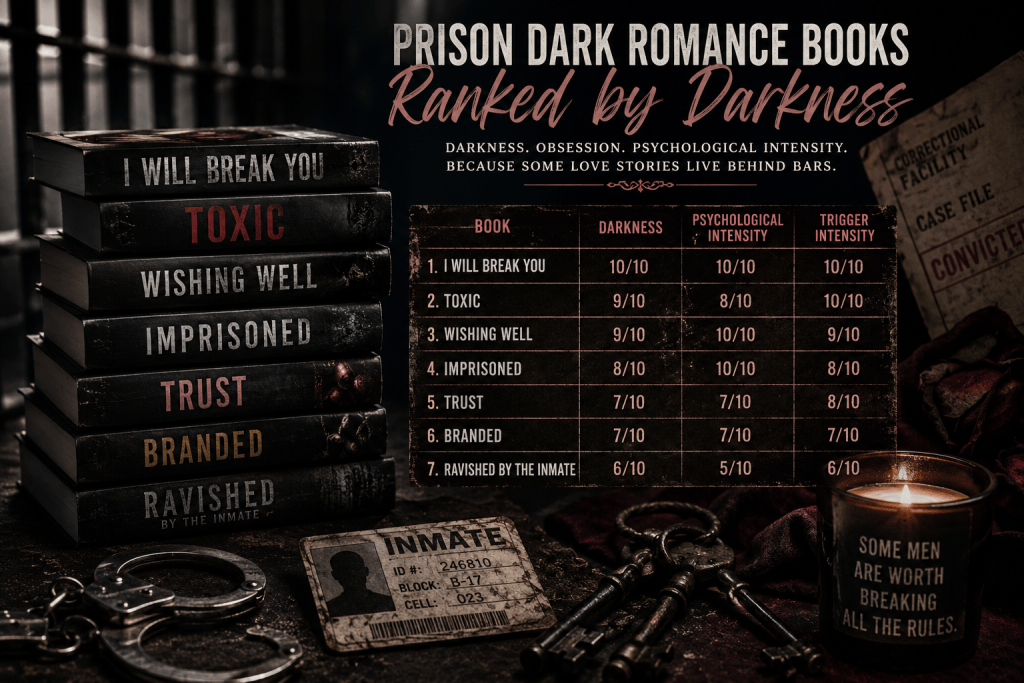
Darkness Ranking: Which Prison Romance Is Actually the Most Intense?
These ratings measure content intensity, not writing quality.
| Book | Darkness | Psychological Intensity | Trigger Intensity |
|---|---|---|---|
| I Will Break You | 10/10 | 10/10 | 10/10 |
| Toxic | 9/10 | 8/10 | 10/10 |
| Wishing Well | 9/10 | 10/10 | 9/10 |
| Imprisoned | 8/10 | 10/10 | 8/10 |
| Trust | 7/10 | 7/10 | 8/10 |
| Branded | 7/10 | 7/10 | 7/10 |
| Ravished By the Inmate | 6/10 | 5/10 | 6/10 |
The distinction that matters most here is between dark events and psychological darkness.
A book can contain violence without making you feel emotionally trapped.
Another can have fewer violent scenes but make every conversation feel unsafe.
That is why Imprisoned ranks below Toxic for overall darkness while reaching a 10/10 for psychological intensity.
Spice Ranking
| Book | Spice |
|---|---|
| Imprisoned | 5/5 |
| Ravished By the Inmate | 5/5 |
| I Will Break You | 5/5 |
| Toxic | 4/5 |
| Trust | 4/5 |
| Wishing Well | 4/5 |
| Branded | 4/5 |
Do not use this chart as a “which book is hottest?” ranking.
Five-pepper spice in a playful OTT romance and five-pepper spice inside a psychologically disturbing serial-killer romance are two completely different experiences.
Context matters more here than the number.
Dangerous Criminal or Morally Gray Hero? Prison Romance Makes the Difference Obvious
One mistake readers make when searching this trope is assuming every incarcerated MMC is automatically a villain hero.
He is not.
The important distinction is what the narrative asks you to forgive.
Knox in Trust fits more comfortably into dangerous-protector territory.
Axel in Imprisoned is much more interested in psychological control.
The criminality surrounding I Will Break You is part of the horror.
And Wishing Well deliberately makes emotional certainty difficult.
If those categories are starting to blur together, my guide to Dark Romance Hero and Character Archetypes breaks down possessive heroes, protective heroes, morally gray men and outright dangerous characters.
I also go deeper into the distinction in Alpha vs. Morally Gray Heroes in Dark Romance.
Because “he committed crimes” tells you surprisingly little about what reading the romance will actually feel like.
Prison Romance vs. Captive Romance: They Are Not the Same Fantasy
These tropes get lumped together constantly, and I think that does readers a disservice.
In captive romance, the dangerous man controls the confinement.
In prison romance, someone else has confined the dangerous man.
That changes the power fantasy.
A captive heroine wonders whether she can escape him.
A prison nurse or psychologist can theoretically walk away at the end of the interaction—and then chooses to come back.
That choice is often what makes prison romance feel so forbidden.
The bars are supposed to keep him away from her.
Instead, they become the place she keeps returning to see him.
If what you actually want is the opposite power structure—the hero controlling the heroine’s freedom—you will probably be happier with my guides to Kidnapping Dark Romance Books or Captive Romance Books.
Books People Often Treat Like Prison Romance—But That Is Not Enough
A dangerous criminal MMC does not automatically make a book prison romance.
Neither does:
- a hero who served time years ago;
- an organized-crime hero who briefly gets arrested;
- a kidnapping story where the heroine describes the location as her “prison”;
- a criminal hiding from law enforcement;
- a hero whose incarceration exists only in backstory.
For this page, I wanted imprisonment to alter the romantic dynamic in a meaningful way.
Either the relationship develops while someone is incarcerated, the characters meet because of the incarceration, or the prison relationship creates consequences that continue after release.
Otherwise we are just talking about dark romance with criminals.
There are already plenty of lists for that.

The Eerie Decision Guide: Start Here Based on Your Exact Mood
You want the most recognizable prison dark-romance fantasy
Start with Toxic.
Prison nurse. Dangerous inmate. Professional boundary. Obsession. Violence. The walls matter.
You want the smartest psychological power struggle
Start with Imprisoned.
The question is less “Will he hurt her?” and more “Why is the psychologist losing control of the interaction?”
You want a dangerous man you can still emotionally root for
Start with Trust.
His criminality matters, but the emotional fantasy leans toward protection rather than pure predation.
You want something disturbing instead of comforting
Start with Wishing Well.
The heroine has an extremely personal reason not to become fascinated by the inmate she interviews.
You want something filthy, fast and ridiculous in the best possible way
Start with Ravished By the Inmate.
Do not demand realism from it. That is not the assignment.
You want prison letters more than prison corridors
Start with Branded.
The emotional fantasy begins while the hero is inaccessible and becomes dangerous once he no longer is.
You want the most unhinged book on this page
Start with I Will Break You.
And read the content warnings first.
Seriously.
If You Loved One, Read This Next
Both use a prison employee/inmate barrier, but Trust is the better move when you want more protectiveness and less “this man might be an even bigger disaster.”
The darkness decreases slightly, while the emotional longing created by separation becomes more important.
Loved Imprisoned? → Read Wishing Well
Move here when the psychological battle was more interesting to you than the actual prison romance.
Loved Wishing Well? → Read I Will Break You
Only if your reaction was, “That was psychologically uncomfortable. Make it worse.”
Loved Ravished By the Inmate? → Read Toxic
Same attraction to someone who should be completely off-limits, but with considerably more emotional damage and consequence.
One Thing I Would Not Do: Start With the Darkest Book
Dark-romance readers sometimes treat escalation like a challenge.
It does not need to be.
If you have never read prison romance before, starting with the most psychologically punishing option can obscure what makes the trope interesting in the first place.
I would start with Toxic or Trust.
Both make the prison barrier central enough that you can tell whether you actually enjoy the trope.
Then move toward Imprisoned if you want psychological manipulation, Wishing Well if you want a nastier moral conflict, or I Will Break You if you have decided boundaries are apparently no longer part of your reading plan.
That progression makes far more sense than sorting books by Goodreads popularity and calling it a day.
Why Prison Romance Feels Different From Ordinary Forbidden Romance
Forbidden romance usually creates a social reason two people should stay apart.
Prison romance creates a physical one.
There are doors.
Guards.
Schedules.
Surveillance.
Rules governing who can touch whom and when.
And often a professional whose entire job depends on remembering exactly what the incarcerated person has done.
That turns proximity itself into tension.
The heroine cannot conveniently forget the hero is dangerous because the setting exists to remind her.
And that is why the best prison romances are not really about “falling for a bad boy.”
They are about attraction developing after the danger has already been proven.
For readers who are more interested in forbidden attraction itself than literal criminality, that tension also runs through my original fiction. You can read He Was My Brother’s Best Friend First or the darker What Breaks You.
Different circumstances.
Same irresistible question:
What happens when knowing you should stay away does absolutely nothing to make you want someone less?
Frequently Asked Questions About Prison Dark Romance
What is the best prison dark romance to start with?
Toxic is my strongest starting point because the prison setting, inmate/nurse boundary, obsession and danger are all central to the relationship.
Choose Trust instead if you want something more protective and emotionally romantic.
What is the darkest prison romance on this list?
By the Eerie Efficiency intensity scale, I Will Break You reaches the highest overall level because of its combination of serial murder, stalking, psychological manipulation, violence and unreliable perception.
It is prison-adjacent rather than primarily prison-set, however.
For a book where the correctional facility itself remains central, Toxic is the darker starting choice.
Which prison romance has the most psychological manipulation?
Imprisoned is the cleanest answer.
The psychologist/inmate structure means emotional observation and manipulation are built directly into the relationship.
Wishing Well is the stronger alternative if you want manipulation mixed with grief and personal history.
Are these all romances with innocent men who were wrongly convicted?
No.
And that is intentional.
A prison-dark-romance list built entirely around secretly innocent men avoids the exact fantasy many readers came looking for.
Sometimes the discomfort is the point.
The hero being dangerous should not automatically be “fixed” by revealing that he never really did anything wrong.
Are prison romances the same as mafia romances?
No.
Mafia romance usually gives the dangerous MMC enormous external power.
Prison romance can strip that away.
An incarcerated criminal may be feared, manipulative or influential, but he still exists inside a system capable of locking doors around him.
If your priority is organized crime rather than incarceration, try 25 Mafia Romance Books That Are Completely Addictive instead.
Are prison romances always non-con or dub-con?
No.
The prison setting can create enormous power imbalances without automatically making every sexual relationship dub-con or non-con.
Those labels should describe what actually happens on the page rather than being attached to a book merely because one character is incarcerated.
For the distinction, read Dub-Con vs. Non-Con: What’s the Difference in Dark Romance?.
Which book has the strongest forbidden-romance feeling?
For me, Imprisoned and Toxic win for different reasons.
Toxic has the clearest institutional barrier.
Imprisoned has the stronger ethical one.
A prison employee wanting an inmate is forbidden.
A mental-health professional allowing fascination with a dangerous patient to become reciprocal feels forbidden in a different—and arguably more psychologically uncomfortable—way.
Final Eerie Verdict
If I were reducing this entire page to four books rather than pretending every prison romance deserves equal attention:
Start with Toxic for the classic dangerous-inmate fantasy.
Choose Imprisoned for psychological control.
Choose Wishing Well when you want your attraction mixed with genuine moral discomfort.
Choose I Will Break You when you have already read enough dark romance to know that “extremely disturbing” sounds more like an invitation than a warning.
The prison setting works best when it does more than make the hero look dangerous.
It should make every interaction harder.
Every touch riskier.
Every return visit more revealing.
Because the real fantasy is not simply that she falls for a criminal.
It is that there is a locked door between them—
and somehow that still isn’t enough to keep either one away.