
Some readers search for dark romance by trope.
Others search for a very specific kind of man.
They want the silent protector who stands behind the heroine with blood on his knuckles. The possessive antihero who has already decided she belongs to him. The manipulator who controls everything without raising his voice. The devoted villain who would sacrifice the entire world before sacrificing her.
Character archetypes are the emotional engines behind dark romance.
A forced-marriage plot can feel completely different depending on whether the hero is a cold strategist, a jealous crime lord, a wounded protector, or an openly unhinged stalker. Likewise, a heroine can transform the same premise by being defiant, calculating, morally gray, quietly resilient, or secretly more dangerous than the man pursuing her.
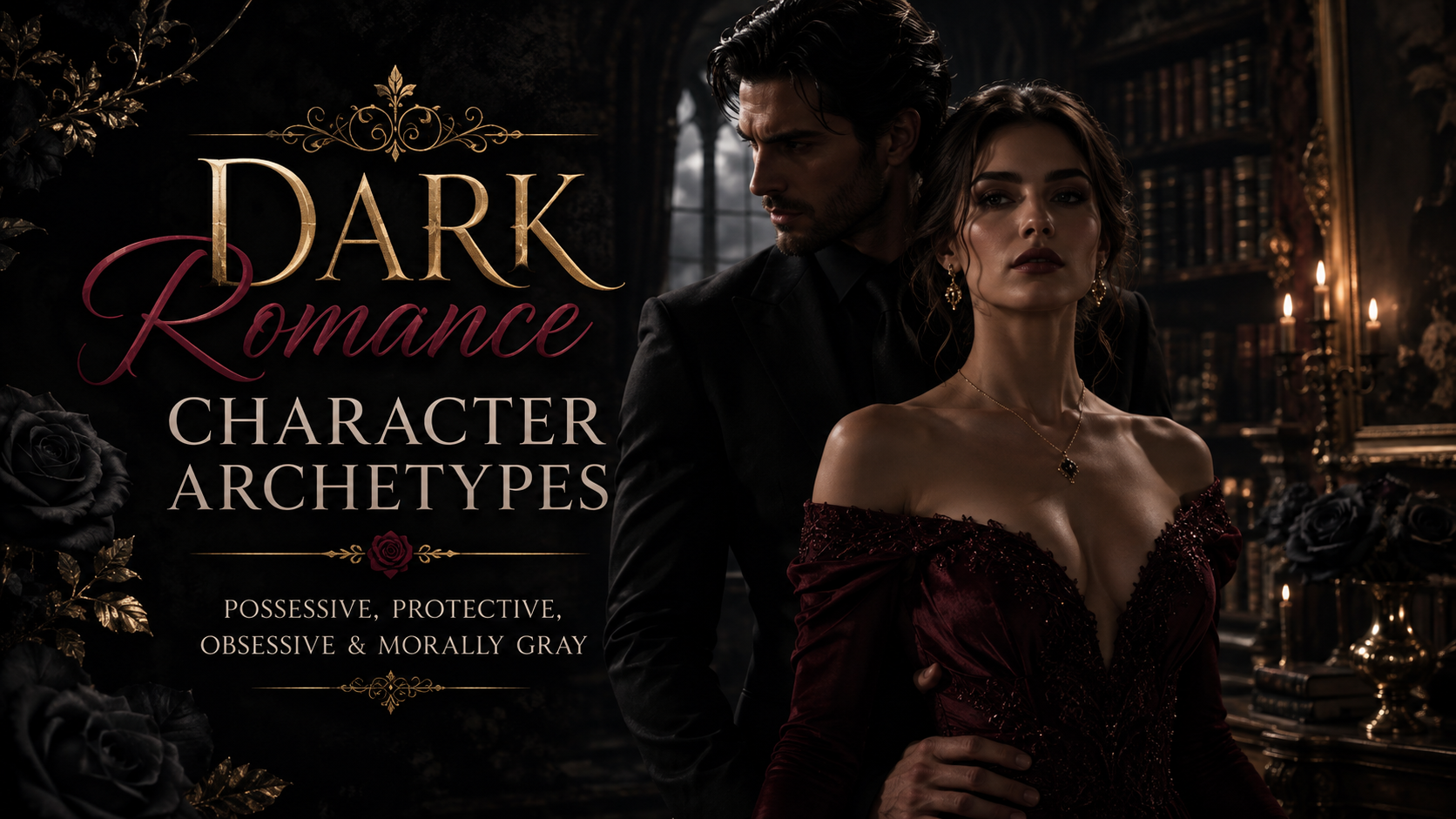
This guide breaks down the most addictive dark romance hero and heroine archetypes, explains the difference between possessive and protective behavior, explores which character combinations create the strongest chemistry, and helps you identify exactly what kind of fictional danger belongs on your reading list.
Important: Dark romance frequently explores obsession, coercion, violence, manipulation, power imbalances, captivity, trauma, and behavior that would be unhealthy or dangerous in real life. Fictional fantasy is not a relationship guide. Always check individual content warnings before reading.
Quick Answer: What Are Dark Romance Character Archetypes?
Dark romance character archetypes are recognizable character patterns that shape a story’s power dynamics, emotional tension, and romantic fantasy.
Common dark romance hero archetypes include:
- The possessive hero
- The protective hero
- The obsessive stalker
- The morally gray antihero
- The villain who gets the girl
- The criminal kingpin
- The cold strategist
- The wounded monster
- The manipulator
- The touch-her-and-die hero
Common dark romance heroine archetypes include:
- The defiant survivor
- The innocent with hidden steel
- The morally gray heroine
- The calculating queen
- The wounded but resilient heroine
- The sunshine heroine in a dark world
- The captive who refuses to surrender
- The monster’s equal
- The undercover threat
- The heroine who becomes darker
An archetype is not the same as a trope. A trope describes a recurring story situation, such as forced marriage or enemies to lovers. An archetype describes the kind of character experiencing it.
For a complete breakdown of recurring plot devices, read Every Dark Romance Trope Explained.

Possessive vs. Protective Heroes: What Is the Difference?
Possessive and protective heroes are often grouped together, but they are not identical.
The difference comes down to the hero’s primary motivation.
A protective hero is focused on her safety.
A possessive hero is focused on his claim.
Many dark romance heroes are both, but one instinct usually dominates.
| Characteristic | Protective Hero | Possessive Hero |
|---|---|---|
| Primary motivation | Keep her safe | Keep her as his |
| Greatest fear | She will be harmed | She will leave or choose someone else |
| Typical behavior | Guards, rescues, watches for threats | Claims, controls, isolates, marks territory |
| Reaction to danger | Removes the threat | Removes the threat and tightens his hold |
| Reaction to another man | Evaluates whether he is dangerous | Treats him as competition |
| View of the heroine | Someone precious to protect | Someone precious who belongs with him |
| Healthier version | Respects her decisions while helping | Expresses jealousy without controlling her |
| Darker version | Uses safety to justify surveillance | Uses love to justify ownership |
| Signature energy | “I won’t let them hurt you.” | “No one else gets to have you.” |
The distinction matters because the emotional fantasy is different.
Protective romance offers the fantasy of being completely safe with someone powerful.
Possessive romance offers the fantasy of being completely wanted by someone who cannot tolerate losing you.
The darkest heroes combine both:
He protects her because he believes she is his—and claims her because protecting her has become the center of his existence.
That combination creates the famous touch-her-and-die energy readers love. For more, visit Touch Her and Die Dark Romance Books.
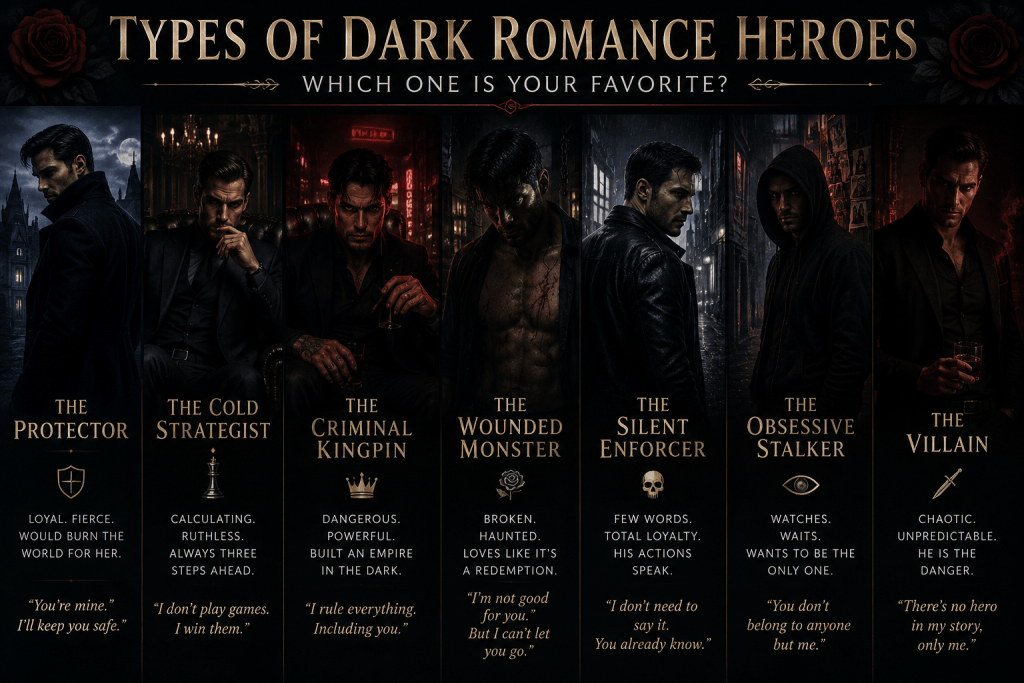
Dark Romance Hero Archetypes
1. The Possessive Hero
The possessive hero does not experience love as a gentle preference.
He experiences it as ownership, hunger, panic, and certainty.
Once he decides the heroine is his, other men become threats. Distance feels intolerable. Her independence may fascinate him, but it can also provoke his need for control.
Common possessive-hero behavior
- Becoming visibly jealous
- Watching anyone who approaches her
- Inserting himself into her daily life
- Using pet names that imply ownership
- Marking her physically or socially as unavailable
- Controlling access to her
- Tracking her whereabouts
- Removing romantic competition
- Declaring the relationship before she has agreed
- Treating separation as temporary resistance
What makes him addictive?
The possessive hero delivers an extreme fantasy of certainty.
He does not hesitate. He does not wonder whether he wants her. He does not keep his options open. His desire is singular, consuming, and impossible to misinterpret.
The fantasy is not simply that he wants the heroine.
It is that he wants her so completely that no substitute could ever satisfy him.
When possessiveness becomes darker
At the extreme end, the hero may:
- Isolate her from friends or family
- Sabotage other relationships
- Manipulate her choices
- Use threats to prevent her from leaving
- Monitor her without consent
- Control her money, work, or movements
- Punish perceived disloyalty
These behaviors may be intentionally explored as part of a dark fictional fantasy, but they are serious warning signs in real relationships.
Readers who love this archetype may enjoy Dark Romance Books With Possessive Male Leads.
2. The Protective Hero
The protective hero is driven by one overwhelming need: keep her alive, safe, and beyond the reach of anyone who might hurt her.
Unlike the possessive hero, he may not initially believe he deserves to keep her. He might even try to push her away while protecting her from a distance.
Common protective-hero behavior
- Quietly checking exits and entrances
- Positioning himself between her and danger
- Teaching her how to defend herself
- Remembering the people who have hurt her
- Watching over her without expecting praise
- Taking injuries meant for her
- Handling threats before she knows they exist
- Providing shelter, security, or resources
- Refusing to abandon her during a crisis
- Becoming terrifying only when she is endangered
What makes him addictive?
The protective hero creates the fantasy of absolute security.
He may be dangerous to everyone else, but his violence has direction. His competence becomes comforting because readers know exactly where his loyalty lies.
His tenderness often appears through action rather than words.
He may never say, “I love you.”
He will replace her broken lock, memorize her route home, sit outside her bedroom all night, and make sure the person who terrified her never comes near her again.
The dark-protector contradiction
The protective hero becomes especially compelling when he is also part of the danger.
He may imprison her to keep her safe.
He may lie because he believes the truth would put her at risk.
He may destroy her freedom in the name of preserving her life.
That contradiction raises one of dark romance’s central questions:
Is he protecting her from the world—or protecting his place in her world?
3. The Obsessive Hero
The obsessive hero cannot stop thinking about the heroine.
She becomes his routine, his weakness, his private religion, and sometimes his reason for functioning.
Possessiveness concerns ownership.
Obsession concerns fixation.
A hero can be obsessed without becoming openly possessive, especially when his fixation remains secret.
Signs of an obsessive hero
- Memorizing tiny details about her
- Collecting information or objects connected to her
- Replaying conversations
- Engineering “accidental” encounters
- Watching her from a distance
- Learning her schedule
- Fantasizing about a shared future before they are together
- Becoming emotionally dependent on seeing or hearing from her
- Treating anyone who upsets her as a personal enemy
- Organizing his life around her without her knowledge
Why readers love him
The obsessive hero magnifies the fantasy of being unforgettable.
The heroine is not simply attractive to him. She alters his internal world. He studies her because nothing else holds his attention in the same way.
This archetype is especially powerful in a slow burn because readers can watch ordinary interest transform into dangerous emotional dependency.
4. The Stalker
The stalker is the obsessive archetype stripped of normal boundaries.
He watches.
He follows.
He enters spaces where he was not invited.
He learns things she never told him.
Sometimes she knows he is there. Sometimes the entire first half of the story is built around discovering who has been watching.
Common versions of the stalker archetype
The silent guardian: He watches to protect her from a threat she does not know exists.
The unknown admirer: He leaves gifts, messages, or signs of his presence.
The territorial predator: He scares away anyone who approaches her.
The digital watcher: He monitors her phone, social media, accounts, or location.
The masked pursuer: His hidden identity makes the pursuit feel more dangerous.
The familiar stranger: He is already part of her life, but she does not realize he is the one watching.
What separates him from the protective hero?
A protector may watch because danger is present.
A stalker often decides that his desire gives him permission to watch.
The overlap can be enormous, but the violation of privacy is central to the stalker fantasy.
5. The Touch-Her-and-Die Hero
The touch-her-and-die hero is a specialized combination of possessive, protective, violent, and devoted.
He does not merely dislike people who hurt the heroine.
He eliminates them.
His defining qualities
- Extreme loyalty
- Controlled or explosive violence
- Territorial behavior
- A personal moral code centered on her
- Little concern for legal consequences
- Disproportionate retaliation
- Ruthlessness toward enemies
- Unexpected gentleness with the heroine
The most satisfying version of this archetype is not violent at random. His reaction feels personal because the heroine is the one boundary no one is allowed to cross.
Someone may insult him and survive.
Someone hurts her and becomes an example.
Why this archetype works
It transforms devotion into action.
The hero’s feelings become visible through what he is willing to risk, destroy, or endure for the heroine. His violence acts as emotional proof.
6. The Morally Gray Antihero
The morally gray antihero does terrible things but retains enough humanity, loyalty, vulnerability, or internal conflict to remain emotionally understandable.
He is not secretly perfect.
He may be a criminal, liar, killer, manipulator, thief, corrupt leader, or violent enforcer. The appeal comes from watching his personal code collide with his desire for the heroine.
Common antihero codes
- He never harms children.
- He protects his family at any cost.
- He only targets people he considers worse than himself.
- He keeps every promise.
- He does not betray those who are loyal to him.
- He refuses certain forms of cruelty.
- He believes violence is acceptable when used against predators.
- He will lie to the world but not to her.
- He will hurt her enemies but tries not to become one of them.
Morally gray vs. morally black
A morally gray hero recognizes at least some ethical boundaries, even when his boundaries differ from society’s.
A morally black hero may understand conventional morality and simply reject it. His devotion to the heroine may be his only redeeming feature—or the story may not attempt to redeem him at all.
For more antiheroes, read Dark Romance Books With Antiheroes.
7. The Villain Who Gets the Girl
The villain does not become a conventional hero simply because he falls in love.
He may remain dangerous, selfish, ruthless, and morally corrupt through the final chapter.
The fantasy lies in his exception.
He may have no mercy for the world, but he develops a weakness for one person.
The villain’s romantic question
The central question is rarely:
Can she make him good?
The more interesting question is:
What happens when a man with no interest in goodness decides she is the one thing he refuses to lose?
Effective villain-romance traits
- Charisma without apology
- A clear personal agenda
- Power that feels real
- Dangerous intelligence
- Emotional restraint
- Genuine capacity for cruelty
- A specific fascination with the heroine
- Consistency in his darkness
- Tenderness that feels rare rather than transformative
The strongest villain romances do not erase his nature. They reveal how love changes the direction of his darkness.
Explore more in Dark Romance Books With Villain Heroes.
8. The Cold Strategist
The cold strategist controls situations before anyone else realizes a game is being played.
He rarely loses his temper because anger is less useful than planning.
He does not chase recklessly.
He rearranges circumstances until the heroine has nowhere else to go.
His preferred weapons
- Information
- Money
- Social influence
- Legal leverage
- Secrets
- Patience
- Psychological pressure
- Carefully manufactured coincidences
- Other people’s weaknesses
Why he is frightening
An explosive hero may reveal exactly how dangerous he is.
The strategist remains calm.
By the time the heroine understands his plan, he may already control her job, home, reputation, protection, or future.
Why readers love him
Competence is attractive, and the cold strategist offers competence sharpened into menace.
His eventual emotional unraveling also feels more powerful because readers have seen how tightly he normally controls himself.
9. The Manipulator
The manipulator does not simply arrange external events. He studies the heroine’s emotions and uses what he learns.
He may know what she fears, what she needs, what makes her feel guilty, and what kind of reassurance will make her lower her guard.
Common manipulation tactics in dark romance
- Creating dependence
- Withholding information
- Offering carefully limited choices
- Love bombing
- Provoking jealousy
- Gaslighting
- Manufacturing danger and then becoming the rescuer
- Isolating the heroine
- Weaponizing secrets
- Making himself appear indispensable
- Rewarding compliance with tenderness
- Convincing her that leaving would hurt others
The manipulator’s fantasy
The fantasy is not safety.
It is psychological surrender.
The heroine may know he is influencing her and still find herself moving exactly where he wants her.
For similar dynamics, visit Dark Romance Books With Manipulative Male Leads.
10. The Criminal Kingpin
The criminal kingpin has power, resources, enemies, and rules of his own.
He may lead a mafia family, criminal organization, underground empire, motorcycle club, corrupt corporation, secret society, or violent dynasty.
What defines him
- Authority over dangerous people
- Wealth or access to resources
- A strong loyalty structure
- Ruthless decision-making
- Constant external threats
- A public reputation
- Emotional isolation
- Pressure to produce an heir, alliance, or marriage
- A conflict between duty and desire
Why he pairs well with romance
Powerful men are rarely allowed ordinary vulnerability.
The heroine becomes one of the few people capable of disrupting his control. Loving her creates a weakness his enemies can exploit—and a reason for him to become even more dangerous.
11. The Wounded Monster
The wounded monster believes something inside him is permanently broken.
He may carry physical scars, psychological trauma, shame, guilt, abandonment wounds, or a history of violence. He often expects rejection and reacts badly when the heroine gets close enough to see him clearly.
Common behaviors
- Pushing her away
- Testing her loyalty
- Expecting betrayal
- Becoming possessive after emotional intimacy
- Hiding behind cruelty
- Refusing comfort
- Assuming he will eventually hurt her
- Protecting her while believing she deserves better
- Becoming enraged when she sees herself as unworthy
What makes him compelling
The heroine does not necessarily cure him.
She sees him.
That distinction matters.
The fantasy is not that love magically erases trauma. It is that someone can witness the ugliest parts of him without reducing him to those parts.
12. The Silent Enforcer
The silent enforcer is usually not the public leader.
He is the man the leader sends when conversation has failed.
He observes more than he speaks, and his reputation often arrives before he does.
Signature qualities
- Few words
- Controlled body language
- Physical competence
- Fierce loyalty
- A violent profession
- Emotional repression
- Unexpected patience
- Protective acts performed quietly
- Devotion expressed through service
The silent enforcer often creates a powerful contrast: the world knows him as a weapon, while the heroine gradually discovers the person holding it.
13. The Jealous Rival
The jealous rival may begin as an enemy, competitor, bully, family adversary, professional obstacle, or unwanted fiancé.
His desire appears through conflict before either character is ready to call it attraction.
Signs the rivalry has become obsession
- He notices who she talks to.
- He interferes with her dates.
- He competes for her attention.
- He provokes her simply to get a reaction.
- He remembers every insult she gives him.
- He becomes furious when she is indifferent.
- He protects her while insisting he dislikes her.
- He treats access to her emotions as a victory.
This archetype works beautifully with enemies to lovers because hostility gives both characters permission to remain emotionally intense before they become vulnerable.
14. The Reluctant Guardian
The reluctant guardian is assigned—or forced—to protect the heroine.
He may be a bodyguard, captor, rival, family friend, brother’s best friend, security specialist, soldier, criminal associate, or man repaying a debt.
At first, she is a responsibility.
Then she becomes the reason he breaks every rule.
Why this archetype creates strong slow-burn tension
- Forced proximity creates repeated contact.
- Professional boundaries delay the relationship.
- Danger encourages emotional intimacy.
- He notices her routines and vulnerabilities.
- Protection becomes personal.
- Jealousy exposes feelings he refuses to name.
- His duty gives him an excuse to remain close.
15. The Devoted Madman
The devoted madman is openly unstable, emotionally extreme, or gleefully violent.
Unlike the cold strategist, he may enjoy chaos. Unlike the wounded monster, he may have no desire to become healthier or easier to love.
His appeal comes from the strange purity of his devotion.
The world may see madness.
The heroine sees consistency.
His romantic language
- Threats delivered like promises
- Gifts no normal person would consider appropriate
- Violence performed cheerfully
- Absolute honesty about his intentions
- Delight when the heroine reveals her own darkness
- Loyalty that survives fear, pain, and rejection
He is not safe.
He may, however, be completely hers.
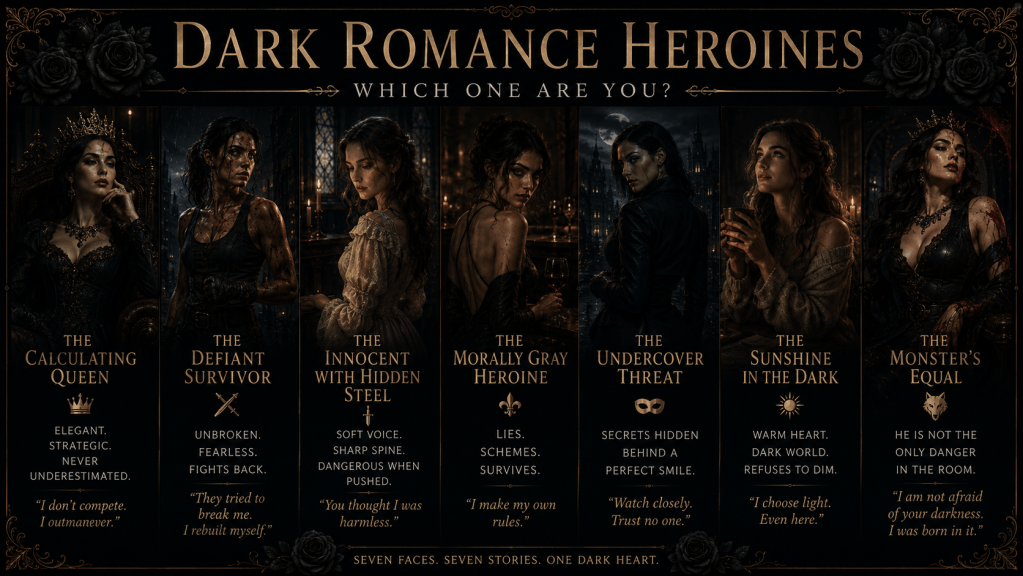
Dark Romance Heroine Archetypes
Dark romance heroines are sometimes reduced to the person being chased, protected, claimed, or captured.
The strongest heroines are more than the object of the hero’s obsession. They shape the obsession, challenge its limits, exploit its weaknesses, and decide what they are willing to become in response.
1. The Defiant Survivor
The defiant survivor refuses to become easy to control.
She may be frightened, trapped, inexperienced, or physically overpowered, but she continues resisting psychologically.
Her strengths
- Sharp instincts
- Emotional endurance
- Refusal to submit internally
- Ability to adapt
- Anger that keeps her moving
- Courage under pressure
- Willingness to confront the hero
Her power is not always physical. Sometimes her greatest victory is preserving her identity in circumstances designed to erase it.
2. The Innocent With Hidden Steel
This heroine may appear gentle, sheltered, inexperienced, or traditionally feminine.
Her softness is real—but it is not weakness.
When pushed, she discovers boundaries she will defend, risks she will take, and darkness she is capable of surviving.
Why readers love her
The contrast creates satisfying transformation.
The dangerous hero expects to overwhelm her. Instead, he discovers that kindness can coexist with stubbornness, intelligence, and enormous emotional strength.
3. The Morally Gray Heroine
The morally gray heroine lies, manipulates, steals, schemes, harms, or makes decisions that cannot be neatly defended.
She is not merely reacting to a dangerous man.
She has darkness of her own.
Common morally gray heroine motives
- Revenge
- Survival
- Protecting family
- Escaping control
- Pursuing power
- Covering up a crime
- Destroying an enemy
- Securing freedom
- Protecting someone vulnerable
- Reclaiming what was taken from her
This archetype works especially well when the hero initially underestimates her.
4. The Calculating Queen
The calculating queen understands power.
She knows when to appear harmless, when to negotiate, when to seduce, and when to strike.
She may enter the story with less physical power than the hero, but she learns how to use reputation, alliances, secrets, and emotional leverage.
Her greatest weapon
People believe power must be loud.
She knows it can whisper.
The calculating queen often becomes a true partner to the kingpin or strategist because she can survive in his world without becoming his decoration.
5. The Wounded but Resilient Heroine
This heroine carries trauma, grief, shame, fear, or emotional damage that affects how she navigates intimacy.
Her arc is not about becoming untouched by what happened.
It is about reclaiming choice.
A strong resilience arc may include
- Learning to trust her perceptions again
- Setting boundaries
- Accepting help without surrendering autonomy
- Confronting the person who harmed her
- Allowing herself to feel anger
- Redefining strength
- Choosing intimacy rather than being pressured into it
- Discovering that survival is not the same as living
6. The Sunshine Heroine in a Dark World
The sunshine heroine brings warmth, humor, compassion, or optimism into a brutal environment.
She is not necessarily naïve. She may understand exactly how dangerous the hero is and choose to preserve her softness anyway.
Why she pairs well with dark heroes
Her warmth exposes his deprivation.
He may have survived without affection for years, but after experiencing hers, he becomes incapable of returning to emotional starvation.
The key is giving her boundaries and agency. A compelling sunshine heroine does not exist only to heal the hero. Her values should influence the story without erasing her own needs.
7. The Captive Who Refuses to Surrender
The captive heroine may be kidnapped, confined, forced into a marriage, trapped by debt, or held through psychological leverage.
Her physical freedom is limited, so the narrative focuses heavily on mental resistance and negotiation.
Sources of captive-heroine power
- Information the captor needs
- Refusal to show fear
- Understanding his weaknesses
- Strategic compliance
- Emotional influence
- Escape planning
- Alliances with others
- Creating uncertainty
- Forcing him to see her as a person rather than a possession
The most interesting captive dynamics involve changing power, not permanent helplessness.
8. The Monster’s Equal
The monster’s equal is not horrified by the hero’s darkness.
She recognizes it.
Sometimes she shares it.
She may be a killer, criminal, predator, strategist, vigilante, supernatural threat, or emotionally ruthless survivor.
Their chemistry comes from recognition
He has spent his life hiding what he is.
She looks directly at it and smiles.
This pairing replaces the traditional beauty-and-the-beast fantasy with something more dangerous:
What happens when the beast finally meets another beast?
9. The Undercover Threat
The undercover threat enters the hero’s life with a hidden motive.
She may be gathering evidence, seeking revenge, protecting someone, spying for a rival, hiding her identity, or planning to destroy him from within.
Why this archetype creates tension
Every romantic moment carries two meanings.
When she gains his trust, she gets closer to her objective—but also closer to the man she may have misjudged. When he becomes possessive, she must determine whether he senses the deception or simply cannot tolerate distance.
The eventual reveal can create betrayal, rage, forced proximity, revenge, and emotional devastation all at once.
10. The Heroine Who Becomes Darker
Some heroines enter dark romance hoping to escape the hero’s world.
Others slowly learn how to rule it.
This archetype is defined by transformation.
Possible stages of her descent
- She is horrified by the hero’s methods.
- She begins understanding why he uses them.
- She benefits from his power.
- She makes one morally questionable choice.
- She discovers that power feels safer than helplessness.
- She acts without his permission.
- He realizes she no longer needs him to commit violence for her.
- They become dangerous together.
The best versions preserve tension around whether this transformation is liberation, corruption, or both.
Possessive, Protective, Obsessive, or Controlling?
These terms are often used interchangeably in romance discussions, but they describe different impulses.
| Archetype | Central Desire | Internal Fear | Typical Action |
|---|---|---|---|
| Protective | Keep her safe | She will be harmed | Guards or rescues her |
| Possessive | Keep her as his | She will choose someone else | Claims or restricts her |
| Obsessive | Remain connected to her | He will lose access to her | Watches, studies, follows |
| Controlling | Direct her behavior | He will lose influence | Limits her choices |
| Jealous | Eliminate competition | He is replaceable | Challenges rivals |
| Manipulative | Shape her decisions | She will reject his preferred outcome | Uses emotion or information |
| Devoted | Prioritize her above everything | He will fail her | Sacrifices for her |
| Dependent | Use her to regulate himself | He cannot function without her | Clings, panics, destabilizes |
One character can occupy several categories.
For example, a hero may protect the heroine from an enemy, control her movements in the name of safety, become obsessed with monitoring her, and react possessively when she turns to another man for help.
The question is not simply which label applies.
The question is which desire drives him when those impulses conflict.
Possessive vs. Protective: Five Situations That Reveal the Difference
Situation 1: She wants to go somewhere dangerous
Protective response: He explains the risk, offers to accompany her, and prepares for possible danger.
Possessive response: He informs her she is not going because he has already decided.
Dark hybrid response: He lets her believe she is going alone while placing armed security around the entire location.
Situation 2: Another man flirts with her
Protective response: He watches for discomfort and intervenes if she wants help.
Possessive response: He intervenes because another man’s interest is unacceptable.
Dark hybrid response: He allows the conversation to continue long enough to identify the rival before privately ensuring it never happens again.
Situation 3: She tries to leave him
Protective response: He may be devastated but allows her to go unless she is in immediate danger.
Possessive response: He treats her decision as temporary, irrational, or irrelevant.
Dark hybrid response: He removes the external threat, eliminates every practical reason for her departure, and then asks whether she still wants to leave.
Situation 4: She keeps a secret
Protective response: He worries the secret concerns her safety.
Possessive response: He is enraged that part of her exists beyond his access.
Dark hybrid response: He already knows the secret and has been waiting to see whether she will trust him with it.
Situation 5: Someone hurts her
Protective response: He focuses first on helping her recover.
Possessive response: He focuses on punishing the person who touched what he considers his.
Dark hybrid response: He cares for her gently, waits until she falls asleep, and then disappears.
Best Dark Romance Character Pairings
An archetype becomes more interesting when it collides with its opposite—or meets its equal.
The Cold Strategist + The Defiant Survivor
He expects people to follow the path he creates.
She keeps finding exits he failed to predict.
Their chemistry comes from intellectual resistance. He becomes fascinated because she is the first person who does not behave like a piece on his board.
The Possessive Kingpin + The Calculating Queen
He controls the empire.
She controls the room.
This pairing works when both characters understand power but use it differently. His authority may be direct and violent, while hers is social, emotional, or strategic.
The Wounded Monster + The Sunshine Heroine
He believes love is conditional.
She offers warmth without pretending his behavior is harmless.
The relationship becomes most satisfying when she retains boundaries and he learns that tenderness is not the same as weakness.
The Stalker + The Undercover Threat
He is watching her.
She is investigating him.
Each believes they know more than the other, turning every interaction into a battle of hidden information.
The Touch-Her-and-Die Hero + The Morally Gray Heroine
He wants to destroy her enemies for her.
She has already handled half of them herself.
Instead of remaining a passive recipient of protection, she becomes a partner in retaliation.
The Silent Enforcer + The Captive Who Refuses to Surrender
He is ordered to guard her.
She refuses to make the job easy.
Their connection builds through observation, small acts of rebellion, reluctant respect, and the moment he chooses her over the person who gave the order.
The Devoted Madman + The Monster’s Equal
Everyone else sees his warning signs.
She sees a challenge.
This pairing creates chaotic chemistry because neither character is positioned as the normal one responsible for redeeming the other.
The Reluctant Guardian + The Innocent With Hidden Steel
He thinks she needs to be sheltered.
She proves she needs information, preparation, and the freedom to fight beside him.
His protection evolves from containment into partnership.

Which Dark Romance Hero Archetype Is Right for You?
Choose the statement that sounds most appealing.
“I want him to make her feel completely safe.”
Your archetype: The Protective Hero
Look for bodyguards, guardians, security experts, reluctant protectors, wounded veterans, and heroes who quietly remove threats.
“I want him jealous, territorial, and unable to share.”
Your archetype: The Possessive Hero
Look for claiming behavior, forced proximity, arranged marriage, mafia romance, rival suitors, and “mine” energy.
“I want him thinking about her every second.”
Your archetype: The Obsessive Hero
Look for secret fixation, hidden photographs, engineered encounters, watching from a distance, and he-falls-first stories.
“I want him terrifyingly intelligent.”
Your archetype: The Cold Strategist
Look for psychological manipulation, blackmail, corporate power, criminal planning, secrets, and heroes who are always several moves ahead.
“I want him to destroy anyone who harms her.”
Your archetype: The Touch-Her-and-Die Hero
Look for violent protectors, mafia enforcers, assassins, vigilantes, bodyguards, and men with selective morality.
“I do not want him redeemed.”
Your archetype: The Villain Who Gets the Girl
Look for morally black heroes, criminal masterminds, monsters, corrupt rulers, and unapologetically dangerous love interests.
“I want him broken, lonely, and secretly desperate for love.”
Your archetype: The Wounded Monster
Look for scarred heroes, recluses, emotionally damaged antiheroes, tortured villains, and men who expect abandonment.
“I want both characters to be dangerous.”
Your ideal pairing: The Monster and His Equal
Look for criminal couples, killers in love, revenge partnerships, morally gray heroines, and couples who become worse together.
Archetype vs. Trope vs. Personality Trait
These three concepts overlap, but they are not interchangeable.
Archetype
A broad character pattern built around motivation and narrative function.
Example: The protective hero.
Trope
A recognizable story situation or relationship setup.
Example: Forced proximity.
Personality trait
An individual characteristic affecting how the character behaves.
Example: Quiet, sarcastic, impatient, charming, or emotionally reserved.
A story might feature:
- A protective hero archetype
- In a forced-proximity trope
- Who has a quiet and emotionally controlled personality
Another story could use the same trope but replace him with a manipulative strategist, producing a completely different emotional experience.
Make Your Next Dark Romance Reading Session Even Better
Once you know which dark romance archetype you love most, the only real challenge is staying comfortable while you read one more chapter—and then accidentally five more.
For Kindle and tablet readers, this remote-control page turner lets you turn pages without repeatedly reaching for your device. It can be especially convenient when you are reading in bed, using a tablet stand, or settling in for a long, obsessive slow burn.
As an Amazon Associate, I may earn from qualifying purchases at no additional cost to you.
How Dark Romance Archetypes Create Emotional Tension
Character archetypes work because each one carries a built-in contradiction.
The protector may become the jailer
His desire to keep her safe can threaten her freedom.
The possessive hero may fear being unwanted
His control often hides vulnerability and terror of abandonment.
The villain may offer the greatest loyalty
A man who respects no law may still treat one promise as sacred.
The innocent heroine may become the most dangerous
Her transformation can destabilize everyone who underestimated her.
The monster may crave tenderness
The harder he appears, the more meaningful every gentle action becomes.
The captive may gain emotional power
Physical confinement does not guarantee psychological surrender.
These contradictions give dark romance its addictive push and pull. Readers are not only asking whether the couple will fall in love.
They are asking:
- Will protection become imprisonment?
- Will obsession become devotion?
- Will she escape him or choose him?
- Will he change for her?
- Will she become darker for him?
- Who truly has the power?
- Can love exist inside something dangerous?
- What will they destroy before they admit what they feel?
When an Archetype Feels Flat
A familiar archetype does not automatically create a memorable character.
The possessive hero becomes flat when:
- He has no motive beyond jealousy.
- Every interaction consists of saying “mine.”
- His possessiveness never creates consequences.
- He has no identity outside the heroine.
- His control is portrayed inconsistently.
The protective hero becomes flat when:
- The heroine is helpless only so he can rescue her.
- He never respects her abilities.
- Every conflict is solved through physical violence.
- His protection eliminates all narrative tension.
- The story never questions whether his choices are justified.
The morally gray hero becomes flat when:
- The narrative insists he is dark without showing difficult choices.
- Every victim conveniently deserves what happens.
- His cruelty disappears as soon as romance begins.
- Trauma is used as a complete excuse for harmful behavior.
- His “grayness” is merely sarcasm and tattoos.
The strong heroine becomes flat when:
- Strength means she never feels fear.
- She rejects help even when doing so makes no sense.
- Her only personality trait is defiance.
- She wins every confrontation without cost.
- She is described as intelligent but repeatedly makes careless decisions to advance the plot.
Complex characters need desire, fear, contradiction, and consequence.
Fictional Fantasy vs. Real-Life Warning Signs
Dark romance allows readers to explore danger within a controlled story.
That does not make the behavior desirable outside fiction.
In real relationships, concerning behavior can include:
- Monitoring your location without permission
- Isolating you from friends and family
- Controlling your money
- Threatening you or people you care about
- Destroying your property
- Ignoring your boundaries
- Preventing you from leaving
- Using jealousy as justification for punishment
- Pressuring or forcing sexual activity
- Making you responsible for their emotional stability
- Framing control as proof of love
A fictional character can be thrilling precisely because the reader is not personally trapped with him.
Enjoying a possessive, controlling, violent, or obsessive character on the page does not mean wanting that behavior in real life.
Read Original Slow-Burn Dark Romance
Want to see these archetypes develop gradually instead of appearing fully obsessed in chapter one?
What Breaks You
What Breaks You is a forbidden age-gap dark romance featuring Amelia and Jim, her father’s best friend.
Expect:
- A painful slow burn
- Forbidden attraction
- Jealousy
- Emotional dependency
- Protective instincts
- Possessive escalation
- Secrecy
- Complicated power dynamics
- A hero fighting feelings he can no longer control
Start reading What Breaks You here.
He Was My Brother’s Best Friend First
For enemies-to-lovers tension, possessiveness, jealousy, and a hero whose restraint becomes increasingly unstable, explore the original Cole and Scarlett story.
Their relationship combines:
- Brother’s best friend
- Enemies to lovers
- Forced proximity
- Buried history
- Mutual provocation
- Slow-building obsession
- A possessive hero who does not initially understand his own fixation
Explore Eerie Efficiency’s original dark romance fiction.
Related Dark Romance Guides
Continue exploring the characters, tropes, and relationship dynamics behind dark romance:
- Every Dark Romance Trope Explained
- The Complete Guide to Dark Romance Subgenres
- Dark Romance Books With Possessive Male Leads
- Touch Her and Die Dark Romance Books
- Dark Romance Books With Antiheroes
- Dark Romance Books With Villain Heroes
- Dark Romance Books With Manipulative Male Leads
- Dark Romance Books Where He Falls First
- Dark Romance FAQ
Frequently Asked Questions About Dark Romance Character Archetypes
What is the most popular dark romance hero archetype?
The possessive, morally gray hero is one of the most popular dark romance archetypes. He usually combines jealousy, obsession, danger, emotional intensity, and unwavering focus on the heroine.
Protective heroes, stalkers, villains, mafia leaders, manipulators, and touch-her-and-die heroes are also extremely popular.
What is the difference between a possessive hero and an obsessive hero?
A possessive hero wants the heroine to belong exclusively to him.
An obsessive hero cannot stop thinking about, watching, studying, or pursuing her.
A character can be possessive without secretly monitoring every part of her life, and he can be obsessive without openly claiming her. Many dark romance heroes are both.
Can a protective hero still be controlling?
Yes.
A protective hero may use genuine concern for the heroine’s safety to justify controlling her movements, choices, communication, or relationships.
That tension is common in dark romance because the same action can function as protection and imprisonment.
What does “touch her and die” mean in romance?
“Touch her and die” describes a hero who reacts violently or ruthlessly when someone threatens, harms, humiliates, or touches the heroine without permission.
The trope combines extreme protection, possessiveness, territorial behavior, and devotion.
What is a morally gray hero?
A morally gray hero commits unethical, illegal, violent, or manipulative acts but retains some humanizing qualities or personal boundaries.
He may be loyal, protective, remorseful, emotionally conflicted, or guided by a private moral code.
What is a morally black hero?
A morally black hero has few conventional ethical boundaries and may show little remorse for harmful behavior.
He does not necessarily become good through love. The heroine may simply become the one person he values above himself or his goals.
What is the difference between an antihero and a villain?
An antihero is usually the story’s central protagonist or romantic lead despite lacking traditional heroic qualities.
A villain actively functions as a source of danger, opposition, corruption, or destruction.
In dark romance, the same character may occupy both roles. He can be the heroine’s primary threat and eventual love interest.
Why are possessive heroes so popular?
Possessive heroes provide an exaggerated fantasy of certainty, exclusivity, and emotional intensity.
They do not treat the heroine as replaceable. Their desire is unmistakable, and the possibility of losing her feels intolerable to them.
Why do readers like protective heroes?
Protective heroes offer the fantasy of safety with someone powerful enough to confront danger.
Their affection is often demonstrated through competence, vigilance, sacrifice, and action rather than conventional declarations.
Can a dark romance heroine be morally gray?
Absolutely.
A morally gray heroine may lie, manipulate, seek revenge, commit crimes, hide important information, or make ethically complicated decisions.
She may also be just as obsessive, possessive, or dangerous as the hero.
Does a strong heroine have to physically fight the hero?
No.
Strength can appear through endurance, strategy, emotional intelligence, negotiation, adaptability, self-awareness, or refusal to surrender psychologically.
A heroine does not need to win a physical fight to possess meaningful power.
What is the best heroine archetype for a possessive hero?
The defiant survivor and calculating queen both pair well with possessive heroes.
The defiant survivor challenges his control directly, while the calculating queen learns how to redirect his obsession and negotiate power within the relationship.
What archetype works best for enemies to lovers?
The jealous rival, cold strategist, defiant survivor, undercover threat, and monster’s equal all work especially well in enemies-to-lovers stories.
Each creates natural conflict without requiring either character to become immediately vulnerable.
What archetype works best for slow-burn romance?
The reluctant guardian, wounded monster, silent enforcer, hidden obsessive, and emotionally repressed protector are ideal for slow burns.
Their feelings usually appear first through behavior, jealousy, vigilance, or sacrifice rather than direct confession.
Are possessive and protective behavior healthy in real life?
Protectiveness can be healthy when it respects the other person’s autonomy and wishes.
Possessiveness becomes unhealthy when it involves ownership, isolation, coercion, monitoring, intimidation, or punishment.
Dark romance often intentionally heightens unhealthy dynamics as part of a fictional fantasy.
How do I know which dark romance archetype I like?
Think about the emotional experience you want.
Choose protective heroes for safety, possessive heroes for exclusivity, obsessive heroes for fixation, strategists for psychological tension, wounded monsters for vulnerability, villains for unapologetic darkness, and touch-her-and-die heroes for violent devotion.
Final Thoughts: The Best Dark Romance Archetype Is the One That Creates Conflict
The most memorable dark romance characters cannot be reduced to one label.
A hero can be protective but terrified of intimacy.
Possessive but convinced the heroine deserves someone better.
Violent but deeply patient with her fear.
Manipulative but incapable of lying when she asks whether he loves her.
A heroine can be frightened but strategic.
Innocent but unbreakable.
Kind but unwilling to forgive.
Captured but never emotionally conquered.
Dark romance becomes addictive when archetypes collide with contradiction.
The protector becomes the threat.
The captive becomes the queen.
The villain becomes devoted.
The innocent heroine discovers she was never as harmless as everyone believed.
And love does not necessarily make either character good.
Sometimes it simply gives their darkness a direction.


One Response