
If you read dark romance long enough, you will eventually run into the terms dub-con and non-con.
They are sometimes grouped together. They are sometimes used interchangeably. And sometimes two readers will finish the exact same scene and classify it differently.
But the basic distinction is important:
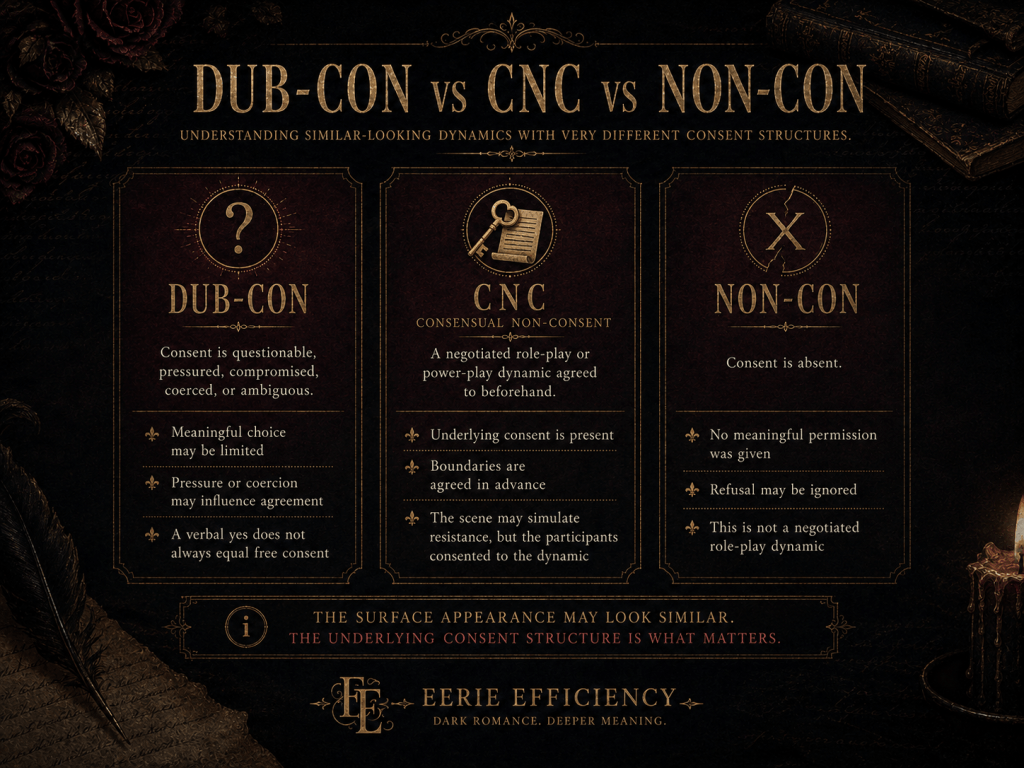
Dub-con, short for dubious consent, generally describes fictional sexual situations where meaningful consent is unclear, compromised, pressured, coerced, impaired, or otherwise ambiguous.
Non-con, short for non-consensual, describes fictional sexual situations where consent is absent.
That sounds straightforward until you add captivity, threats, manipulation, intoxication, power imbalances, fear, conflicting internal narration, prior agreements, or a character who verbally says yes while facing consequences for saying no.
That is where the terminology becomes complicated.
These labels are also not perfectly standardized. Readers, authors, publishers, reviewers, and content-warning systems may draw the boundary in slightly different places. Eerie Efficiency therefore treats dub-con and non-con as content-classification terms that require context, not as flawless universal categories.
This guide explains how the terms are used throughout Eerie Efficiency, what separates them, where the boundaries become blurry, and what readers should look for when deciding whether a book fits their personal limits.
If you are new to the wider vocabulary of the genre, start with the Dark Romance Tropes Explained guide for a broader breakdown of dark-romance dynamics before diving into the consent distinctions below.
Dub-Con vs Non-Con at a Glance
| Question | Dub-Con | Non-Con |
|---|---|---|
| What is happening with consent? | Consent is questionable, compromised, coerced, impaired, pressured, or ambiguous. | Consent is absent. |
| Can there be verbal agreement? | Yes. A verbal “yes” may exist while the circumstances make meaningful consent questionable. | Not necessarily. There may be refusal, no agreement, inability to consent, or no opportunity to consent. |
| Can the character freely refuse? | Often this is the central uncertainty. | The activity occurs without the character’s consent regardless of whether refusal is possible. |
| Can coercion be involved? | Frequently. | It can be, although coercion is not required for something to be non-consensual. |
| Can threats be involved? | Yes, especially when agreement is obtained because of consequences. | Yes, but non-con can occur without an explicit threat. |
| Can power imbalance matter? | Yes, when it interferes with the character’s actual ability to choose. | Yes, but imbalance alone does not define non-con. |
| Can intoxication or impairment matter? | Yes. Capacity may be questionable. | Yes. If a character cannot consent, the situation may be classified as non-con. |
| Does physical resistance have to occur? | No. | No. Lack of physical resistance does not establish consent. |
| How much ambiguity exists? | Usually substantial. | The defining issue is that consent is not present, even if other parts of the scene are narratively complicated. |
| Why might readers disagree? | Different readers may weigh coercion, internal desire, threats, power, or capacity differently. | Disagreement can still occur over the text’s framing or whether consent was actually established. |

This table is a starting point, not a formula.
Consent in fiction cannot always be classified by counting whether a certain number of warning signs appear. The surrounding circumstances matter.
What Does Dub-Con Mean in Dark Romance?
Dubious consent sits in the uncertain territory between clearly free agreement and clearly absent consent.
The defining question is usually not simply:
Did the character say yes?
It is:
How meaningful was that yes under the circumstances?
A fictional scene may be described as dub-con when agreement exists but the character’s freedom, capacity, or willingness is substantially compromised.
That can include situations involving:
- coercive pressure
- manipulation
- serious consequences for refusal
- threats
- extreme power imbalance
- impaired judgment
- intoxication
- reluctant participation
- conflicting communication
- fear mixed with attraction
- a character agreeing because refusing feels impossible
- circumstances where the character technically participates but does not appear to have a genuinely free choice
One of the biggest mistakes when discussing dub-con is assuming that attraction settles the issue.
It does not.
A character can be attracted to another character and still be coerced.
A character can experience desire while still believing they cannot refuse.
A character can have a physiological response without having given meaningful consent.
Likewise, eventual romantic feelings do not automatically tell us whether an earlier interaction was consensual.
That distinction becomes especially important in dark-romance plots built around manipulation, leverage, or control. If those dynamics are what interest you as a reader, the Dark Romance Books With Manipulative Male Leads guide explores that relationship archetype more broadly. Manipulation itself, however, does not automatically make every intimate scene dub-con.
Context still matters.
What Does Non-Con Mean?
Non-con refers to fictional sexual content in which consent is absent.
The key distinction is not necessarily how violent, graphic, frightening, or emotionally devastating the scene is.
It is whether the character consented.
Possible indicators include situations where:
- a character explicitly refuses
- force is used despite refusal
- sexual activity continues after consent is withdrawn
- the character is unable to consent
- the character is unaware the sexual activity is occurring
- permission was never given
- resistance is ignored
Importantly, a non-consensual scene does not have to involve extreme physical violence to qualify as non-con.
Likewise, a lack of physical resistance does not automatically indicate agreement.
A character freezing, submitting because resistance appears futile, or failing to fight back does not by itself establish consent.
That is why non-con is better understood through consent status than through the scene’s level of violence.
The Most Important Difference: Ambiguous Consent vs. Absent Consent
The most useful way to distinguish these terms is:
Dub-con = meaningful consent is uncertain, compromised, coerced, or ambiguous.
Non-con = consent is absent.
It is tempting to think of them as a simple darkness ladder:
consensual → dub-con → non-con
But that can become misleading.
Dub-con is not merely “a milder version of non-con.”
These are classifications describing the status of consent.
A dub-con scene can still be psychologically intense, frightening, disturbing, or emotionally brutal.
A non-con scene does not need graphic violence to be non-consensual.
The emotional experience of the reader can also be completely different from the label itself.
One reader may find a heavily coercive dub-con scenario more upsetting than a comparatively brief non-con scene in another novel. Another reader may have a strict boundary around explicit refusal regardless of how much detail appears on the page.
That is one reason Eerie Efficiency separates individual content dimensions instead of attempting to summarize an entire book with a single “darkness” label.
Why the Line Between Dub-Con and Non-Con Gets Blurry
The hardest fictional scenes to classify are usually not the obvious ones.
They are the scenes in which the character’s words, desires, circumstances, and available choices point in different directions.
Several factors can complicate the classification.
Internal Narration
A character may internally experience desire while externally resisting.
Or the opposite may happen: the character participates outwardly while internally believing refusal is unsafe.
Internal attraction tells us something about desire.
It does not automatically answer the consent question.
Fear vs. Desire
Dark romance frequently places attraction beside fear.
A character can feel both.
The existence of desire does not necessarily erase coercion, threats, captivity, or inability to refuse.
Threats and Consequences
Consider a character who technically agrees to intimacy but has been told that refusing will result in something catastrophic.
The words may contain agreement.
The surrounding situation contains coercion.
That is exactly the kind of scenario where readers may use the term dub-con.
Captivity
Captivity makes the analysis more complicated because the relationship already contains an extreme imbalance of freedom.
But captivity alone does not automatically answer the consent status of every later interaction.
A captive character might eventually initiate an encounter.
A captor might never pressure the captive sexually.
Another story might make sexual compliance part of the captivity itself.
Those are materially different situations.
For a deeper look at the relationship dynamic rather than just consent terminology, see Captive Romance Books That Are Dark, Addictive, and Impossible to Put Down and Kidnapping Dark Romance Books That Are Twisted, Captive, Obsessive & Impossible to Put Down.

Blackmail
Blackmail presents a similar problem.
If a character agrees because another character possesses damaging information, the important question becomes how much meaningful choice remains.
That does not mean every book using the blackmail trope contains dub-con.
Some use blackmail to create forced proximity, secrets, emotional leverage, or plot tension without attaching that leverage to sexual participation.
The Blackmail Romance Books guide examines the broader trope.
Intoxication or Impairment
A character’s ability to understand what is happening and make a meaningful decision matters.
This creates particularly difficult classification questions because fictional portrayals vary enormously.
Being somewhat impaired is not identical to being incapable of consent.
But extreme impairment may make meaningful consent impossible.
That is why the surrounding text matters more than attaching a label based solely on the presence of alcohol or another substance.
Authority and Power
A boss, professor, billionaire, captor, mafia leader, king, employer, or otherwise powerful character may have significant leverage over another character.
That imbalance alone does not automatically mean intimate interactions are dub-con.
The more useful question is:
Can the less powerful character realistically say no without punishment, retaliation, or consequences imposed by the more powerful character?
Dub-Con, Coercion, and Consent Are Not the Same Thing
Several dark-romance terms are frequently discussed together even though they describe different things.
Dubious Consent
Consent exists in an uncertain, pressured, impaired, manipulated, or otherwise questionable form.
Coercion
A character’s decision is influenced through threats, pressure, leverage, intimidation, consequences, or manipulation.
Coercion can contribute to a dub-con classification.
Depending on the severity and circumstances, it can also reach a point where describing the situation as merely “dubious” no longer adequately captures what is happening.
Non-Consent
Consent is absent.
Consensual Power Exchange
Characters can willingly participate in highly unequal or controlling sexual dynamics.
A power imbalance in the scene does not necessarily mean that consent is absent if the participants have freely agreed to that dynamic.
Consensual Non-Consent
CNC involves prior consent to simulate or role-play a non-consensual dynamic.
More on that distinction below.
Forced Proximity
Characters being unable or unwilling to avoid each other does not automatically tell us anything about whether later sexual activity is consensual.
Forced proximity is a plot device.
Consent is a separate question.
You can explore that trope separately in Forced Proximity Dark Romance Books You Won’t Be Able to Put Down.
Captivity
Again, captivity creates an obvious imbalance of power and freedom.
It does not automatically make every intimate interaction within that story non-consensual.
Blackmail
Blackmail can create coercion, but its presence in the plot does not automatically establish the consent status of every sexual encounter.
Manipulation
A manipulative character can participate in consensual sex.
The personality of the character does not determine consent by itself.
The same applies to morally gray heroes, villains, possessive heroes, stalkers, and antiheroes.
A dangerous MMC is a character archetype.
Non-consent is a description of a particular interaction.
This distinction is especially useful when browsing trope-heavy dark romance. A book appearing on a list of possessive male leads tells you something about the character dynamic—not automatically what happens sexually.
Dub-Con vs. Consensual Non-Consent
Dub-con and CNC are not interchangeable.
CNC stands for consensual non-consent.
In a CNC dynamic, the participants have agreed beforehand to simulate or role-play behavior that may appear non-consensual within the scene.
The crucial difference is the underlying agreement.
In simplified terms:
CNC: The apparent lack of consent is part of a scenario that was consensually negotiated.
Non-con: The character genuinely has not consented.
Dub-con: The character’s meaningful consent is uncertain, pressured, impaired, coerced, or ambiguous.
This distinction can become more complicated in fiction when the reader does not immediately know whether an agreement exists, but the conceptual difference remains important.
A scene written to resemble force is not automatically non-con if the characters have explicitly negotiated that fantasy.
Conversely, calling something CNC does not transform an interaction into consensual role-play if the characters never actually agreed to it.
Borderline Scenarios: How Would They Be Classified?
These examples are intentionally non-graphic.
They are not legal definitions or legal advice.
They show how Eerie Efficiency approaches literary and content classification.
Scenario A: Agreement Under Threat
A character agrees to sexual activity because refusing would trigger a serious threatened consequence.
There is technically verbal agreement.
But that agreement has been obtained through coercion.
Depending on how the threat, available alternatives, and character’s ability to refuse are portrayed, readers may classify this as dub-con or coercive sexual content.
The important question is not merely whether the word “yes” appeared.
It is whether the character meaningfully had a choice.
Scenario B: Explicit Refusal
A character clearly refuses.
The other character continues anyway.
That is non-con.
The presence of attraction, previous intimacy, or later romantic feelings does not change the consent status of that interaction.
Scenario C: Negotiated CNC
Two characters discuss boundaries beforehand and explicitly agree to role-play a scenario in which one character will pretend to resist.
The fictional role-play may resemble non-consent inside the scene, but the underlying interaction is consensual non-consent because the participants agreed to the dynamic.
Scenario D: Severe Intoxication
A character verbally agrees while heavily intoxicated.
The central question becomes capacity.
If the character is portrayed as incapable of understanding or meaningfully consenting, the situation is different from a character who has consumed alcohol but remains capable of making decisions.
This is one area where reductive labels are particularly unhelpful.
The text’s portrayal of capacity matters.
Scenario E: Attraction During Captivity
A captive character gradually develops attraction to the captor and later initiates intimacy.
The existence of captivity does not, by itself, tell us whether that particular interaction is consensual.
We would still examine:
- who initiates
- whether refusal remains possible
- whether threats are connected to intimacy
- whether compliance is expected
- whether the character appears capable of making an independent choice
- how the interaction is framed by the narrative
This is exactly why Eerie Efficiency does not classify scenes solely by the trope surrounding them.
How Eerie Efficiency Classifies Dub-Con and Non-Con
When Eerie Efficiency discusses these themes, the goal is not to pretend every complicated fictional interaction can be assigned an objectively perfect label.
The goal is to give readers useful information.
When evaluating a scene or relationship dynamic, I consider:
- whether consent is explicitly present
- whether refusal appears realistically possible
- whether threats influence the character’s agreement
- whether coercion influences participation
- whether the character has the capacity to consent
- whether consent can be withdrawn
- what happens if the character attempts to withdraw consent
- whether sexual access is tied to captivity, money, safety, blackmail, employment, or another consequence
- how the character’s internal narration frames the interaction
- how the narrative itself frames the behavior
- whether the behavior occurs once or forms a recurring part of the central relationship
Most importantly:
Borderline cases deserve explanation.
If a scene is difficult to categorize because it contains coercion, mixed signals, impaired capacity, or other complicating circumstances, simply stamping “dub-con” on the book without context is not especially useful.
A reader who avoids explicit refusal might have completely different limits from a reader who avoids intoxication.
Someone comfortable with captivity may still have a hard boundary around coerced intimacy.
Someone comfortable with negotiated CNC may avoid actual non-consent entirely.
Specificity helps readers make those distinctions for themselves.
How Dub-Con and Non-Con Affect Eerie Efficiency Ratings
Eerie Efficiency does not use a single “how messed up is this?” rating.
Different types of intensity are scored separately.
Read the complete Dark Romance Rating Methodology here.
How these books are rated: Spice is scored from 1–5. Darkness, obsession, psychological intensity, violence, emotional damage, trigger intensity, romance focus, and overall recommendation are scored from 1–10. Ratings reflect content intensity, not literary quality.
Dub-con or non-con may contribute to several dimensions.
Darkness
Consent violations can increase the overall darkness of a story, but the actual score depends on the entire book.
Psychological Intensity
Coercion, fear, control, emotional manipulation, captivity, and complicated power dynamics may raise psychological intensity.
Emotional Damage
The effect of an event on the characters and relationship can influence this rating independently of how explicit the scene itself is.
Trigger Intensity
Dub-con, non-con, sexual assault, severe coercion, or impaired-consent situations can significantly affect trigger intensity.
Again, there is no automatic numerical score simply because one of these labels appears.
Frequency matters.
Explicitness matters.
Narrative framing matters.
Severity matters.
The amount of time the book spends on the material matters.
Its effect on the characters matters.
That is why two books containing the same warning can receive very different intensity ratings.

Spice Does Not Measure Consent
This distinction is important enough to separate from the rest of the methodology.
Spice measures sexual explicitness.
It does not measure how consensual, coercive, disturbing, or psychologically dark that content is.
A book can therefore be:
- high spice and completely consensual
- high spice with dub-con
- high spice with non-con
- low spice but psychologically brutal
- low spice but extremely high in trigger intensity
- highly dark without being especially sexually explicit
Seeing a 5/5 spice rating does not tell you whether a book contains non-con.
Seeing a 10/10 darkness rating does not tell you whether it is highly explicit.
These are different questions.
Why “Spicy” and “Dark” Are Not the Same Thing
Dark romance terminology becomes much easier to navigate once sexual explicitness and darkness stop being treated as synonyms.
A highly explicit romance can contain enthusiastic consent throughout.
A less sexually explicit novel can contain severe coercion, violence, captivity, psychological abuse, or non-consensual material.
That is precisely why Eerie Efficiency uses separate ratings.
Consider three hypothetical books:
| Book | Spice | Darkness | Trigger Intensity |
| Book A | 5/5 | 3/10 | 2/10 |
| Book B | 3/5 | 9/10 | 10/10 |
| Book C | 5/5 | 8/10 | 8/10 |
All three could offer completely different reading experiences.
A single “spicy” label would tell you almost nothing about which one fits your boundaries.
If you are still figuring out where your preferred darkness level sits, Soft Dark Romance Books: The Perfect Starting Point Into Dark Romance can help establish the gentler end of the genre, while the Best Dark Romance Books of All Time guide covers a much wider range of dark-romance styles.
Content Warnings: What Readers Should Look For
If consent-related content matters to your reading choices, the book’s content warnings are usually more useful than relying on the word “dark.”
Common terms include:
Dub-con
Dubious, compromised, pressured, or ambiguous consent.
Non-con
Non-consensual sexual content.
Sexual assault
A broader warning that may be used instead of—or in addition to—non-con.
Coercion
Agreement or participation influenced by pressure, threats, leverage, intimidation, or consequences.
CNC
Consensual non-consent: a negotiated or agreed simulated non-consensual dynamic.
Somnophilia
Sexual activity or fantasy involving sleep. Whether a particular fictional portrayal is consensual depends on the circumstances and any prior agreement.
Intoxication
Alcohol or substance use may affect judgment or capacity.
Captivity
One character controls another character’s physical freedom. This warning alone does not determine whether individual sexual interactions are consensual.
Blackmail
Leverage or threatened consequences are used to influence another character.
Power imbalance
Characters have meaningfully unequal authority, resources, freedom, status, or control.
No universal content-warning vocabulary exists across every author, retailer, publisher, or reading community.
One author might use “dub-con.”
Another may use “coercion.”
Another might warn broadly for “sexual situations involving questionable consent.”
If you have a firm boundary, checking the author’s own detailed content warnings is usually more useful than relying solely on retailer categories or a general dark-romance label.
Common Misconceptions About Dub-Con and Non-Con
“Dub-con means the character secretly wanted it.”
No.
Desire and consent are related but separate concepts.
A character can experience attraction or physical arousal while simultaneously facing coercion or lacking meaningful freedom to refuse.
The existence of desire does not automatically resolve the consent question.
“Non-con always involves extreme violence.”
No.
Non-con is defined here by absence of consent, not by the level of physical brutality.
A scene can lack consent without containing graphic violence.
“If the character eventually falls in love, the earlier interaction becomes consensual.”
No.
Later feelings do not retroactively change whether consent existed during an earlier encounter.
Characters can reinterpret experiences.
Relationships can change.
Narratives can develop in complicated directions.
But later romance cannot travel backward in time and create consent that was absent.
“If someone doesn’t fight back, it isn’t non-con.”
No.
Physical resistance is not required for the absence of consent.
Fear, freezing, shock, powerlessness, or belief that resisting will make the situation worse can all affect behavior.
“CNC and non-con are the same thing.”
No.
CNC relies on underlying consent to simulate a non-consensual dynamic.
Actual non-con does not.
“A power imbalance automatically means dub-con.”
Not necessarily.
A wealthy character dating a financially struggling character creates an imbalance.
A boss dating an employee creates an imbalance.
A powerful supernatural character dating a human can create an enormous imbalance.
But the relevant question is whether that power interferes with the other character’s meaningful freedom to consent or refuse.
“Captivity romance automatically means every sexual interaction is non-con.”
No.
Captivity is the surrounding relationship circumstance.
Consent still has to be evaluated at the level of the individual interaction.
“Morally gray heroes automatically mean dub-con.”
No.
A character can stalk, lie, manipulate, kill, blackmail, steal, or behave terribly in other areas while still respecting sexual consent.
Likewise, a conventionally charming character can violate consent.
Character archetype and consent status are separate classifications.
This distinction matters in trope-specific guides like Dark Romance Books With Villain Heroes, where “villain” describes the hero archetype—not an automatic sexual-content warning.
A Simple Reader Decision Guide
You do not need to have the same boundaries as another dark-romance reader.
What matters is knowing enough about the terminology to find books that fit yours.
If coercive tension works for you but explicit refusal does not
Look beyond a generic “dub-con/non-con” warning and determine whether the book includes explicit refusal, coercive agreement, or both.
If impaired consent is a hard limit
Look specifically for warnings involving:
- intoxication
- medication
- unconsciousness
- sleep
- inability to consent
A general “dark themes” warning may not give you enough information.
If you enjoy negotiated power play but not actual consent violations
Distinguish CNC from non-con.
The fictional surface can look similar while the underlying consent structure is completely different.
If captivity is fine but coerced sexual activity is not
Do not assume that a captivity warning answers both questions.
Check the detailed content warnings.
If manipulation is enjoyable but sexual coercion is not
Again, separate the character dynamic from the sexual content.
A manipulative hero does not automatically mean the book contains dub-con.
If either dub-con or non-con is a hard limit
Check the author’s content warnings before reading whenever possible.
Reviews and trope lists can help, but author-provided warnings are particularly valuable when your boundary depends on a very specific distinction.
Where These Dynamics Fit Into Dark Romance More Broadly
Consent is only one component of what can make a romance feel dark.
Other books derive their intensity from obsession, surveillance, violence, criminal worlds, manipulation, revenge, captivity, taboo relationships, psychological warfare, or extreme possessiveness.
That means two books described as “dark romance” may share almost nothing in terms of what actually makes them dark.
If you want obsessive relationships without necessarily searching specifically for consent-related themes, try:
Dark Romance Books Where He’s Obsessed With Her Immediately
25 Dark Romance Books With Jealous Possessive Heroes
Dark Romance Books With “Touch Her and Die” Energy
If you specifically want the more transgressive side of the genre, Taboo Dark Romance Books You Shouldn’t Read (But Will) explores taboo as a broader category.
Those distinctions matter because “dark,” “taboo,” “obsessive,” “possessive,” “dub-con,” and “non-con” are not synonyms.
The more precise the terminology becomes, the easier it is to find the exact kind of darkness you actually want.
Want to Read Eerie Efficiency’s Original Fiction?
Eerie Efficiency isn’t only about analyzing dark romance—I also write original fiction.
If you want to move from trope analysis into an actual story, you can read:
He Was My Brother’s Best Friend First
or
I keep these separate from the classification examples above intentionally. A story should not be labeled dub-con, non-con, CNC, or anything else merely because it is dark, obsessive, forbidden, or sexually explicit. Those labels should only be applied when the actual content supports them.
FAQ
Is dub-con the same as non-con?
No.
Dub-con generally refers to compromised, questionable, coerced, impaired, or ambiguous meaningful consent.
Non-con refers to the absence of consent.
The exact boundary is not universally standardized, which is why difficult cases may be classified differently by different readers.
Can a book contain both dub-con and non-con?
Yes.
Different scenes in the same novel can involve different consent dynamics.
A relationship might contain coercive or ambiguous interactions in one part of the story and explicit non-consensual content elsewhere.
That is another reason a single broad content-warning label may not tell a reader everything they want to know.
Is coercion always dub-con?
Not automatically.
Coercion is one factor frequently associated with dub-con because pressure or threats can make meaningful consent questionable.
But coercion exists on a spectrum, and some fictional scenarios may move beyond ambiguity into clearly absent consent.
Context matters more than forcing every coercive interaction into one label.
Is CNC considered non-con?
Not when CNC actually means consensual non-consent.
CNC involves consent to simulate or role-play a non-consensual scenario.
That underlying agreement separates it from genuine non-consent.
Does physical arousal mean a fictional scene is consensual?
No.
Physiological response does not establish consent.
Neither attraction nor arousal answers whether a character meaningfully agreed to participate.
Can captivity romance contain consensual sex?
Yes.
Captivity creates a major power imbalance and can complicate the ability to refuse, but captivity alone does not automatically classify every intimate interaction.
The circumstances of each interaction still matter.
Does dub-con automatically make a book extremely dark?
No.
Dub-con may contribute to a book’s Darkness, Psychological Intensity, Emotional Damage, or Trigger Intensity scores, but Eerie Efficiency does not assign automatic ratings based solely on the presence of one theme.
Frequency, framing, severity, explicitness, and narrative impact all matter.
Why do readers sometimes classify the same scene differently?
Because ambiguous fictional consent often requires interpreting several things simultaneously:
- what the character says
- what the character thinks
- what consequences exist
- what power the other character holds
- whether refusal is realistically possible
- whether the character has capacity
- whether consent was previously established
- whether consent can be withdrawn
When those factors point in different directions, disagreement is unsurprising.
A useful content guide should explain the ambiguity rather than pretending it does not exist.
Final Takeaway
The clearest distinction is this:
Dub-con involves uncertainty, compromise, coercion, impairment, pressure, or ambiguity around meaningful consent.
Non-con involves the absence of consent.
Neither term tells you everything about how violent, explicit, psychologically intense, or emotionally difficult a book will be.
Neither term should be determined solely by whether a character feels attraction.
And neither can always capture every complicated fictional scenario perfectly.
That is why context matters.
For Eerie Efficiency, the goal is not to flatten complicated scenes into convenient labels. It is to give readers enough information to understand what kind of darkness they are actually choosing.
When a book exists near the boundary between dub-con, coercion, and non-con, I would rather explain why than hide the complexity behind a single warning.
And when you see those terms used elsewhere on Eerie Efficiency, you can return to this guide for the distinction—and to the Dark Romance Rating Methodology for how that content fits into the site’s broader ratings for darkness, psychological intensity, emotional damage, trigger intensity, and spice.