
Dark romance has a vocabulary problem.
A dangerous man walks onto the page, takes control of a room, threatens somebody, becomes obsessed with the heroine, and suddenly he is described as an alpha hero, a morally gray hero, an antihero, and occasionally a villain—all in the same review.
Those words are not interchangeable.
The simplest distinction is this:
An alpha hero is defined primarily by behavior. A morally gray hero is defined primarily by morality.
An alpha hero takes charge.
A morally gray hero makes ethically questionable choices.
One character can absolutely be both. In dark romance, he frequently is. But treating the terms as synonyms makes it much harder to find the kind of MMC you actually want.
A reader looking for commanding bedroom energy does not necessarily want a hero who kidnaps someone.
A reader craving an ethically compromised criminal mastermind does not necessarily care whether he dominates every conversation.
And a reader searching for an obsessive antihero may be disappointed by an otherwise powerful alpha whose moral compass remains remarkably intact.
This guide separates the archetypes by power, morality, obsession, control, emotional behavior, and reader experience—then gives you verified book examples that demonstrate the difference.
Alpha Hero vs. Morally Gray Hero: The 30-Second Answer
| Trait | Alpha Hero | Morally Gray Hero |
|---|---|---|
| Defined by | Dominance and leadership | Ethical ambiguity |
| Needs to be dangerous? | No | Usually morally questionable, but not necessarily physically dangerous |
| Needs to be dominant? | Usually | No |
| Breaks rules? | Sometimes | Frequently |
| Controls situations? | Often | Only when it benefits his goals |
| Protective? | Commonly | Sometimes |
| Possessive? | Common in dark romance | Common, but not required |
| Criminal behavior required? | No | No |
| Can be a good person? | Absolutely | Not completely |
| Can be both? | Very frequently | Very frequently |
Here is the distinction I use when evaluating dark romance heroes:
Alpha asks: “How does he exert power?”
Morally gray asks: “What is he willing to do with that power?”
That one distinction solves most of the confusion.
What Actually Makes a Hero “Alpha”?
An alpha hero does not simply have muscles, money, a dangerous occupation, or a habit of barking orders.
His defining characteristic is social and relational dominance.
He tends to:
- make decisions quickly
- assume authority
- expect other people to follow
- protect aggressively
- take responsibility for outcomes
- occupy space confidently
- confront threats instead of retreating
- pursue rather than wait
- become territorial when emotionally invested
Dark romance often turns these traits up several notches.
Protection becomes possession.
Confidence becomes control.
Leadership becomes “I already decided what is happening.”
That is why dark-romance alpha heroes can feel much more extreme than the traditional romance alpha.
But an alpha hero can still have clear ethical boundaries.
He might be bossy, sexually dominant, jealous, frighteningly competent and fiercely protective while refusing to harm innocent people or manipulate the heroine.
That would make him alpha without necessarily making him morally gray.
If possessiveness is the part you actually crave, this distinction matters even more. A hero can be alpha without becoming obsessive; obsession is its own spectrum.
Internal reading path: 25 Dark Romance Books With Jealous Possessive Heroes is the better next stop when “alpha” really means “I want him territorial, jealous and incapable of sharing.”
What Actually Makes a Hero Morally Gray?
A morally gray hero is defined by the gap between what conventional morality says he should do and what he actually chooses to do.
He may:
- commit violence for reasons he considers justified
- manipulate people to achieve a larger goal
- lie while believing the truth would cause more damage
- protect one person at everyone else’s expense
- punish people outside legal systems
- participate in organized crime
- stalk someone while convincing himself it is protection
- abduct someone because he believes the alternative is worse
- destroy enemies without feeling remorse
- violate ethical boundaries while maintaining his own private code
The crucial part is that he is not simply evil for entertainment.
There is usually a logic.
You may hate the logic.
But you can see it.
That is what makes morally gray characters so compelling: the reader keeps being forced to ask,
“Would I ever approve of this—and why am I still hoping he gets the girl?”
This is also where dark romance becomes much more psychologically interesting than the phrase “red flag hero” suggests.
The best morally gray MMCs do not merely behave badly.
They make the reader understand why bad behavior makes sense to them.
Morally Gray Is Not the Same as Morally Black
This is one of the most common classification mistakes in dark romance.
A morally gray hero still has meaningful moral boundaries.
They may be distorted.
They may be selective.
They may exist only for the heroine, their family, their organization or a personal code.
But something restrains him.
A morally black hero goes considerably further.
He may hurt innocent people without meaningful remorse, deliberately traumatize the heroine, enjoy cruelty for its own sake or recognize that an action is indefensible and simply not care.
That difference matters because “morally gray” has become so broad online that almost every dangerous MMC gets the label.
He murdered six people?
Morally gray.
He stalked her?
Morally gray.
He kidnapped her?
Morally gray.
He psychologically dismantled her life for his amusement?
At some point, we have left gray.
For readers, this matters because darkness level and moral classification are not the same measurement.
A book can have horrific external violence surrounding a hero who behaves relatively ethically toward the heroine.
Another book can contain less physical violence but feature a deeply manipulative relationship that feels psychologically darker.
That is exactly why Eerie Efficiency rates darkness, obsession, psychological intensity, violence, emotional damage and trigger intensity separately instead of collapsing everything into one “dark” score.
Alpha vs. Morally Gray vs. Possessive vs. Protective
These four traits frequently appear together, but they describe different things.
Alpha
Power style:
“I’m handling this.”
Protective
Motivation:
“I need you safe.”
Possessive
Attachment:
“I need you to be mine.”
Morally Gray
Ethics:
“I will do something wrong if I believe the result is worth it.”
Now combine them.
An alpha protective hero might order the heroine into a safe house because someone is trying to kill her.
An alpha possessive hero might hate another man looking at her.
A morally gray protective hero might secretly destroy her enemy without telling her.
A morally gray possessive hero might manipulate circumstances so leaving him becomes nearly impossible.
An alpha + possessive + morally gray hero?
That is where a very large portion of dark romance lives.
Readers who specifically want the control-and-manipulation side rather than simple dominance should continue into Dark Romance Books With Manipulative Male Leads, because that archetype is much closer to psychological power than traditional alpha behavior.
Why Readers Confuse Alpha Heroes With Morally Gray Heroes
Because dark romance frequently gives them the same visual packaging.
Both may be:
- wealthy
- intimidating
- physically imposing
- emotionally reserved
- sexually dominant
- powerful
- jealous
- dangerous
- controlling
- competent
- surrounded by violence
But the underlying fantasy is different.
The alpha fantasy is largely about certainty.
He knows.
He chooses.
He acts.
He protects.
He does not spend 200 pages wondering whether he should text her.
The morally gray fantasy is about transgression.
He does something he should not do.
The reader understands that.
The heroine understands that.
And attraction survives anyway.
That difference explains why someone can adore possessive alpha heroes while disliking captivity romance—and why another reader may love morally ambiguous assassins but get bored by dominant billionaire heroes.
The surface similarities hide very different reading experiences.
The Most Important Question: How Does He Treat Her?
This is more useful than asking whether a hero is “dark.”
Consider three hypothetical men.
Hero A
He kills professionally.
With the heroine, however, he respects consent, listens when she says no and never intentionally manipulates her.
Morality: very questionable.
Relationship darkness: relatively lower.
Hero B
He has never killed anyone.
But he secretly interferes with the heroine’s career, isolates her socially, manipulates her choices and engineers circumstances that make her dependent on him.
Violence: low.
Psychological darkness: extremely high.
Hero C
He is dangerous, dominant, violent, possessive and controlling—but the heroine actively enjoys the dynamic.
External darkness: high.
Relationship distress: potentially lower than Hero B.
This is precisely why one-dimensional darkness ratings are not enough.
A reader who handles fictional murder easily may be intensely uncomfortable with gaslighting.
Another reader may tolerate obsessive behavior but never non-consent.
Someone else may want the most controlling MMC possible but only when the heroine enthusiastically pushes back.
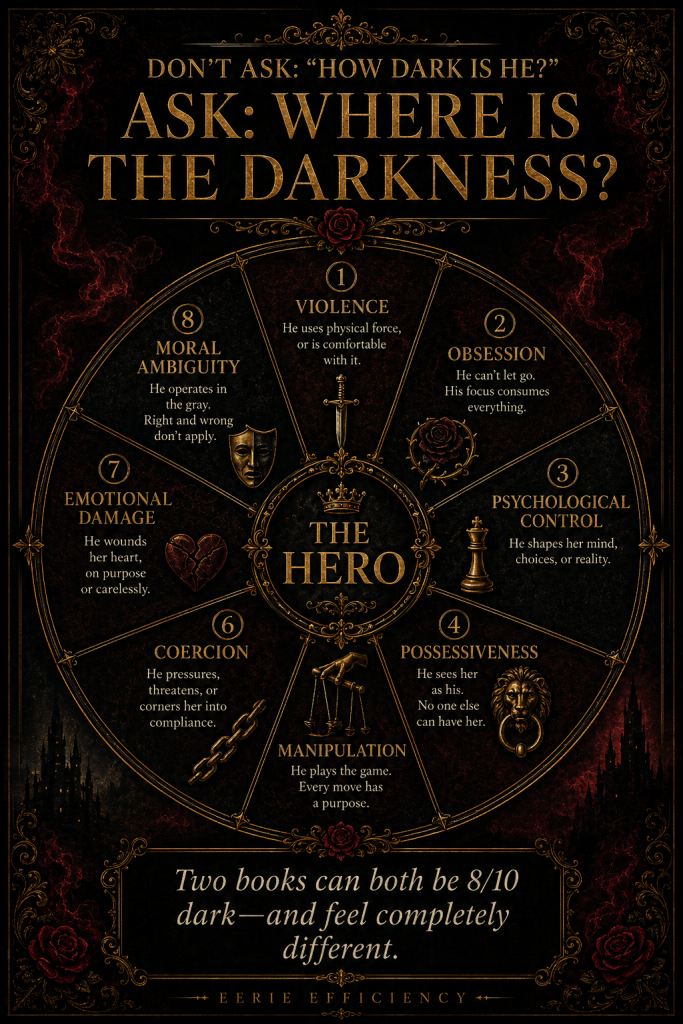
“How dark is it?” is therefore the wrong question.
Ask:
Where is the darkness located?
How These Books Are Rated
Spice is scored from 1–5. Darkness, obsession, psychological intensity, violence, emotional damage, trigger intensity, romance focus, and overall recommendation are scored from 1–10. Ratings reflect content intensity, not literary quality. Read our complete Dark Romance Rating Methodology for detailed definitions.
For this guide, I am also identifying what each MMC demonstrates best:
A = primarily alpha
MG = primarily morally gray
A/MG = strong overlap
8 Dark Romance Books That Show the Difference
These are not the same recycled ten titles that appear on every dark romance list.
Each earns its place because it demonstrates a different point on the alpha-to-morally-gray spectrum.
1. Hans — S.J. Tilly
Classification: A/MG — obsessive alpha + vigilante morality
Hans is one of the easiest examples of why “alpha” and “morally gray” should not be separated into neat boxes.
He is dangerous, violent and deeply controlling, but his characterization also revolves around a private moral framework. His book is officially described as a dark vigilante romance, and S.J. Tilly’s own content-warning page confirms graphic violence, death, stalking, breaking and entering, surveillance and human-trafficking themes.
Why readers love it
Hans gives readers the fantasy of the highly competent dangerous man whose obsession becomes focused on one woman.
His intensity feels active rather than theoretical. He watches. He intervenes. He acts.
What makes it different
Unlike the mafia rulers elsewhere on this list, Hans operates more like a shadow.
The power fantasy comes less from official authority and more from the fact that he is extraordinarily capable of doing things other people cannot.
Who should read it
Readers who want:
- stalker energy
- vigilante morality
- obsession
- high competence
- “dangerous to everyone else” energy
- an MMC who crosses legal and personal boundaries
Who should avoid it
Skip it if stalking, surveillance, invasion of privacy or graphic violence ruins the romantic fantasy for you.
EE Ratings
Spice: 4/5
Darkness: 7/10
Obsession: 10/10
Psychological Intensity: 7/10
Violence: 9/10
Emotional Damage: 6/10
Trigger Intensity: 8/10
Romance Focus: 8/10
Overall Recommendation: 9/10
Trigger Warnings: graphic violence, death, stalking, breaking and entering, surveillance, human-trafficking themes.
Best for readers who liked: obsessive stalker heroes but want the MMC’s darkness directed heavily outward rather than pure psychological cruelty toward the heroine.
My EE Verdict
Best example here of an MMC who is both alpha and morally gray without those two traits feeling identical.
His dominance is one part of the appeal.
His willingness to violate normal rules is another.
2. Silenced — Serena Akeroyd
Classification: A/MG — powerful criminal ruler with extreme possessiveness
Nikolai is a Russian Pakhan presented as Cassiopeia’s savior, captor and lover. Serena Akeroyd officially identifies the book as a modern Hades-and-Persephone retelling with Russian Bratva, captive heroine, breeding kink and “he falls first” elements. The author’s content-warning page lists graphic violence, dubious consent, references to past domestic violence, Stockholm syndrome and forced drugging of the FMC by someone other than the MMC.
Why readers love it
The appeal is enormous contrast:
a man feared by almost everyone versus the one woman around whom his behavior changes.
That “monster to the world, something completely different to her” setup is catnip for readers who want exaggerated dark-romance devotion.
What makes it different
Silenced pushes harder into captor-as-protector territory than most books here.
That creates a useful test for readers:
Does protection still feel romantic when the protector decides he should also control the conditions of your safety?
Who should read it
Readers wanting:
- Bratva romance
- Hades/Persephone energy
- extreme possessiveness
- forced proximity
- captive heroine dynamics
- strong power imbalance
Who should avoid it
Readers sensitive to dubious consent or captivity dynamics should approach carefully.
EE Ratings
Spice: 5/5
Darkness: 8/10
Obsession: 9/10
Psychological Intensity: 8/10
Violence: 9/10
Emotional Damage: 7/10
Trigger Intensity: 9/10
Romance Focus: 8/10
Overall Recommendation: 8/10
Trigger Warnings: graphic violence, dubious consent, past domestic violence references, Stockholm-syndrome themes, forced drugging of the heroine by a third party.
Best for readers who liked: captor/protector contradictions and heroes whose version of safety looks suspiciously like possession.
My EE Verdict
This is exactly the type of book that proves protective does not automatically mean morally good.
Sometimes the morally gray part is not whether he protects her.
It is whether she gets any say in how he does it.
3. Beautiful Beast — Neva Altaj
Classification: A/MG — powerful alpha with softer relationship darkness
Rafael’s setup is classic dark-mafia power: when hacker Vasilisa is brought before him, she ends up trapped into working for him to protect the people she loves. Publisher and bookseller descriptions frame him as deadly, possessive and unwilling to let her go, while the book functions as the first Mafia Legacy: Perfectly Imperfect novel.
Why readers love it
Because not every dark-romance reader wants the MMC to psychologically destroy the FMC.
Some want:
terrifying reputation + forced proximity + fixation + surprising tenderness.
Beautiful Beast sits nicely in that space.
What makes it different
Rafael demonstrates an important category I call the externally dark hero.
His criminal world and power make him dangerous.
But that does not mean every interaction with the heroine has to become an escalating psychological war.
Who should read it
Readers wanting:
- mafia
- Beauty-and-the-Beast flavor
- scarred hero
- hacker heroine
- forced proximity
- age gap
- possessiveness without maximum psychological brutality
Who should avoid it
If you need your dark romance to feel emotionally punishing from beginning to end, this may feel comparatively soft.
EE Ratings
Spice: 4/5
Darkness: 6/10
Obsession: 8/10
Psychological Intensity: 5/10
Violence: 7/10
Emotional Damage: 5/10
Trigger Intensity: 6/10
Romance Focus: 9/10
Overall Recommendation: 9/10
Trigger Warnings: kidnapping/confinement and violence are central to the premise; readers should consult current author or retailer content notes for complete warnings.
Best for readers who liked: powerful mafia heroes but prefer the relationship itself less punishing.
My EE Verdict
Best bridge book on this list for readers who love alpha heroes but are testing how much moral gray they actually enjoy.
4. Grieved Loss — Adelaide Forrest
Classification: MG/A — obsession first, alpha behavior second
Ryker has watched Calla from the shadows for years. After her husband dies, he gives her time to grieve before stepping fully into her life—and making it extremely clear he considers her and her children his.
The author’s official Bellandi Crime Syndicate page describes the series as featuring over-the-top antiheroes and lists abusive relationship history, physical abuse, off-page sexual abuse, forced proximity, forced marriage, explicit sexual content and graphic violence among its warnings.
Why readers love it
This one scratches a specific itch:
the hero who has mentally committed to the relationship long before the heroine realizes there is a relationship to commit to.
What makes it different
The family component changes the possessive fantasy.
Ryker isn’t simply claiming a woman.
He is envisioning an entire prebuilt life.
That can feel intensely romantic to one reader and horrifyingly presumptuous to another.
That division is exactly why it belongs here.
Who should read it
Readers wanting:
- long-term fixation
- stalking/watch-from-the-shadows energy
- single-mother heroine
- mafia antihero
- forced proximity
- aggressively possessive devotion
Who should avoid it
Skip if grief combined with possession feels uncomfortable, or if you dislike heroes who make enormous relational decisions without meaningful heroine input.
EE Ratings
Spice: 4/5
Darkness: 8/10
Obsession: 10/10
Psychological Intensity: 8/10
Violence: 8/10
Emotional Damage: 8/10
Trigger Intensity: 9/10
Romance Focus: 9/10
Overall Recommendation: 8/10
Trigger Warnings: abusive ex-husband, physical abuse, off-page sexual abuse, forced proximity, forced marriage, explicit sexual content, graphic violence.
Best for readers who liked: “he has already decided she’s his” heroes.
My EE Verdict
If you want to understand the difference between confidence and entitlement, read a hero like Ryker.
That boundary is where alpha behavior begins sliding hard into moral ambiguity.
5. Ruthless Enforcer — Lucy Monroe
Classification: A/MG — classic alpha framework with criminal morality
Lucy Monroe describes her Syndicate Rules world as featuring over-the-top alpha heroes across Italian, Greek and Irish organized crime. Ruthless Enforcer follows Lucia and Atlas, with the author’s site emphasizing the tension, emotion and obsession between them; published descriptions identify explicit intimacy, graphic violence and difficult past experiences among its content concerns.
Why readers love it
Atlas fits the classic fantasy of a man who is dangerous because he is capable, not because the narrative constantly needs to tell you how dangerous he is.
What makes it different
This is a useful example of the traditional alpha archetype transplanted into a morally compromised world.
His environment increases the darkness even when the underlying attraction still resembles classic alpha-romance appeal.
Who should read it
Readers wanting:
- mafia
- strong alpha presence
- obsession
- high spice
- external danger
- adults with lived experience
Who should avoid it
Readers who dislike organized-crime settings or graphic violence may not enjoy the surrounding world even if the romance works for them.
EE Ratings
Spice: 5/5
Darkness: 7/10
Obsession: 8/10
Psychological Intensity: 6/10
Violence: 8/10
Emotional Damage: 7/10
Trigger Intensity: 7/10
Romance Focus: 9/10
Overall Recommendation: 8/10
Trigger Warnings: explicit sexual content, graphic violence, past domestic violence, miscarriage backstory and complicated family dynamics.
Best for readers who liked: old-school alpha romance energy but want a darker mafia framework.
My EE Verdict
One of the most useful examples on this page because it demonstrates how setting can make an alpha hero appear morally darker than his relationship behavior alone would suggest.
6. Scarred Queen — Nikita Slater
Classification: MG/A leaning very dark
Scarred Queen is officially described as a dark mafia antihero romance in which Reyes intends to take Casey from her existing life and claim her amid a violent mafia world.
Why readers love it
There is very little “maybe I shouldn’t want her” hesitation.
The attraction comes from certainty taken to a disturbing extreme.
For readers who want their alpha heroes apologetically dominant, this is considerably darker territory.
What makes it different
This is where the distinction between alpha fantasy and coercive fantasy becomes especially important.
The hero’s certainty is not merely sexy confidence.
It has consequences for the heroine’s autonomy.
Who should read it
Readers who deliberately seek:
- extreme antiheroes
- mafia darkness
- possession
- coercive dynamics
- powerful men who do not behave like conventional romance heroes
Who should avoid it
Not a good starting point for readers whose idea of “alpha” is simply protective, confident and sexually dominant.
EE Ratings
Spice: 4/5
Darkness: 9/10
Obsession: 9/10
Psychological Intensity: 9/10
Violence: 8/10
Emotional Damage: 9/10
Trigger Intensity: 9/10
Romance Focus: 8/10
Overall Recommendation: 7/10
Trigger Warnings: coercive/controlling relationship dynamics, organized crime, violence and possession themes; check current author warnings before reading.
Best for readers who liked: antiheroes who genuinely behave like antiheroes rather than heroes wearing black suits.
My EE Verdict
This is the book I would use to test one question:
When you say you want an alpha hero, do you actually want dominance—or do you want a man willing to override normal morality entirely?
Those are very different fantasies.
7. Until Death — Nicole Blanchard
Classification: morally black/alpha rather than merely gray
Until Death follows Catriona and Aiden O’Connor, an Irish-mafia enforcer she marries in place of her sister. Nicole Blanchard’s own material calls Aiden ruthless, possessive and unhinged, while Google Books explicitly identifies the book with forced marriage, jealous/possessive behavior and a “morally black antihero.”
That makes it especially useful for this guide.
Why readers love it
Because sometimes the reader isn’t actually asking for gray.
They are asking for black with one emotional exception.
Aiden represents the hero whose romantic appeal comes partly from the fact that conventional morality simply is not his operating system.
What makes it different
He helps establish the far boundary of our spectrum.
Calling every hero morally gray eventually makes the term meaningless.
Some MMCs belong farther down the scale.
Who should read it
Readers wanting:
- Irish mafia
- forced marriage
- intensely possessive MMC
- “my wife” energy
- morally black antihero
- fast-moving danger
Who should avoid it
Readers looking specifically for ethical complexity where the hero remains genuinely torn between right and wrong may want a subtler MMC.
EE Ratings
Spice: 5/5
Darkness: 9/10
Obsession: 9/10
Psychological Intensity: 8/10
Violence: 9/10
Emotional Damage: 8/10
Trigger Intensity: 9/10
Romance Focus: 9/10
Overall Recommendation: 8/10
Trigger Warnings: forced-marriage themes, violence, controlling/possessive relationship behavior and disturbing dark-romance content; consult the book’s full current trigger-warning list before reading.
Best for readers who liked: heroes who have crossed from morally questionable into deliberately ruthless territory.
My EE Verdict
Best book here for understanding why “morally gray” should not become a catch-all label for every dark hero.
Some men are several shades past gray.
8. Scandalized — Kelly Kilburn
Classification: alpha/morally gray, but considerably more approachable
Scandalized follows mob princess Taryn and Liam, a powerful man who becomes determined to protect her when her defiance puts her in danger. Kelly Kilburn’s official page frames the story around organized crime, an arranged marriage threat, family power and Liam’s determination to save Taryn even when she does not want saving.
Why readers love it
Because “morally gray” does not have to mean maximum depravity.
Some readers want dangerous-world morality without feeling emotionally pulverized.
What makes it different
The heroine’s resistance to having her entire identity determined by other people gives the alpha dynamic more friction.
That matters.
A controlling MMC feels completely different when the heroine has strong ambitions that have nothing to do with him.
Who should read it
Readers wanting:
- mafia setting
- powerful families
- possessive/protective hero
- heroine fighting for autonomy
- college/new-adult environment
- an easier entry into morally gray romance
Who should avoid it
Readers searching specifically for the darkest psychological relationship on this list should start elsewhere.
EE Ratings
Spice: 4/5
Darkness: 5/10
Obsession: 7/10
Psychological Intensity: 6/10
Violence: 6/10
Emotional Damage: 6/10
Trigger Intensity: 6/10
Romance Focus: 9/10
Overall Recommendation: 8/10
Trigger Warnings: organized-crime violence, coercive family expectations and threats surrounding an arranged marriage; verify the current complete author content notes for additional warnings.
Best for readers who liked: dangerous men and mafia worlds but don’t necessarily want the relationship itself to feel brutal.
My EE Verdict
Best beginner option on this list.
It lets you test whether the attraction is the powerful man, the morally compromised world or both.
Alpha vs. Morally Gray Heroes: Darkness Ranking
From easiest entry point to most intense overall:
| Rank | Book | Darkness |
| 1 | Scandalized | 5/10 |
| 2 | Beautiful Beast | 6/10 |
| 3 | Hans | 7/10 |
| 4 | Ruthless Enforcer | 7/10 |
| 5 | Silenced | 8/10 |
| 6 | Grieved Loss | 8/10 |
| 7 | Scarred Queen | 9/10 |
| 8 | Until Death | 9/10 |
But remember:
darkest does not automatically mean best.
If the specific darkness that bothers you is stalking, Hans could hit harder than the number suggests.
If control over heroine autonomy is your biggest trigger, Grieved Loss may feel more intense than a more violent book.
The score tells you intensity.
The trigger profile tells you where that intensity comes from.
Spice Ranking
| Book | Spice |
| Silenced | 5/5 |
| Ruthless Enforcer | 5/5 |
| Until Death | 5/5 |
| Hans | 4/5 |
| Beautiful Beast | 4/5 |
| Grieved Loss | 4/5 |
| Scarred Queen | 4/5 |
| Scandalized | 4/5 |
Do not use spice as a substitute for darkness either.
A book can be extremely explicit and psychologically mild.
Another can contain fewer sex scenes while making you question every decision the characters make.
Reader Decision Guide
You want a classic dominant alpha hero
Start with:
You get the commanding archetype inside a darker mafia environment without making psychological manipulation the entire point.
You want alpha but not emotionally brutal
Start with:
This is the strongest bridge between powerful-male fantasy and darker moral territory.
You want obsessive stalker energy
Start with:
Especially if surveillance and dangerous devotion are part of the fantasy rather than automatic deal-breakers.
You want “he already decided she’s his”
Start with:
The obsession predates the relationship in a way that will either hit your exact trope preference or make you run.
You want captor/protector contradiction
Start with:
The central tension is essentially:
Can someone take away part of your freedom while sincerely believing he is the person keeping you safe?
You want an MMC darker than “morally gray”
Start with:
Particularly if the phrase morally black antihero sounds more appealing than frightening.
You want the mildest entry point
Start with:
A better option if you are transitioning from mainstream possessive heroes into darker territory.
Which Book Should You Start With?
If I were building a progression for someone trying to discover their actual dark-romance hero preference, I would read:
1. Scandalized
↓
2. Beautiful Beast
↓
3. Ruthless Enforcer
↓
4. Hans
↓
5. Silenced
↓
6. Grieved Loss
↓
7. Scarred Queen
↓
8. Until Death
That progression moves roughly from:
powerful man
to
dangerous man
to
obsessive man
to
man whose personal moral system has replaced society’s.
You may discover halfway through that you have found your limit.
That is useful information.
Dark romance is much easier to navigate once you know whether your personal line is violence, coercion, manipulation, stalking, captivity or something else entirely.
What to Read Next Based on the Dark Romance Hero You Love
If you loved a dominant hero but wished he were darker
Read Ruthless Enforcer.
If you loved possessiveness but don’t want maximum cruelty
Read Beautiful Beast.
If you loved stalker energy
Read Hans.
If you love “I’ve been watching you longer than you know”
Read Grieved Loss.
If your weakness is “dangerous man becomes her captor and protector”
Read Silenced.
If your complaint about morally gray heroes is “he wasn’t actually that bad”
Read Until Death.
That last category deserves more attention.
Dark-romance readers increasingly complain about books being marketed around supposedly dangerous heroes whose actual behavior never becomes particularly dark. Recent reader discussions have explicitly criticized books they felt were “vanilla” stories dressed in dark-romance marketing.
That does not mean lighter dark romance is bad.
It means expectations matter.
Books People Think Belong on an Alpha vs. Morally Gray List—but Don’t
Every rich controlling billionaire
Money does not create an alpha hero.
A man can be wealthy, arrogant and controlling while being emotionally insecure and largely reactive.
Power is not the same thing as alpha behavior.
Every mafia hero
Criminal occupation automatically creates ethical complications, but that alone does not guarantee sophisticated moral ambiguity.
Sometimes the mafia world is simply setting.
The hero may still operate with an extremely clear ethical code.
Every jealous hero
Jealousy describes an emotional reaction.
It does not automatically make a man alpha.
It certainly does not automatically make him morally gray.
If jealousy is what you’re actually searching for, read 25 Dark Romance Books With Jealous Possessive Heroes instead.
Every stalker
Stalking is morally problematic behavior.
But a character consisting of nothing except “he follows her” is not automatically a compelling morally gray hero.
The strongest gray characterization requires an actual internal philosophy.
Every villain
Villains and morally gray heroes overlap, but a true villain may operate beyond gray entirely.
The morally gray hero still gives the reader something to debate.
The villain may simply give you something to enjoy despite knowing better.
Common Misconceptions About Alpha and Morally Gray Heroes
“Alpha means toxic.”
No.
Alpha describes dominance.
Toxicity describes harmful relationship behavior.
They frequently coexist in dark romance because authors intentionally exaggerate power dynamics, but one does not require the other.
“Morally gray means secretly good.”
Definitely not.
A well-written morally gray hero does not need a secret puppy rescue to justify every murder.
Sometimes the whole appeal is that he loves selectively.
He may be extraordinarily good to five people and dangerous to everyone else.
“If he protects her, he’s a good guy.”
Protection can become control astonishingly quickly.
The more useful questions are:
Did she ask for protection?
Can she reject it?
What happens when she disagrees with him?
Those three questions reveal far more about a dark-romance relationship than “touch her and die.”
“The darker hero is automatically more obsessive.”
No.
Darkness and obsession are separate.
That is one reason the Eerie Efficiency methodology scores them separately.
A brutally violent mafia enforcer could have an Obsession score of 5/10.
A relatively nonviolent stalker could score 10/10.
“Morally gray heroes need tragic backstories.”
A tragic past can explain behavior.
It does not automatically make the characterization deeper.
One of my biggest issues with morally gray labeling is when trauma becomes a universal excuse:
He did horrible things, but something horrible happened to him.
That may create sympathy.
It does not erase agency.
The better question is whether his past helps the reader understand his moral system—not whether it absolves him.
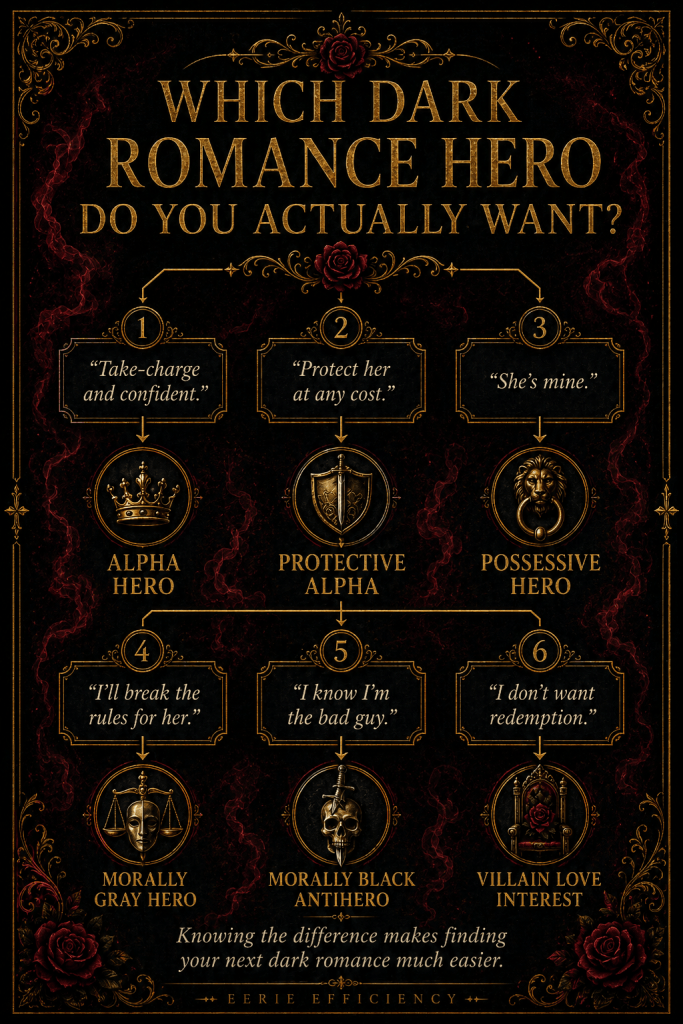
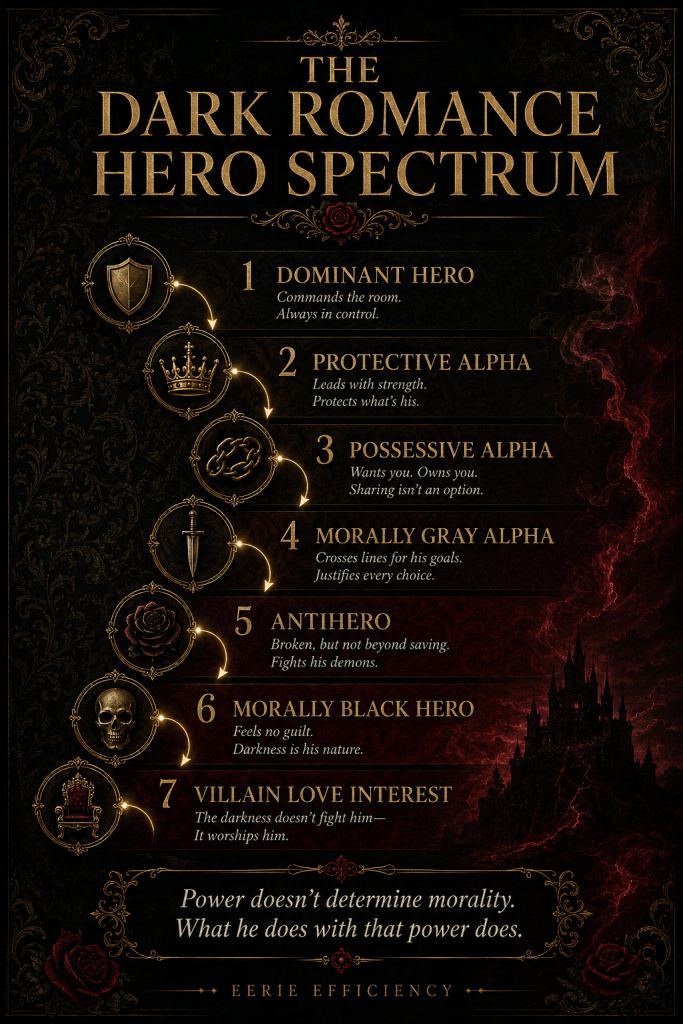
The Alpha-to-Morally-Black Spectrum
Think of dark romance heroes like this:
Dominant Hero
↓
Protective Alpha
↓
Possessive Alpha
↓
Morally Gray Alpha
↓
Antihero
↓
Morally Black Hero
↓
Villain Love Interest
These categories overlap.
The important thing is understanding what changes as you move down the spectrum:
- heroine autonomy may decrease
- manipulation may increase
- violence may become more personal
- consent may become more complicated
- obsession may override ethics
- remorse may decrease
That is much more useful than simply asking for “a red flag MMC.”
A Note on My Own Fiction
These distinctions also matter when I write obsessive heroes, because possessiveness alone is not enough to make a character interesting.
In He Was My Brother’s Best Friend First, the attraction is much closer to the alpha/possessive end of the spectrum: forbidden chemistry, escalating tension and a man whose emotional investment becomes increasingly difficult to hide.
In What Breaks You, the dynamic pushes farther into morally messy territory because power, age difference, obsession and emotional boundaries complicate the relationship itself.
I don’t think every dark-romance MMC needs to become the most depraved man ever put on paper.
What matters more is understanding exactly which boundary he crosses—and why the reader keeps turning pages after he crosses it.
That question is far more interesting to me than simply labeling him a red flag.
What I Look for in a Great Morally Gray Hero
A convincing morally gray MMC should have:
1. A recognizable personal code
Even if I disagree with it.
2. Consistency
His morality should not change conveniently whenever the plot needs him to appear romantic.
3. Consequences
Other characters should react realistically when he does terrible things.
4. Agency
A tragic childhood can explain him.
It should not completely excuse him.
5. Genuine moral tension
If every supposedly questionable action is eventually revealed to have been secretly heroic, he was never particularly gray.
6. A heroine who matters beyond redeeming him
She should have goals, limits and a personality independent of his darkness.
7. A relationship dynamic specific to them
“I hate everyone except her” can be fun.
But it is not enough by itself to build an unforgettable relationship.
What I Look for in a Great Alpha Hero
A convincing alpha MMC needs more than commands.
I want:
- competence
- decisiveness
- emotional certainty
- believable authority
- a reason people actually follow him
- vulnerability that does not erase his personality
- conflict when his need for control collides with the heroine’s agency
The weakest alpha heroes are simply loud.
The strongest rarely need to announce that they are in control.
Everyone else already knows.
FAQ: Alpha vs. Morally Gray Heroes
What is the difference between an alpha male and a morally gray hero?
An alpha hero is defined primarily by dominance, confidence and leadership behavior. A morally gray hero is defined by ethically questionable decisions or beliefs. A character can be one, both or neither.
Can an alpha hero be a good person?
Absolutely.
He can be dominant, protective, sexually commanding and highly assertive while maintaining strong ethical boundaries.
Can a morally gray hero be submissive?
Yes.
Morality and dominance are separate axes.
A character can make ethically questionable decisions without being socially or sexually dominant.
Are all dark romance heroes morally gray?
No.
Some are surprisingly ethical despite living in dark worlds.
Others are morally black.
Some are outright villains.
What is a morally black hero?
A morally black hero crosses beyond ambiguous ethics into behavior the narrative does not realistically frame as defensible. He may knowingly commit extreme harm, show very limited remorse or prioritize his own desires despite devastating consequences.
What is an antihero?
An antihero lacks traditional heroic qualities but remains central to the story and often becomes someone the audience roots for despite serious flaws.
An antihero may be morally gray or morally black.
Are possessive heroes automatically alpha?
No.
Possession describes attachment.
Alpha behavior describes dominance.
A needy, insecure or emotionally dependent hero can still be extremely possessive.
Why are morally gray heroes so popular in dark romance?
Because they create tension traditional heroic behavior cannot.
The reader is simultaneously evaluating the romance and judging the hero.
That contradiction creates powerful engagement:
I know this is wrong. Why do I understand him anyway?
What is the best book on this list for dark-romance beginners?
Scandalized or Beautiful Beast.
They offer dangerous men and morally compromised worlds without immediately beginning at the highest level of psychological intensity.
What is the darkest recommendation here?
Until Death and Scarred Queen sit at the darkest end of this particular list, though their darkness manifests differently.
Which recommendation has the strongest obsession?
Hans and Grieved Loss.
Both center on fixation that exists independently of a normal developing courtship.
Final Verdict: Alpha vs. Morally Gray Isn’t an Either/Or Question
The best way to classify a dark-romance hero is not:
Alpha or morally gray?
Ask two separate questions.
Question One:
How does he use power?
That tells you whether he is alpha, passive, dominant, controlling, protective or possessive.
Question Two:
What ethical boundaries will he cross?
That tells you whether he is heroic, morally gray, morally black or villainous.
Once you separate those questions, dark-romance recommendations get dramatically better.
You stop asking for “dangerous alpha men” and start knowing what you actually mean:
Give me a highly dominant hero who is ethically compromised but fiercely protective of the heroine.
Or:
Give me a morally gray manipulator who isn’t physically violent.
Or:
Give me a possessive alpha who feels dangerous without non-consent.
Or:
Forget gray. Give me the villain.
And that is when your TBR gets interesting.