| Disclosure: This post may contain affiliate links. As an Amazon Associate, I earn from qualifying purchases at no extra cost to you. |
Dark romance is supposed to make you nervous.
It explores attraction where attraction probably should not exist, devotion that crosses into obsession, and relationships built inside dangerous situations. The love interest may be a criminal, captor, stalker, manipulator, murderer, villain—or all five before breakfast.
But “dark” is not one universal level of darkness.
One reader may be perfectly comfortable with fictional murder but unable to read about pregnancy loss. Another may love obsessive stalkers but avoid cheating. Someone else may tolerate extreme violence yet want absolutely nothing to do with humiliation, animal harm, or addiction.
That is why trigger warnings matter.
A useful warning does not tell readers whether a book is morally acceptable. It gives them enough information to decide whether the experience is right for them.
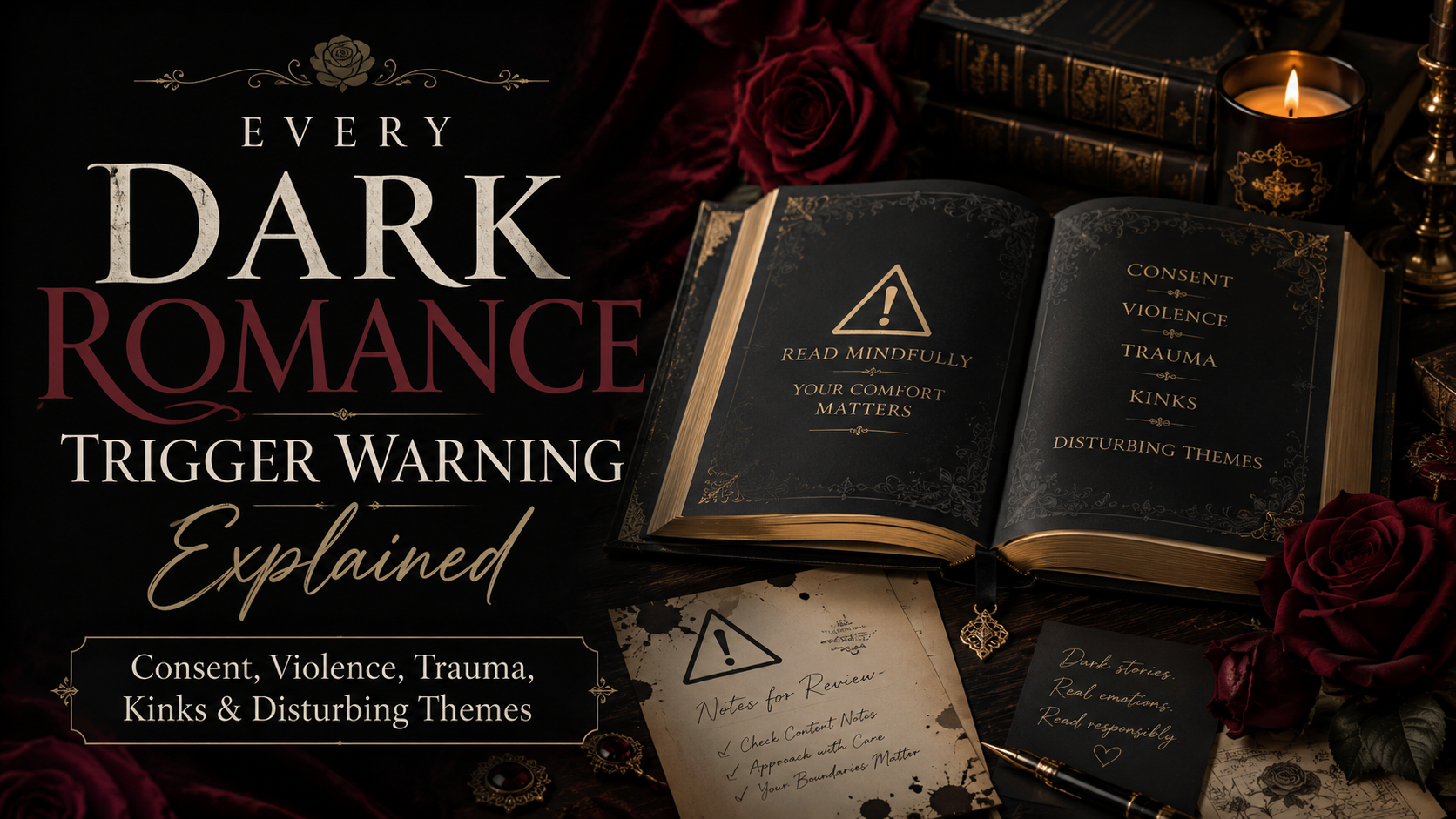
Content warnings can help readers avoid material they do not want to encounter, prepare themselves for difficult scenes, or choose a book based on the exact kind of darkness they enjoy. Authors and reading platforms use different labels—including trigger warnings, content warnings, content notes, and reader advisories—but the underlying purpose is usually the same: informed reading.
This guide explains the major trigger warnings found in dark romance, what each one actually means, how similar warnings differ, and which labels deserve a closer look before you start reading.
Important: Trigger lists vary between authors, publishers, retailers, and reader-generated databases. Always check the author’s current warning page when possible. A brief retailer description may not include every potentially upsetting element.

Quick Dark Romance Trigger Warning Cheat Sheet
| Warning | What It Usually Means |
|---|---|
| Dubious consent or dub-con | Consent exists, but it is compromised, pressured, unclear, or affected by unequal power |
| Non-consent or non-con | Sexual activity occurs without consent |
| CNC | Consensual non-consent; characters agree to role-play a non-consensual scenario |
| Sexual assault | Unwanted sexual contact, whether committed by the love interest or another character |
| Stalking | Repeated watching, following, tracking, surveillance, or unwanted contact |
| Kidnapping | A character is taken or transported against their will |
| Captivity | A character is prevented from leaving or kept under another person’s control |
| Coercion | Threats, pressure, leverage, or consequences are used to obtain compliance |
| Manipulation | A character controls another through deception, guilt, fear, or psychological influence |
| Domestic abuse | Physical, emotional, sexual, or financial abuse within an intimate relationship |
| Graphic violence | Detailed descriptions of injury, torture, blood, or death |
| Self-harm | Intentional injury inflicted on oneself |
| Suicide | Suicidal thoughts, attempts, discussion, or death by suicide |
| Pregnancy loss | Miscarriage, stillbirth, abortion, or other loss involving pregnancy |
| Reproductive coercion | Interference with contraception or pressure involving pregnancy |
| Substance abuse | Harmful or compulsive use of alcohol or drugs |
| Eating disorder | Restrictive eating, purging, bingeing, or related thoughts and behaviors |
| Grooming | Trust, dependence, or authority is cultivated to facilitate exploitation |
| Incest | Sexual or romantic involvement between biologically related family members |
| Pseudo-incest | Taboo family-adjacent dynamics without a biological relationship |
| Somnophilia | Sexual activity involving a sleeping or unconscious person |
| Breath play | Restricting or controlling breathing during sexual activity |
| Knife or gun play | Weapons are incorporated into sexual or erotic scenes |
| Degradation | Insults, humiliation, or demeaning treatment used sexually or emotionally |
| Breeding kink | Erotic focus on impregnation, pregnancy risk, or reproductive language |
| Human trafficking | People are bought, sold, transported, or exploited |
| Animal harm | Injury, neglect, cruelty, or death involving an animal |
| Child harm | Abuse, danger, illness, disappearance, or death involving a child |
Trigger Warning vs. Content Warning: Is There a Difference?
The terms are often used interchangeably, especially in romance communities.
A content warning describes potentially upsetting or sensitive material in a story. A trigger warning traditionally refers to material that could provoke a trauma response in some people. In everyday BookTok, Goodreads, StoryGraph, and dark-romance discussions, however, readers frequently use “trigger warning” as the umbrella term for both.
Some people prefer content note because not every warning represents a clinical trigger. A reader may avoid cheating because they hate the trope, not because it creates a trauma response. Another may actively seek books containing fictional stalking or violence.
The label matters less than the information.
A useful warning should be:
- Specific enough to help.
- Visible before the reader encounters the material.
- Clear about whether the content is mentioned, remembered, threatened, or shown on the page.
- Updated when new editions or bonus scenes add material.
- Free of unnecessary plot spoilers whenever possible.
Research into warning systems also shows that identifying triggering content is subjective and difficult to standardize, which helps explain why reader-generated databases sometimes disagree.
Consent-Related Trigger Warnings
Consent warnings are among the most important—and most misunderstood—labels in dark romance.
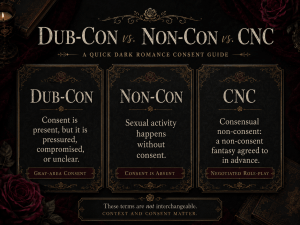
Dubious Consent or Dub-Con
Dubious consent means consent is present in some form, but the circumstances make its validity uncertain.
That uncertainty may involve:
- Intoxication.
- Fear.
- Blackmail.
- Unequal authority.
- Captivity.
- Financial dependence.
- Emotional pressure.
- A threat that is implied rather than spoken.
- A character saying yes because saying no feels unsafe.
- Consent that becomes unclear during the encounter.
Dub-con does not necessarily mean a character physically fights or verbally refuses. The central question is whether they were genuinely free to choose.
A scene can be erotically written and still qualify as dub-con.
Non-Consent or Non-Con
Non-con means sexual activity happens without consent.
It may involve verbal refusal, physical resistance, inability to consent, force, threats, restraint, or a situation in which consent was never requested.
A warning may apply when non-consensual activity occurs:
- Between the main couple.
- Between a protagonist and a former partner.
- As part of a character’s backstory.
- During captivity.
- Off-page but discussed.
- On-page and described in detail.
Readers who are comfortable with non-con between fictional main characters may still feel differently about assault committed by an outside villain. The context matters, so a simple “non-con” label does not always tell the entire story.
CNC: Consensual Non-Consent
CNC stands for consensual non-consent.
The characters agree—either explicitly or through an established relationship—to act out a fantasy that resembles force, resistance, kidnapping, or assault. The fictional scene may include pleading, chasing, restraint, or verbal refusal as part of the role-play.
The defining feature is prior consent.
CNC and non-con can look similar on the page, but they are not the same narrative situation. Readers who enjoy CNC may still avoid actual non-consent.
Sexual Assault
Sexual assault is a broader warning covering unwanted sexual contact.
It may include:
- Rape.
- Attempted rape.
- Unwanted touching.
- Forced kissing.
- Sexual coercion.
- Assault while unconscious.
- Assault involving intoxication.
- Assault occurring before the story begins.
- Memories or flashbacks involving assault.
A book may list both “sexual assault” and “non-con” because one refers to the subject generally while the other describes a particular scene between characters.
Attempted Sexual Assault
This warning means an assault is threatened or begins but is interrupted before it is completed.
Attempted assault can still be graphic, frightening, or emotionally intense. Readers should not assume “attempted” means mild.
Consent Under the Influence
A character participates in sexual activity while drunk, drugged, sedated, or otherwise impaired.
The warning may apply even when the character appears willing because intoxication can affect their ability to make an informed decision.
Forced Arousal or Forced Orgasm
A character’s body is stimulated without consent or beyond the point at which they want the activity to continue.
This warning is especially important because physical arousal is not the same as consent. A character’s involuntary bodily response does not mean they wanted what happened.
Virginity Loss Under Coercive Circumstances
This warning is sometimes listed separately when a character’s first sexual experience includes fear, pain, force, manipulation, an arranged relationship, or unclear consent.
Virginity itself is not a trigger. The surrounding loss of agency may be.
Power, Control, and Captivity Warnings
Dark romance often builds tension by placing one character under another character’s control.
Kidnapping or Abduction
Kidnapping means a character is taken or transported against their will.
The abductor may be:
- The romantic lead.
- A criminal organization.
- A family member.
- A trafficker.
- A rival.
- An outside villain from whom the love interest later provides protection.
Kidnapping does not automatically mean the character remains confined throughout the story. That is where captivity comes in.
Captivity or Imprisonment
Captivity means a character is prevented from leaving.
The character may be kept in:
- A locked room.
- A remote house.
- A compound.
- A criminal organization’s property.
- A basement or cell.
- A hospital or institution.
- A vehicle or ship.
- A supernatural realm.
Some captivity stories involve physical restraints. Others involve surveillance, threats, financial control, or the knowledge that escape would put someone else in danger.
Forced Proximity vs. Captivity
These are not interchangeable.
Forced proximity means circumstances keep characters together—such as a snowstorm, shared workplace, road trip, or single available bed.
Captivity means someone does not have the freedom to leave.
A book can contain both, but forced proximity by itself is not necessarily dark or abusive.
For more distinctions like this, read Every Dark Romance Trope Explained.
Coercion
Coercion means pressure, threats, leverage, or consequences are used to force compliance.
Examples include:
- “Marry me or your family loses everything.”
- “Sleep with me or I expose your secret.”
- “Stay here or someone you love gets hurt.”
- “Obey me and I will protect you.”
- “Do this because you owe me.”
Coercion can be sexual, emotional, financial, criminal, or social.
Blackmail
Blackmail is a specific form of coercion in which someone threatens to reveal information, release evidence, damage a reputation, or cause another consequence unless demands are met.
Forced Marriage
A character is pressured, threatened, sold, traded, politically obligated, or otherwise compelled to marry.
Forced marriage differs from a mutually accepted arranged marriage. In an arranged marriage, families may choose the match, but both participants can still agree. In a forced marriage, at least one person lacks a meaningful choice.
Explore the trope further in Dark Romance Books With Forced Marriage or Arranged Marriage.
Financial Abuse
One character controls another by restricting access to money, employment, property, transportation, housing, or basic necessities.
Financial abuse can appear in billionaire, mafia, marriage-of-convenience, captive, and domestic-abuse storylines.
Isolation
A character is deliberately separated from friends, family, coworkers, communication, or outside support.
Isolation may be physical—such as being taken to a remote location—or psychological, with the abuser convincing the character that nobody else can be trusted.
Surveillance and Tracking
A character is watched through cameras, GPS devices, hacked phones, hidden software, security systems, or hired investigators.
This warning often overlaps with stalking but may be listed separately when technology or privacy invasion plays a major role.
Obsession and Psychological Trigger Warnings
Stalking
Stalking involves repeated watching, following, tracking, appearing unexpectedly, entering private spaces, sending unwanted messages, or collecting information about someone without permission.
Dark-romance stalking may be framed as threatening, erotic, protective, or some combination of all three.
The term can cover a wide spectrum:
- Watching from a distance.
- Following someone home.
- Installing cameras.
- Breaking into a residence.
- Stealing personal belongings.
- Tracking a phone.
- Threatening romantic rivals.
- Manipulating events to create contact.
- Secretly controlling the target’s environment.
Because the severity varies, readers should check more detailed warnings rather than assuming every “stalker romance” contains the same behavior.
Obsessive or Possessive Behavior
Obsession means a character’s thoughts and actions become fixated on another person.
Possession may include jealousy, controlling clothing or friendships, claiming language, territorial behavior, surveillance, threats, or violence toward perceived rivals.
Obsession is often a desired dark-romance trope, but it can overlap with stalking, coercive control, emotional abuse, and isolation.
Manipulation
Manipulation involves influencing someone through deception, guilt, fear, affection, strategic vulnerability, or distorted information.
A manipulative love interest may:
- Manufacture a crisis.
- Pretend to be the only safe person.
- Hide important information.
- Turn the protagonist against loved ones.
- Reward obedience and punish independence.
- Create dependence.
- Lie about danger.
- Engineer “coincidental” meetings.
Gaslighting
Gaslighting is a sustained form of psychological manipulation designed to make someone doubt their memory, perception, judgment, or sanity.
Not every lie is gaslighting.
A character hiding their criminal identity is deceptive. A character repeatedly altering evidence and insisting the protagonist imagined events may be gaslighting them.
Psychological Abuse
Psychological abuse can include intimidation, threats, humiliation, isolation, gaslighting, emotional punishment, unpredictable rage, or deliberate destruction of a person’s confidence.
It may occur without physical violence.
Emotional Abuse
Emotional abuse includes sustained cruelty, degradation, manipulation, silent treatment, threats of abandonment, calculated jealousy, belittling, or using affection as a weapon.
Brainwashing or Psychological Conditioning
A character is systematically trained, broken down, reprogrammed, or conditioned to think and behave differently.
This may involve:
- Isolation.
- Sleep deprivation.
- Repetition.
- Rewards and punishments.
- Drugs.
- Sensory manipulation.
- Identity destruction.
- Forced dependence.
Stockholm Syndrome or Trauma Bonding
These labels are sometimes used loosely in fiction discussions.
A trauma bond generally refers to an intense attachment strengthened through repeated cycles of harm and relief, fear and affection, or punishment and reward.
“Stockholm syndrome” is frequently used in captor/captive stories to describe a captive developing feelings for a captor, although the term is controversial and often oversimplified.
A romance developing during captivity does not automatically prove either phenomenon. The label depends on how the relationship is portrayed.
Bullying
Bullying involves repeated cruelty, intimidation, exclusion, public humiliation, threats, harassment, or physical aggression.
Dark bully romance may range from cruel jokes and social sabotage to assault, sexual coercion, criminal behavior, and attempted murder. “Bully romance” alone does not reveal how far the behavior goes.
Humiliation and Degradation
Humiliation involves making a character feel ashamed, exposed, powerless, or embarrassed.
Degradation involves treating or describing the person as inferior, dirty, worthless, or less than human.
These elements may occur:
- Consensually during sex.
- Non-consensually as abuse.
- Publicly.
- Privately.
- Verbally.
- Through forced actions.
Readers comfortable with consensual degradation kink may still avoid non-consensual humiliation.
Violence, Crime, and Death Warnings
Graphic Violence
Graphic violence contains detailed descriptions of injuries, attacks, blood, wounds, or death.
A book labeled “violence” may contain brief fights. A book labeled “graphic violence” or “extreme violence” is more likely to linger on the physical details.
Gore
Gore emphasizes blood, exposed tissue, dismemberment, organs, decomposition, or severe bodily damage.
Gore is usually more visually descriptive than ordinary violence.
Murder
A murder warning means one or more intentional killings occur or are discussed.
The murderer may be:
- The love interest.
- The protagonist.
- A serial killer.
- A criminal rival.
- A family member.
- An outside antagonist.
The emotional impact changes depending on whether the victim is a stranger, villain, loved one, child, or animal, so additional warnings may be needed.
Serial Killers
A character has murdered multiple people in separate incidents.
Serial-killer romance may include crime-scene details, body disposal, trophies, hunting behavior, investigations, or murder described from the killer’s point of view.
Torture
Torture means severe physical or psychological pain is intentionally inflicted to punish, interrogate, control, terrorize, or obtain information.
Possible forms include:
- Beating.
- Cutting.
- Burning.
- Electrocution.
- Drowning.
- Sensory deprivation.
- Sleep deprivation.
- Threats against loved ones.
- Forced witnessing.
- Sexual torture.
Mutilation or Dismemberment
Mutilation involves severe or permanent damage to the body. Dismemberment specifically involves removal or separation of limbs or body parts.
Body Horror
Body horror focuses on disturbing changes to the human body, including mutation, infestation, transformation, decomposition, parasitic invasion, surgical alteration, or loss of bodily control.
It is especially common in horror romance and dark romantasy.
Gun Violence
Firearms are used to threaten, injure, or kill.
A separate gun-play warning may be used when a firearm appears in a sexual context.
Knife Violence
Knives are used in attacks, threats, torture, murder, or self-harm.
Knife play is different: it usually refers to erotic use, although the scene may still involve injury or compromised consent.
War, Combat, and Military Violence
The story contains warfare, battlefield injury, combat trauma, execution, imprisonment, forced enlistment, or civilian casualties.
Organized Crime
Mafia, cartel, gang, trafficking, assassination, extortion, racketeering, and criminal-family violence may fall under this warning.
Human Trafficking
People are recruited, transported, bought, sold, imprisoned, or exploited for labor or sex.
A trafficking warning may involve the protagonist directly or appear as part of a criminal investigation or rescue storyline.
Death of a Loved One
A partner, parent, sibling, friend, or other significant character dies.
This may happen before the story and shape the protagonist’s grief, or occur on the page.
Grief
A character experiences mourning, loss, survivor’s guilt, or prolonged emotional distress following a death or separation.
Suicide
This warning may include:
- Suicidal thoughts.
- Suicide attempts.
- Death by suicide.
- Discussion of a past suicide.
- Discovering a body.
- Threats of suicide used as manipulation.
“Suicide” is more specific than a general mental-health warning and should be treated separately.
Self-Harm
A character intentionally injures themselves.
The behavior may be shown, remembered, discussed, concealed, discovered by another character, or described in detail.
Abuse and Family-Trauma Warnings
Domestic Violence
Domestic violence involves abuse within a romantic, marital, cohabiting, or family relationship.
It may be physical, sexual, psychological, emotional, or financial.
The abusive person is not always the final love interest. A survivor may be escaping a former partner when the story begins.
Physical Abuse
A character is hit, kicked, restrained, burned, strangled, injured, or otherwise physically harmed.
Child Abuse
A child or minor experiences physical, emotional, sexual, or psychological abuse.
The abuse may happen on-page, appear in flashbacks, be disclosed later, or shape an adult character’s backstory.
Child Neglect
A caregiver fails to provide safety, supervision, food, medical care, affection, or other necessary support.
Parental Abuse
A parent or guardian abuses, controls, exploits, rejects, or terrorizes a child.
This warning may apply to adult protagonists remembering childhood experiences.
Sibling Abuse
A sibling engages in physical, emotional, sexual, or coercive abuse.
Incest
Incest refers to sexual or romantic activity between biologically related family members.
Warnings may distinguish between:
- On-page activity.
- Past abuse.
- Consensual adult relationships.
- Non-consensual abuse.
- References or implications.
- Side characters versus the central relationship.
Pseudo-Incest or Family-Adjacent Taboo
Pseudo-incest describes a taboo dynamic between characters who are not biologically related but occupy family-like roles.
Examples can include:
- Stepsiblings.
- Adoptive-family dynamics.
- Foster-family dynamics.
- A parent’s new spouse’s adult child.
- People raised together as family.
- Guardian or ward dynamics.
“Stepbrother romance” alone does not indicate biological incest, but some readers prefer to avoid both.
Grooming
Grooming is a pattern in which someone builds trust, dependence, secrecy, or emotional attachment to facilitate exploitation.
It can involve gifts, special attention, isolation, boundary testing, normalization of sexual behavior, or use of authority.
An age gap by itself is not automatically grooming. The warning becomes relevant when one character deliberately shapes or exploits the other’s vulnerability, particularly when the behavior begins while that person is underage.
Age-Gap Power Imbalance
Both characters may be adults, but differences in age, wealth, authority, experience, housing, employment, or emotional dependence create unequal power.
This warning is especially relevant for:
- Teacher/student.
- Boss/employee.
- Guardian/ward.
- Parent’s friend.
- Doctor/patient.
- Professor/student.
- Religious-leader relationships.
Religious Abuse or Religious Trauma
Religion, spiritual authority, guilt, shame, punishment, purity culture, conversion, excommunication, or fear of damnation is used to control or harm a character.
Religious trauma may exist even when no religious leader directly abuses the person.
Cults
The story contains a controlling ideological or religious group characterized by isolation, coercion, ritual, exploitation, enforced obedience, or punishment for leaving.
Reproductive and Pregnancy Trigger Warnings
Pregnancy-related warnings are deeply personal and should not be hidden beneath a generic “mature themes” label.
Pregnancy
Pregnancy is a significant part of the story.
Some readers actively seek pregnancy romance. Others avoid it entirely, so even a healthy pregnancy can be useful to flag.
Unplanned or Accidental Pregnancy
A pregnancy occurs without being intended by one or both characters.
Forced Pregnancy
A character is deliberately impregnated or compelled to continue a pregnancy without consent.
Reproductive Coercion
Someone interferes with another person’s reproductive choices.
This may include:
- Birth-control sabotage.
- Condom removal.
- Lying about fertility.
- Preventing access to contraception.
- Pressuring someone to become pregnant.
- Pressuring someone to end or continue a pregnancy.
Birth-Control Tampering
Contraception is secretly removed, damaged, replaced, withheld, or interfered with.
Breeding Kink
Breeding kink involves erotic language or fantasy centered on impregnation, pregnancy risk, fertility, or being “bred.”
It may be entirely consensual and may not result in pregnancy.
A breeding kink warning does not automatically mean reproductive coercion. The distinction depends on consent.
Miscarriage
A pregnancy ends spontaneously before viability.
The event may happen on-page, be remembered, or be part of a character’s history.
Stillbirth
A baby is delivered without signs of life later in pregnancy.
Infant Loss
A baby dies during birth, shortly afterward, or during infancy.
Abortion
The story includes abortion, discussion of abortion, pressure surrounding abortion, or conflict over the decision.
Infertility
A character experiences difficulty conceiving, a medical diagnosis, fertility treatment, grief, or relationship conflict related to fertility.
Difficult Pregnancy or Traumatic Birth
The story contains severe pregnancy complications, medical emergencies, near death, emergency surgery, or traumatic labor and delivery.
Mental Health Trigger Warnings
Depression
A character experiences persistent hopelessness, emptiness, withdrawal, loss of interest, exhaustion, or other depressive symptoms.
Anxiety and Panic Attacks
The story includes intense anxiety, panic episodes, physical fear responses, avoidance, or intrusive worry.
Post-Traumatic Stress
A character experiences flashbacks, nightmares, hypervigilance, avoidance, intrusive memories, or distress following trauma.
Dissociation
A character feels detached from their body, identity, emotions, memory, or surroundings.
Psychosis or Hallucinations
A character experiences hallucinations, delusions, paranoia, or impaired perception of reality.
Writers and reviewers sometimes use psychological terminology loosely, so readers may want to check whether the portrayal is clinical, supernatural, metaphorical, or intentionally unreliable.
Institutionalization
A character is admitted or committed to a psychiatric hospital, treatment center, institution, or asylum-like setting.
This may include forced treatment, restraint, medication, abuse of authority, or medical trauma.
Eating Disorders
The story contains anorexia, bulimia, binge eating, purging, compulsive exercise, severe restriction, body checking, or eating-disorder thoughts.
Body Dysmorphia and Body-Shaming
A character has a distorted or distressing perception of their appearance, or experiences ridicule, criticism, humiliation, or discrimination because of their body.
Substance-Related Warnings
Alcohol Use
Characters drink alcohol. This warning is most useful when drinking is frequent, central to the story, or associated with impaired consent.
Alcoholism
A character has a destructive or dependent relationship with alcohol.
Drug Use
Characters use illegal drugs, misuse medication, or consume fictional substances.
Drug Addiction
The story explores dependency, withdrawal, relapse, overdose, or harm caused by compulsive drug use.
Forced Drugging
A character is drugged without consent.
This may happen for kidnapping, assault, interrogation, control, medical experimentation, or memory loss.
Overdose
A character consumes a dangerous or fatal quantity of drugs or medication.
Recovery and Relapse
The story includes sobriety, treatment, withdrawal, relapse, or the emotional consequences of addiction recovery.
Sexual and Kink-Related Warnings
A kink warning does not automatically mean the scene is abusive. Many dark romances include consensual BDSM or fantasy play alongside genuinely non-consensual events.
Consent and context remain essential.
BDSM
BDSM is an umbrella term that may involve bondage, discipline, dominance, submission, sadism, or masochism.
A general BDSM label does not reveal the intensity, safety practices, or specific activities involved.
Bondage and Restraint
A character is tied, cuffed, pinned, chained, or otherwise physically restrained.
Restraint may be consensual, dubiously consensual, or forced.
Dominance and Submission
One character takes authority or control while another yields it.
This can be a consensual relationship structure, sexual dynamic, temporary scene, or abusive arrangement depending on the story.
Impact Play
Striking the body for erotic stimulation, including spanking, flogging, paddling, or caning.
Pain Play
Pain is incorporated into sexual activity.
Breath Play or Choking
Pressure is applied to the neck or breathing is restricted during sexual activity.
The wording varies between authors. Some list “choking,” while others use “breath play” or “asphyxiation play.”
Knife Play
A knife or blade is used erotically to create fear, sensation, restraint, marking, or injury.
Gun Play
A firearm is incorporated into an erotic scene.
This is distinct from ordinary gun violence, although a story may contain both.
Blood Play
Blood, bleeding, cutting, or wounds are incorporated into erotic activity.
Wax Play
Hot wax is dripped onto the body.
Somnophilia
Somnophilia involves sexual attraction to or activity with a sleeping or unconscious person.
It can be consensual when discussed and agreed upon beforehand, dubiously consensual when permission is unclear, or non-consensual when no consent exists.
Always check which version the story contains.
Free Use
Free use is a consensual arrangement in which a character agrees to be sexually available under defined circumstances.
A story may use the term even when boundaries are poorly communicated, so readers sensitive to consent ambiguity should check full warnings.
Exhibitionism
A character is aroused by being watched or exposed.
Voyeurism
A character watches someone undress or engage in sexual activity.
Voyeurism can be consensual or non-consensual.
Degradation Kink
Insults, objectification, humiliating language, or demeaning treatment are used erotically.
Praise Kink
Approval, compliments, affectionate commands, or verbal reinforcement are central to the sexual dynamic.
Praise kink is not inherently dark, but it may appear alongside possessiveness or authority.
Primal Play
Primal play emphasizes chasing, hunting, biting, wrestling, growling, capture, and instinctive predator/prey energy.
Consent may be established before the chase, or the story may blend primal play with dub-con or non-con.
Pet Play
A character takes on animal-like behaviors or a pet role within a sexual or power-exchange dynamic.
Humiliation Kink
Embarrassment, exposure, shame, or loss of dignity becomes part of the erotic experience.
Orgasm Control
One character decides when or whether another may orgasm.
This includes edging, denial, forced orgasm, or repeated stimulation.
Forced Orgasm
A character is stimulated until orgasm despite resistance or refusal.
It may occur consensually within CNC or BDSM, or non-consensually.
Anal Sex or Anal Play
The story includes anal penetration, stimulation, toys, or related sexual activity.
Group Sex
Sexual activity involves more than two participants.
Sharing
A romantic partner permits, encourages, directs, or watches another person engage sexually with the protagonist.
Double Penetration
Two forms of penetration occur simultaneously.
Fisting
A hand is inserted vaginally or anally.
Object Insertion
Objects not typically designed as sex toys are used for penetration or stimulation.
Lactation
Breast milk, milk production, or nursing is included in a sexual or nonsexual context.
Pregnancy Sex
Sexual content occurs during pregnancy, sometimes with breeding or body-change themes.
Relationship and Betrayal Warnings
Cheating
A character engages in romantic or sexual activity outside an agreed-upon monogamous relationship.
Readers often differ over what counts as cheating, especially during separation, forced relationships, or unclear exclusivity. Check reviews when this is a hard limit.
Other-Woman or Other-Man Drama
A rival, former partner, admirer, spouse, or third party threatens the central relationship.
This does not always mean cheating occurs.
Love Triangle
A character has meaningful romantic or sexual tension with two people.
Polyamory or Why Choose
The central relationship involves multiple consenting partners.
Polyamory itself is not a trigger, but readers may want advance notice about relationship structure.
Betrayal
One character seriously deceives, abandons, exposes, frames, exploits, or harms another.
Forced Separation
Characters are kept apart through family interference, imprisonment, blackmail, misunderstanding, danger, or external obligation.
Toxic Relationship
The central relationship contains destructive patterns such as manipulation, cruelty, obsession, codependence, jealousy, abuse, or repeated betrayal.
“Toxic” is subjective, so more specific warnings are always better.
Codependency
Characters rely on each other in an unhealthy or identity-consuming way, often enabling destructive behavior or feeling unable to function independently.
Social and Identity-Based Warnings
Racism
The story includes racial slurs, discrimination, racial violence, systemic racism, or racist beliefs.
Homophobia or Transphobia
Characters experience slurs, rejection, discrimination, threats, violence, or internalized shame related to sexual orientation or gender identity.
Misogyny
The story contains hatred, degradation, discrimination, or violence directed toward women.
Ableism
A disabled, chronically ill, neurodivergent, or mentally ill character experiences discrimination, dehumanization, ridicule, or harmful stereotypes.
Classism
A character is demeaned or exploited because of poverty, employment, social status, or family background.
Slut-Shaming
A character is insulted, punished, humiliated, or socially targeted because of real or perceived sexual behavior.
Fatphobia
The story includes body-based discrimination, insults, humiliation, or harmful treatment directed at a fat character.
Other Common Warnings Readers Frequently Miss
Animal Harm or Animal Death
An animal is injured, abused, neglected, threatened, or killed.
For many readers, this is a harder limit than violence involving human characters and deserves its own warning.
Child Harm or Child Death
A child is endangered, kidnapped, abused, severely injured, or killed.
The harm may occur off-page and still be emotionally intense.
Medical Trauma
The story includes invasive procedures, hospitalization, medical restraint, reproductive care, emergency treatment, needles, surgery, malpractice, or fear associated with healthcare.
Car Accident
A serious crash occurs or is remembered.
Fire
Characters experience a house fire, arson, burns, smoke inhalation, or loss of property through fire.
Drowning
A character nearly drowns, is deliberately submerged, dies by drowning, or experiences water-related trauma.
Claustrophobia
A character is trapped in a small or enclosed space.
Buried Alive
A character is placed underground, sealed in a confined space, or threatened with live burial.
Home Invasion
Someone enters a residence without permission, often while the occupant is present.
Sleep Paralysis or Night Terrors
The story includes frightening sleep disturbances, inability to move, hallucination-like experiences, or recurring nightmares.
Cannibalism
Human flesh is consumed, threatened, prepared, or discussed.
Necrophilia
Sexual activity or attraction involving a corpse is depicted or referenced.
Desecration of Bodies
Corpses are mutilated, displayed, hidden, dismembered, or treated in disturbing ways.
“On-Page,” “Off-Page,” “Mentioned,” and “Graphic” Explained
The same warning can create radically different reading experiences depending on how the material appears.
On-Page
The event occurs during the story and is directly witnessed or described.
Off-Page
The event occurs outside the immediate scene. Readers learn about it afterward.
Mentioned
The subject is referenced but not dramatized.
Implied
The text strongly suggests the event without explicitly confirming or describing it.
Flashback
A past event is shown through memory, dream, or nonlinear narration.
Graphic
The writing includes detailed sensory or physical description.
Fade to Black
The scene begins or is clearly about to happen, but the narrative cuts away before explicit details.
A useful warning might say:
On-page kidnapping, graphic violence, past sexual assault discussed without flashbacks, and threatened animal harm with no animal death.
That is far more informative than simply writing “dark themes.”
Are Trigger Warnings Spoilers?
Sometimes—but they do not have to be.
A warning can disclose the type of content without revealing:
- Who experiences it.
- Who causes it.
- When it happens.
- Whether the character survives.
- How the conflict ends.
- Whether the central relationship is responsible.
Authors can also place detailed warnings behind a link, on a separate website page, or after a general advisory so readers can choose how much information they see.
Some readers prefer surprises. Others need information before committing their time and emotional energy. Neither reading style is wrong.
Where to Find Reliable Trigger Warnings
Check multiple sources when a warning is especially important to you.
1. The Author’s Website
The author’s official warning page is usually the best starting point. Many dark-romance authors maintain detailed lists that include consent dynamics, violence, sexual content, trauma, and danger involving children or animals.
2. The Book’s Front Matter
Look before the first chapter, after the copyright page, or immediately after the dedication.
3. The Retailer Description
Amazon and other retailers sometimes include content notes in the description, A+ content, or sample pages. Retailer warnings may be abbreviated.
4. The StoryGraph
The StoryGraph allows readers to submit content warnings and indicate whether they consider them minor, moderate, or graphic. Because these are community-generated, they can be helpful but are not always consistent.
5. Romance.io
Romance.io allows readers to filter or exclude books using topics and content labels, including dark themes and consent-related material.
6. Goodreads Reviews
Search reviews for phrases such as:
- Trigger warnings.
- Content warnings.
- Does the dog die?
- Cheating.
- Pregnancy.
- Non-con.
- On-page.
- Graphic.
- Third-act breakup.
7. Reader Communities
Book groups, Reddit communities, Facebook groups, and BookTok discussions can help answer highly specific questions. Remember that one reader may overlook something another considers important.
For additional beginner and advanced questions, visit the Dark Romance FAQ: 200+ Questions About Tropes, Triggers, Spice, and Morally Gray Love.
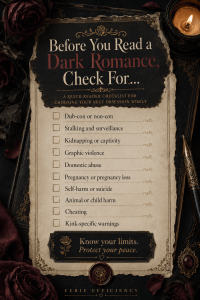
How to Build Your Personal Dark-Romance Limits List
You do not need to divide every subject into “safe” and “never.”
Try using four categories.
Green: I Enjoy This
These are elements you actively seek.
Examples:
- Stalking.
- Possessive behavior.
- Mafia violence.
- Villain romance.
- Captor/captive tension.
- Consensual primal play.
Yellow: It Depends on Context
You may read it when it is off-page, non-graphic, committed by a villain, or handled carefully.
Examples:
- Dub-con.
- Cheating.
- Pregnancy.
- Bullying.
- Addiction.
- Torture.
Red: I Do Not Want This
These are firm limits.
Examples:
- Animal death.
- Child harm.
- Incest.
- Non-con between the main couple.
- Pregnancy loss.
- Suicide.
Gray: Ask Me Again Later
Tolerance can change with mood, stress, personal experiences, and timing.
A warning that does not bother you today may be too much next month. You are allowed to stop reading even when you previously thought you could handle the content.
Make Your Next Dark-Romance Binge More Comfortable
Once you have checked the warnings and found a book that fits your personal limits, the only thing left to do is get comfortable—and prepare to lose several hours to “just one more chapter.”
A remote Kindle page turner is one of those reading accessories that can seem unnecessary until you use one. Clip the receiver to your Kindle or compatible touchscreen e-reader, place the device on a stand, and turn pages with the handheld remote instead of repeatedly reaching out from under your blanket.
It is especially convenient for reading in bed, using a treadmill, managing hand or wrist discomfort, or settling in for a long dark-romance binge.
Sponsored affiliate link: I may earn a commission if you purchase through this link, at no additional cost to you.
Dark Does Not Always Mean the Same Thing
A book may be dark because of:
- The romantic relationship.
- The outside world.
- A character’s past.
- Graphic violence.
- Psychological manipulation.
- Taboo sexual content.
- Grief and trauma.
- Horror elements.
- Criminal activity.
- Moral ambiguity.
This distinction matters.
A serial-killer romance may contain graphic murder but a surprisingly affectionate central relationship. A billionaire romance may contain little physical violence but extensive coercive control. A captive romance may be emotionally brutal without gore. A dark romantasy may contain war, slavery, and body horror while keeping the sexual relationship consensual.
Spice level does not measure darkness.
A book can be extremely explicit and emotionally safe, or nearly closed-door and deeply disturbing.
For a broader breakdown of the genre, read 15 Dark Romance Subgenres and Sub-Niches Explained.
Read My Free Slow-Burn Dark Romance
Prefer obsession that develops slowly instead of immediate extreme darkness?
My free ongoing fiction follows Jim and Amelia through forbidden attraction, an age-gap power imbalance, emotional conflict, secrecy, and the kind of tension that keeps getting harder to ignore.
The story is intended for adult readers and becomes more intense as the relationship develops.
Start reading the free forbidden age-gap dark romance here.

Frequently Asked Questions About Dark Romance Trigger Warnings
What are the most common dark romance trigger warnings?
Common warnings include stalking, kidnapping, captivity, coercion, manipulation, violence, murder, sexual assault, dub-con, non-con, abusive relationships, trauma, pregnancy, addiction, self-harm, and death.
What is the difference between dub-con and non-con?
Dub-con involves consent that is unclear, pressured, impaired, or compromised. Non-con involves sexual activity without consent.
Is CNC the same as non-con?
No. CNC is consensual non-consent: characters agree to role-play a non-consensual scenario. Non-con occurs without consent.
Is stalking always considered a trigger in dark romance?
It should be disclosed when it plays a significant role, but some authors classify it as a trope rather than a trigger. Readers with a firm limit should still check detailed warnings.
Does “dark themes” count as an adequate warning?
Not really. The phrase is too broad to tell readers whether a book contains stalking, assault, pregnancy loss, animal harm, suicide, or graphic torture.
Does a trigger warning mean the author approves of the behavior?
No. A content warning identifies what appears in the story. It does not state that the author, publisher, or reader approves of it.
Can I enjoy a fictional trigger and still oppose it in real life?
Yes. Fictional interests do not automatically reflect real-world desires, beliefs, boundaries, or moral approval.
Why do some readers actively search by trigger warning?
In dark romance, warnings can function as both boundaries and discovery tools. A reader may avoid pregnancy but actively seek stalking, captivity, knife play, or possessive behavior.
Are trigger warnings always accurate?
No. Lists may be incomplete, subjective, outdated, or submitted by readers who interpreted scenes differently. Check more than one source when a subject is a firm limit.
Should authors warn for cheating?
Many readers consider cheating a hard limit, so including it is useful even when it is not conventionally viewed as traumatic content.
Should animal death be listed separately from violence?
Yes. Many readers tolerate human violence but will not read animal harm or death.
Does an age gap automatically require a grooming warning?
No. An age gap between consenting adults is not automatically grooming. Grooming involves a deliberate pattern of cultivating trust or dependence for exploitation.
Is bully romance the same as abuse?
Not always, but it can overlap. Some bully romances involve social cruelty and insults; others include coercion, assault, stalking, sexual humiliation, or severe physical violence.
Can a book have a happy ending and still contain extreme triggers?
Yes. A happily-ever-after describes the ultimate romantic outcome, not the safety or morality of everything that happens before it.
Is dark romance appropriate for minors?
Dark romance is generally written and marketed for adults because it may contain explicit sexual content, violence, coercion, abuse, trauma, and mature relationship dynamics.
What should I do when I encounter an unexpected trigger?
Stop, skip the scene, read a plot summary, ask another reader what happens, or set the book aside. Finishing a book is not an obligation.
Final Thoughts: You Are Allowed to Choose Your Own Darkness
Trigger warnings are not a test of whether someone is “tough enough” for dark romance.
They are tools.
They allow one reader to avoid a painful subject while helping another locate the exact fictional danger they enjoy. They make it possible to distinguish consensual fantasy from assault, possessiveness from coercive control, forced proximity from captivity, and dark sexual play from abuse.
You do not need to defend the darkness you enjoy.
You also do not need to tolerate every disturbing subject just because you read dark romance.
Check the warnings. Know your limits. Change those limits whenever you need to.
Then choose the story that gives you the danger, obsession, emotional destruction, or morally questionable devotion you came for—without stumbling into the one thing you never wanted to read.
Continue Exploring Dark Romance
- Every Dark Romance Trope Explained
- Dark Romance FAQ: 200+ Reader Questions Answered
- Captive Romance Books That Are Dark, Addictive, and Intense
- Dark Romance Books With Forced Marriage or Arranged Marriage
- Dark Romance Books With Antiheroes Who Are Dangerous but Irresistible
- Read My Free Dark Romance Fiction


3 Responses