Some dark romance books are controversial because they are violent. Others are controversial because the hero is obsessive, the sex is extreme, or the relationship would be indefensible outside fiction.
The books that create the biggest arguments, though, usually do something more uncomfortable: they make the reader question where fantasy ends, where coercion begins, whether redemption is even possible, and whether wanting the couple together means forgiving things that should never be forgiven.
That distinction matters.
A book can have murder, stalking, BDSM, and a body count and still feel relatively comfortable because the romance gives the reader a clear emotional safety net. Another book can contain less physical violence yet feel infinitely more disturbing because the heroine’s autonomy is steadily dismantled.
That is what this list measures.
These are not simply dark romance books with impressive trigger-warning lists. They are books whose central romantic dynamics are themselves controversial.
Some readers consider them unforgettable.
Some consider them irredeemable.
Some finish them and immediately need to discuss what they just read.
And several are books I would never recommend to someone merely because they enjoyed a possessive hero in a mainstream dark romance.
How these books are rated: Spice is scored from 1–5. Darkness, obsession, psychological intensity, violence, emotional damage, trigger intensity, romance focus, and overall recommendation are scored from 1–10. Ratings reflect content intensity, not literary quality. Read our complete Dark Romance Rating Methodology for detailed definitions.
If you are still figuring out where your personal limits are, read the complete Eerie Efficiency guide to dark romance trigger warnings before choosing from the upper end of this list.
Quick Answer: What Are the Most Controversial Dark Romance Books?
The books on this list are controversial for very different reasons.
| BookMain Source of ControversyDarknessTrigger IntensityBest Starting Point? | ||||
|---|---|---|---|---|
| Enslaved | Systemic sexual exploitation and extreme abuse | 10/10 | 10/10 | No |
| Her Master’s Courtesan | Captivity, conditioning, and deliberate dehumanization | 10/10 | 10/10 | No |
| Quintessentially Q | Brutality, captivity, trauma, and destructive desire | 10/10 | 10/10 | No — Book 2 |
| Seduced in the Dark | Captor/captive romance and compromised consent | 10/10 | 10/10 | No — Book 2 |
| Screaming in the Silence | Kidnapping, rape, and emotional attachment to a captor | 9/10 | 10/10 | Only for experienced readers |
| The Darker Side of Trey Grey | Sexual exploitation, trauma, and M/M abuse themes | 9/10 | 10/10 | Only for experienced readers |
| Abduction | A sexual fantasy becoming actual captivity | 9/10 | 10/10 | No |
| Big Sky | Captivity, bodily autonomy, humiliation, and extreme kink | 9/10 | 9/10 | Maybe |
| Beneath the Burn | Captivity, violence, trauma, and BDSM | 9/10 | 10/10 | Maybe |
| Mr. X | Violent antihero romance and revenge | 9/10 | 9/10 | Yes, for dark-romance regulars |
| Empathy | Romance involving a killer and psychological manipulation | 8/10 | 9/10 | Yes |
| Destroyed | Dangerous attraction, trauma, violence, and destructive intimacy | 8/10 | 9/10 | Yes |
EE verdict: If you have only read polished, possessive-hero dark romance, do not start at the top of this table. Darkness is not a ladder where finishing a 7/10 means you will automatically enjoy a 10/10. Some of these books cross entirely different boundaries.
For a broader selection before getting this extreme, start with the Best Dark Romance Books of All Time.
What Actually Makes a Dark Romance Book Controversial?
A useful controversial-dark-romance list cannot simply sort books by body count.
At Eerie Efficiency, I separate darkness from trigger intensity and psychological intensity because they answer different questions.
A violent mafia romance may rate 8/10 for violence but only 5/10 psychologically if the central couple feels secure.
A captivity romance may contain fewer murders and still score 10/10 psychologically because the heroine’s perception of freedom, consent, safety, and attachment is being manipulated.
The most divisive books usually contain at least one of these:
- consent that is intentionally compromised rather than merely “rough”
- captivity or forced dependency
- sexual violence committed by or closely connected to a romantic lead
- psychological conditioning
- extreme power imbalance
- humiliation or degradation
- bodily autonomy violations
- heroes the narrative does not neatly rehabilitate
- relationships that force the reader to distinguish fantasy from moral approval
- endings that do not erase what happened earlier
That last point is where many recommendation lists fail.
A hero becoming affectionate in the final third does not retroactively lower the darkness of what happened in the first two-thirds.
Eerie Efficiency ratings do not give redemption arcs a discount.
1. Enslaved by Marissa Honeycutt
Enslaved is the first part of The Life of Anna, and this is one of those books where “check the trigger warnings” is inadequate advice.
The available content-warning data includes graphic physical abuse, rape, sexual assault, sexual violence, slavery, torture, violence, murder, and forced institutionalization. The author’s series is explicitly marketed as dark romance.
Why It Belongs on a List of the Most Controversial Dark Romance Books
Because the darkness is not an obstacle surrounding the romance.
It is built into the heroine’s world.
That creates a radically different reading experience from a romance where a dangerous man protects the heroine from even worse men. Enslaved offers far less emotional distance between the romantic framework and the abuse.
That difference is enormous.
Why Readers Love It
Readers who respond to it tend to become absorbed by the scale of Anna’s ordeal, the long-form emotional arc, and the sheer extremity of the world Honeycutt constructs.
It is not a quick “bad man kidnaps woman, feelings happen” premise.
It is sustained psychological pressure.
What Makes It Different From Every Other Recommendation Here
Scale.
Several books on this list trap a heroine with one dangerous person.
Enslaved makes the larger system feel dangerous.
That is substantially more oppressive.
EE Personal Verdict
This is where my rating system becomes especially useful.
A book can score high in darkness because terrible events occur.
Enslaved scores high across darkness, psychological intensity, emotional damage, violence, and trigger intensity simultaneously.
That combination matters more than any single trigger.
This is not the book I would hand someone who says, “I think I’m ready to try something really dark.”
It is a book for someone who already knows exactly what “really dark” means to them.
Who Should Read It
Readers who deliberately seek extreme captivity narratives, sustained psychological trauma, and books that do not soften their subject matter.
Who Should Avoid It
Readers who need meaningful consent between romantic partners, dislike prolonged victimization, or primarily read dark romance for possessiveness and protective obsession.
Eerie Efficiency Ratings
Spice: 5/5
Darkness: 10/10
Obsession: 9/10
Psychological Intensity: 10/10
Violence: 10/10
Emotional Damage: 10/10
Trigger Intensity: 10/10
Romance Focus: 6/10
Overall Recommendation: 8/10
Trigger Warnings: Sexual violence, rape, physical abuse, slavery/exploitation, torture, violence, murder, coercion, psychological abuse, forced institutionalization.
Best for readers who liked: Extremely bleak captivity fiction where survival and emotional attachment become inseparable.
2. Her Master’s Courtesan by Lily White
If your preferred dark hero eventually reveals that he is secretly a marshmallow, this is probably the wrong book.
Her Master’s Courtesan is categorized as dark erotica/dark romance, and its premise revolves around a man who captures women, breaks them down psychologically, and rebuilds them for submission. Contemporary discussion of the book repeatedly emphasizes how deliberately disturbing that process is.
Why Readers Love It
Because Lily White does not pretend the premise is gentler than it is.
There is a particular audience for dark fiction that becomes frustrated when an allegedly terrifying hero kidnaps someone and becomes a considerate boyfriend fifty pages later.
That is not the appeal here.
Why It Is So Controversial
The disturbing element is conditioning.
Captivity is frightening.
Watching someone’s autonomy be systematically dismantled is psychologically different.
The book confronts readers with a dynamic that can feel closer to erotic psychological horror than conventional romance.
What Makes It Different
The book does not rely on the heroine simply being attracted to a dangerous man.
The power imbalance itself becomes central to the experience.
EE Personal Verdict
This is one of the clearest examples of why I separate Romance Focus from Overall Recommendation.
A book can be compelling within dark erotic fiction without delivering the emotional reassurance many romance readers expect.
That is exactly why putting every “dark book with sex” on one scale makes recommendation lists nearly useless.
Who Should Read It
Readers specifically looking for psychological conditioning, captivity, extreme dominance, and stories willing to make the romantic framework uncomfortable.
Who Should Avoid It
Anyone looking for a secretly protective captor, a consent-forward BDSM relationship, or an emotionally safe introduction to dark romance.
Eerie Efficiency Ratings
Spice: 5/5
Darkness: 10/10
Obsession: 10/10
Psychological Intensity: 10/10
Violence: 9/10
Emotional Damage: 10/10
Trigger Intensity: 10/10
Romance Focus: 4/10
Overall Recommendation: 8/10
Trigger Warnings: Kidnapping, captivity, coercion, sexual violence, psychological conditioning, degradation, dehumanization, BDSM, physical abuse.
Best for readers who liked: Captor fiction where psychological domination is more important than romantic comfort.
3. Quintessentially Q by Pepper Winters
Quintessentially Q is Book 2 of the Monsters in the Dark series. Pepper Winters identifies the series with captive romance, BDSM, explicit content, non-consent, dubious consent, enemies-to-lovers elements, and an aggressive alpha hero. The second book is also repeatedly described by readers as considerably more intense than the opening installment.
Reading Order Warning
Do not start here.
This is Book 2, and much of its emotional impact depends on the relationship and trauma established earlier.
That matters on a controversial-books list because dropping readers directly into the “darkest installment” just to maximize shock is bad recommendation practice.
Why Readers Love It
The intensity.
This is the kind of book readers describe in physical terms: exhausting, devastating, consuming.
The romance is not operating separately from the psychological damage.
They collide.
What Makes It Different
The most interesting tension is that the relationship includes desires the characters themselves struggle to understand while external brutality pushes the story beyond consensual darkness.
It therefore creates more than one kind of discomfort.
EE Personal Verdict
This scores a full 10 for darkness, but what stands out more to me is the 10/10 emotional damage.
Some extremely violent books are surprisingly easy to emotionally compartmentalize.
This one is not.
Who Should Read It
Experienced readers who want emotional devastation alongside extreme darkness.
Who Should Avoid It
Anyone trying dark romance for the first time, readers sensitive to captivity or sexual violence, and readers who need a clean separation between consensual kink and traumatic violence.
Eerie Efficiency Ratings
Spice: 5/5
Darkness: 10/10
Obsession: 9/10
Psychological Intensity: 10/10
Violence: 10/10
Emotional Damage: 10/10
Trigger Intensity: 10/10
Romance Focus: 8/10
Overall Recommendation: 9/10
Trigger Warnings: Captivity, abduction, non-consent/dubious consent, sexual violence, physical violence, BDSM, trauma, psychological abuse.
Best for readers who liked: Dark romance where the relationship is intensely erotic but the surrounding story is emotionally brutal.
4. Seduced in the Dark by C.J. Roberts
Published in 2012, Seduced in the Dark is the second book in The Dark Duet and is categorized as dark romance, BDSM, erotica, and abuse fiction.
Again: this is Book 2. Do not read it first.
Why It Is Still Controversial
Because captor/captive romance creates a problem that a simple “morally gray hero” label does not capture.
What does romantic choice mean when a relationship begins inside deprivation of freedom?
That question follows the story even when feelings become emotionally complicated.
Why Readers Love It
The psychological entanglement.
Readers who love the duet rarely love it because Caleb behaves like an ideal romantic hero.
They love the emotional contradiction.
What Makes It Different
The book asks readers to remain emotionally invested after lines have already been crossed.
That is much harder than introducing a dangerous hero and gradually revealing that he never intended real harm.
EE Personal Verdict
This is an important dividing line in dark romance.
If your enjoyment requires eventually being able to say, “Okay, but he would never actually hurt her,” this entire kind of captor romance may not work for you.
And knowing that before purchasing the book is infinitely more useful than being told that the hero is merely “possessive.”
Who Should Read It
Readers fascinated by captivity, compromised consent, attachment under extreme circumstances, and morally unresolved romantic dynamics.
Who Should Avoid It
Readers who need the romantic hero to remain separate from the heroine’s victimization.
Eerie Efficiency Ratings
Spice: 5/5
Darkness: 10/10
Obsession: 9/10
Psychological Intensity: 10/10
Violence: 9/10
Emotional Damage: 10/10
Trigger Intensity: 10/10
Romance Focus: 8/10
Overall Recommendation: 9/10
Trigger Warnings: Kidnapping, captivity, abuse, sexual violence, coercion, non-consent/dubious consent, trafficking themes, psychological manipulation, violence.
Best for readers who liked: Captor/captive romance where the moral problem is never conveniently erased.
For more on how captivity differs from ordinary possessiveness, the complete dark romance trope guide breaks down the difference between obsession, stalking, kidnapping, coercion, forced proximity, and related tropes.
5. Screaming in the Silence by Lydia Kelly
The publisher description does not hide the premise.
Raleigh is kidnapped after being struck by a car, held by multiple men, sexually assaulted, and develops complicated feelings toward one of her captors.
That alone explains why this remains such a divisive book.
Why Readers Love It
Because it creates emotional conflict that readers cannot easily categorize.
You may understand why Raleigh becomes attached.
You may desperately want her safe.
You may find yourself reacting emotionally to the relationship and then questioning that reaction.
That discomfort is the point.
What Makes It Different
This is one of the most literal examples on this list of a romance forcing the reader to confront the difference between emotional attachment and free choice.
EE Personal Verdict
The element that pushes this toward 10/10 trigger intensity is not merely that sexual violence happens.
It is that the romantic question exists inside the aftermath of that violence.
That makes it far more psychologically confronting than books where the sexual violence is committed only by an external villain.
Who Should Read It
Readers specifically interested in morally disturbing captor attachment narratives.
Who Should Avoid It
Anyone sensitive to rape, kidnapping, captivity, trauma bonding, or romantic narratives involving an abuser/captor.
Eerie Efficiency Ratings
Spice: 4/5
Darkness: 9/10
Obsession: 7/10
Psychological Intensity: 10/10
Violence: 9/10
Emotional Damage: 10/10
Trigger Intensity: 10/10
Romance Focus: 6/10
Overall Recommendation: 8/10
Trigger Warnings: Kidnapping, rape, captivity, physical violence, psychological trauma, coercion, abuse, trauma bonding themes.
Best for readers who liked: Captivity stories that are psychologically uncomfortable rather than romantically reassuring.
6. The Darker Side of Trey Grey by Tara Spears
This is the recommendation I expect many casual dark-romance lists to miss.
The Darker Side of Trey Grey is an M/M novel categorized around dark romance, abuse, BDSM, and erotica, with discussion of the book specifically identifying sexual slavery among its subject matter.
Why It Belongs Here
Dark romance recommendation culture often repeatedly circulates the same heterosexual captor romances.
That creates the false impression that transgressive dark romance occupies a very narrow lane.
It does not.
Trey’s story brings severe trauma and exploitation into an M/M romantic framework.
Why Readers Love It
The emotional intensity.
The book’s darkness is rooted heavily in damage, vulnerability, and what prolonged abuse does to a person’s ability to experience intimacy.
What Makes It Different
Its controversy is less about the fantasy of “being claimed by a dangerous man” and more about what happens when sexuality, exploitation, trauma, and love become tangled together.
EE Personal Verdict
This is a psychological 10 before it is a violence 10.
That distinction is exactly why the Eerie Efficiency system has separate categories.
Someone comfortable with fictional murder may still be completely unequipped for prolonged sexual exploitation and trauma.
Who Should Read It
Readers looking for extremely heavy M/M dark romance and trauma-centered character work.
Who Should Avoid It
Readers sensitive to sexual exploitation, abuse, or intense trauma narratives.
Eerie Efficiency Ratings
Spice: 4/5
Darkness: 9/10
Obsession: 8/10
Psychological Intensity: 10/10
Violence: 8/10
Emotional Damage: 10/10
Trigger Intensity: 10/10
Romance Focus: 7/10
Overall Recommendation: 8/10
Trigger Warnings: Sexual exploitation, abuse, sexual violence, BDSM, trauma, coercion, psychological distress.
Best for readers who liked: Character-driven dark romance where surviving trauma matters as much as the romantic relationship.
7. Abduction by Varian Krylov
Abduction takes an especially uncomfortable premise: a college student who writes erotic stories inspired by dark fantasies is abducted and confronted with the reality of circumstances resembling those fantasies. The book was published in 2009.
That premise alone raises one of the most important distinctions in dark romance:
Fantasizing about something is not the same thing as consenting to it happening.
Why It Is Controversial
Because it deliberately collapses the distance between imagined non-consent and actual powerlessness.
That is a much more challenging idea than ordinary consensual roleplay.
Why Readers Love It
Readers who respond to it often want fiction that interrogates fantasy rather than simply reproducing it.
What Makes It Different
The heroine’s previous fantasies create an additional psychological layer.
The book can make the reader ask whether recognizing an element of one’s fantasy changes anything about the absence of consent.
It does not—but the emotional complication is precisely why the premise is provocative.
EE Personal Verdict
This is one of the books on this list I would most strongly caution against choosing merely because you enjoy CNC as a fictional kink.
The psychological issue here is the gap between chosen fantasy and imposed reality.
That gap is the book.
Who Should Read It
Readers specifically interested in extreme non-consent fiction and the psychology of dark fantasy.
Who Should Avoid It
Readers wanting consensual-non-consent roleplay, safe BDSM, or a clearly protective dominant hero.
Eerie Efficiency Ratings
Spice: 5/5
Darkness: 9/10
Obsession: 7/10
Psychological Intensity: 9/10
Violence: 8/10
Emotional Damage: 9/10
Trigger Intensity: 10/10
Romance Focus: 5/10
Overall Recommendation: 7/10
Trigger Warnings: Abduction, captivity, non-consent, sexual violence, psychological trauma, coercion, abuse.
Best for readers who liked: Erotic psychological fiction that examines the boundary between fantasy and consent.
8. Big Sky by Kitty Thomas
Kitty Thomas originally published Big Sky before “dark romance” had fully solidified as the giant online category it is today, later describing the book as a dark contemporary standalone. The author has also discussed the unusually polarized early reader response.
Modern reader databases tag it with dark romance, abduction, and high explicitness.
Why It Is Controversial
Because it goes beyond captivity into issues of bodily autonomy, sexual control, humiliation, and unusual kink.
And unlike many modern dark romances, it does not feel engineered around TikTok-friendly “unhinged hero” moments.
It feels stranger.
That is a compliment if you are the correct reader.
Why Readers Love It
Because it can genuinely surprise readers who thought dark romance had stopped surprising them.
What Makes It Different
The erotic dynamic is unusual enough that the controversy cannot be reduced to “he kidnaps her.”
There is a level of ownership and bodily control that will be either exactly what an extreme-darkness reader wants or an immediate DNF.
EE Personal Verdict
This is one of the books where Trigger Intensity 9/10 does not mean Violence 9/10.
The discomfort comes substantially from control, degradation, bodily autonomy, and the eroticization of circumstances many readers will find deeply unsettling.
That makes it an excellent example of why violence alone is a terrible way to rank dark romance.
Who Should Read It
Experienced readers bored by interchangeable mafia killers and looking for something genuinely unconventional.
Who Should Avoid It
Readers with strong aversions to captivity, humiliation, bodily control, or extreme power imbalances.
Eerie Efficiency Ratings
Spice: 5/5
Darkness: 9/10
Obsession: 9/10
Psychological Intensity: 9/10
Violence: 6/10
Emotional Damage: 8/10
Trigger Intensity: 9/10
Romance Focus: 7/10
Overall Recommendation: 8/10
Trigger Warnings: Abduction, captivity, coercive control, humiliation, bodily autonomy violations, BDSM/kink, psychological manipulation.
Best for readers who liked: Dark romance that prioritizes ownership and psychological submission over body-count spectacle.
9. Beneath the Burn by Pam Godwin
Pam Godwin categorizes Beneath the Burn as a standalone dark rock-star romance, while other listings identify BDSM, abuse, captivity/abduction, and intense violence among its elements.
Why Readers Love It
Because it combines several emotional engines that could each carry a novel:
trauma, danger, sexual intensity, romance, violence, and tortured characters.
Why It Is Controversial
The book contains darkness that extends beyond the romantic couple.
That makes the reading experience different from a hero-centered transgression story.
The question becomes less “Can I forgive this man?” and more “How much suffering do I actually want a romance to make me experience?”
What Makes It Different
It has more traditional romantic propulsion than several books above it while still carrying unusually heavy material.
That gives it a useful position on this list.
EE Personal Verdict
If you want to test whether you enjoy extreme external darkness before moving into romances where the hero himself creates the deepest consent problem, this is a more logical stepping stone than jumping directly into the first five books.
Who Should Read It
Readers who want extreme stakes but still need a strong romantic through-line.
Who Should Avoid It
Anyone sensitive to captivity, sexual violence, torture, or prolonged trauma.
Eerie Efficiency Ratings
Spice: 5/5
Darkness: 9/10
Obsession: 8/10
Psychological Intensity: 9/10
Violence: 9/10
Emotional Damage: 9/10
Trigger Intensity: 10/10
Romance Focus: 8/10
Overall Recommendation: 9/10
Trigger Warnings: Captivity, abuse, violence, sexual violence, trauma, BDSM, torture themes, psychological distress.
Best for readers who liked: Romance with extreme external danger and heavily traumatized leads.
10. Mr. X by Clarissa Wild
Clarissa Wild labels Mr. X a standalone dark-romance novel and gives an explicit warning for disturbing situations, drugs and alcohol, strong language, and graphic violence.
Why It Belongs Here
This is the violent-antihero end of controversial dark romance.
Not every controversial book needs to rely on captivity or sexual conditioning.
Sometimes the problem is much simpler:
How dangerous can the romantic lead become before the reader stops wanting the romance?
Why Readers Love It
The dangerous hero fantasy is delivered without pretending the danger is purely aesthetic.
What Makes It Different
Compared with the upper books on this list, Mr. X is more recognizable as the ancestor of today’s “unhinged MMC” dark romance.
That actually makes it a useful transition book.
EE Personal Verdict
Readers sometimes tell themselves they want an irredeemable hero when what they really want is a protective hero who murders other people.
Those are different fantasies.
Books like this help reveal which one you actually enjoy.
Who Should Read It
Readers who want violent antiheroes, revenge, danger, and a substantial romance component.
Who Should Avoid It
Readers who need the male lead’s violence to stay entirely outside the romantic relationship.
Eerie Efficiency Ratings
Spice: 5/5
Darkness: 9/10
Obsession: 9/10
Psychological Intensity: 9/10
Violence: 10/10
Emotional Damage: 8/10
Trigger Intensity: 9/10
Romance Focus: 7/10
Overall Recommendation: 8/10
Trigger Warnings: Graphic violence, murder, drugs/alcohol, disturbing situations, coercive behavior, psychological manipulation.
Best for readers who liked: Violent antiheroes who actually behave like dangerous people rather than merely talking about it.
If this is your preferred kind of darkness, the Eerie Efficiency guide to dark romance books with unhinged heroes is the better next rabbit hole.
11. Empathy by Ker Dukey
Empathy centers on Blake, a police detective and contract killer who describes himself as lacking empathy, and Melody, whose life becomes entangled with his violence. The book is explicitly described as a very dark, twisted romance.
Why Readers Love It
Because it operates partly like psychological suspense.
You are not just waiting for the relationship to develop.
You are trying to understand the person at its center.
Why It Is Controversial
The killer-as-romantic-lead trope changes dramatically depending on how thoroughly a book confronts his psychology.
A sanitized assassin can function like a fantasy action hero.
A character whose emotional deficits actually affect intimacy is much more disturbing.
What Makes It Different
Its strongest category is psychological intensity, not spice and not even raw darkness.
EE Personal Verdict
This is one I would recommend before the 10/10 books if what attracts you to dark romance is abnormal psychology rather than captivity.
It gives you darkness without immediately throwing you into the deepest consent-related material on this page.
Who Should Read It
Readers fascinated by killers, morally compromised protagonists, psychological suspense, and damaged relationships.
Who Should Avoid It
Readers who dislike romantic leads connected to murder or emotionally manipulative behavior.
Eerie Efficiency Ratings
Spice: 4/5
Darkness: 8/10
Obsession: 8/10
Psychological Intensity: 10/10
Violence: 9/10
Emotional Damage: 9/10
Trigger Intensity: 9/10
Romance Focus: 7/10
Overall Recommendation: 8/10
Trigger Warnings: Murder, violence, psychological manipulation, trauma, morally disturbing behavior, abuse themes.
Best for readers who liked: Psychological dark romance where understanding the hero is almost as important as loving him.
Readers who specifically prefer mind games and control over physical brutality should also see Dark Romance Books With Manipulative Male Leads.
12. Destroyed by Pepper Winters
Pepper Winters calls Destroyed a standalone “Grey Romance,” while Goodreads categorizes it across dark romance, abuse, erotica, and contemporary romance. The story also involves an underground fighting environment and a dangerous, heavily damaged male lead.
Why It Belongs Here
Because not every controversial book needs to reach the absolute ceiling.
A useful list needs books that show readers where the transition happens between conventionally dark romance and material that becomes genuinely difficult.
Destroyed occupies that border.
Why Readers Love It
The tortured characters and volatile attraction.
What Makes It Different
It is more recognizably romantic than the most transgressive books above it.
That makes the disturbing moments feel different because readers receive more of the emotional structure they expect from romance.
EE Personal Verdict
This would be one of my preferred starting points for a reader who says:
“I’ve already read plenty of dark romance. I want something rougher, but I don’t want to jump straight into sexual slavery or extreme captor conditioning.”
That is a far more useful recommendation than simply saying “start with the least dark book.”
Who Should Read It
Readers comfortable with violent heroes, trauma, underground fighting, destructive attraction, and emotionally damaged characters.
Who Should Avoid It
Readers wanting a light possessive romance with a few dark aesthetics pasted on top.
Eerie Efficiency Ratings
Spice: 4/5
Darkness: 8/10
Obsession: 8/10
Psychological Intensity: 9/10
Violence: 8/10
Emotional Damage: 9/10
Trigger Intensity: 9/10
Romance Focus: 8/10
Overall Recommendation: 8/10
Trigger Warnings: Violence, underground fighting, abuse themes, trauma, controlling behavior, psychological distress.
Best for readers who liked: Tortured-hero romances where attraction feels genuinely dangerous.
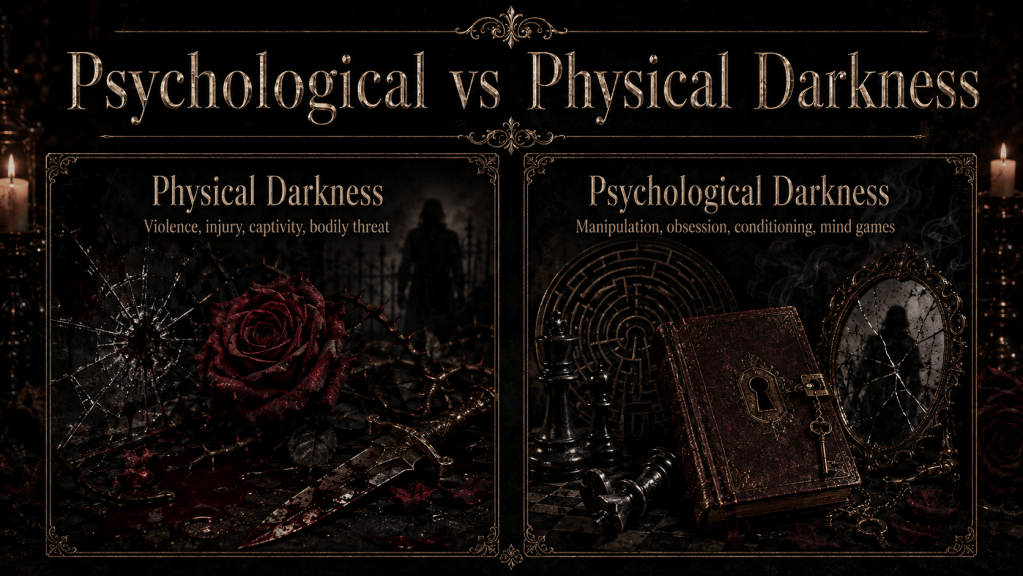
Darkness Ranking: From “Proceed Carefully” to “Know Exactly What You’re Choosing”
Darkness is not a quality score.
A 10/10 book is not automatically better than an 8/10 book.
| Rank | Book | Darkness |
| 1 | Enslaved | 10/10 |
| 2 | Her Master’s Courtesan | 10/10 |
| 3 | Quintessentially Q | 10/10 |
| 4 | Seduced in the Dark | 10/10 |
| 5 | Screaming in the Silence | 9/10 |
| 6 | The Darker Side of Trey Grey | 9/10 |
| 7 | Abduction | 9/10 |
| 8 | Big Sky | 9/10 |
| 9 | Beneath the Burn | 9/10 |
| 10 | Mr. X | 9/10 |
| 11 | Empathy | 8/10 |
| 12 | Destroyed | 8/10 |
The more useful question is not “Which is darkest?”
It is:
What kind of darkness bothers you?
Someone comfortable with fictional murder may hate humiliation.
Someone comfortable with BDSM may refuse to read captivity.
Someone comfortable with captivity may be unable to read sexual violence.
Someone else may tolerate all three but hate psychological conditioning.
Use the individual category scores—not just the overall darkness number.
Spice Ranking
Spice measures explicit sexual content, not how disturbing that content is.
That is why Spice and Trigger Intensity should never be treated as interchangeable ratings.
| Book | Spice |
| Enslaved | 5/5 |
| Her Master’s Courtesan | 5/5 |
| Quintessentially Q | 5/5 |
| Seduced in the Dark | 5/5 |
| Abduction | 5/5 |
| Big Sky | 5/5 |
| Beneath the Burn | 5/5 |
| Mr. X | 5/5 |
| Screaming in the Silence | 4/5 |
| The Darker Side of Trey Grey | 4/5 |
| Empathy | 4/5 |
| Destroyed | 4/5 |
If the distinction between a 3, 4, and 5 is unclear, use the Eerie Efficiency Dark Romance Spice Scale.
Which Controversial Dark Romance Book Should You Start With?
You Want Dark Without Immediately Going to the Extreme
Start with Destroyed.
You still get dangerous characters, violence, trauma, and destructive attraction without starting with the most psychologically punishing material on this page.
You Want a Violent, Dangerous Hero
Start with Mr. X.
You Want Psychological Darkness
Start with Empathy.
You Want Extreme External Danger Plus Strong Romance
Start with Beneath the Burn.
You Want Captivity and Extreme Power Imbalance
Try Big Sky—but read the warnings first.
You Specifically Want Non-Consent and Captor Psychology
Abduction or Screaming in the Silence.
Neither should be treated as a casual next step from ordinary possessive romance.
You Want the Books I Would Put in the “Experienced Extreme-Darkness Readers Only” Category
Seduced in the Dark, Quintessentially Q, Her Master’s Courtesan, or Enslaved.
That is not marketing language.
Those books reach the point where knowing your personal triggers matters more than knowing whether the book is popular.
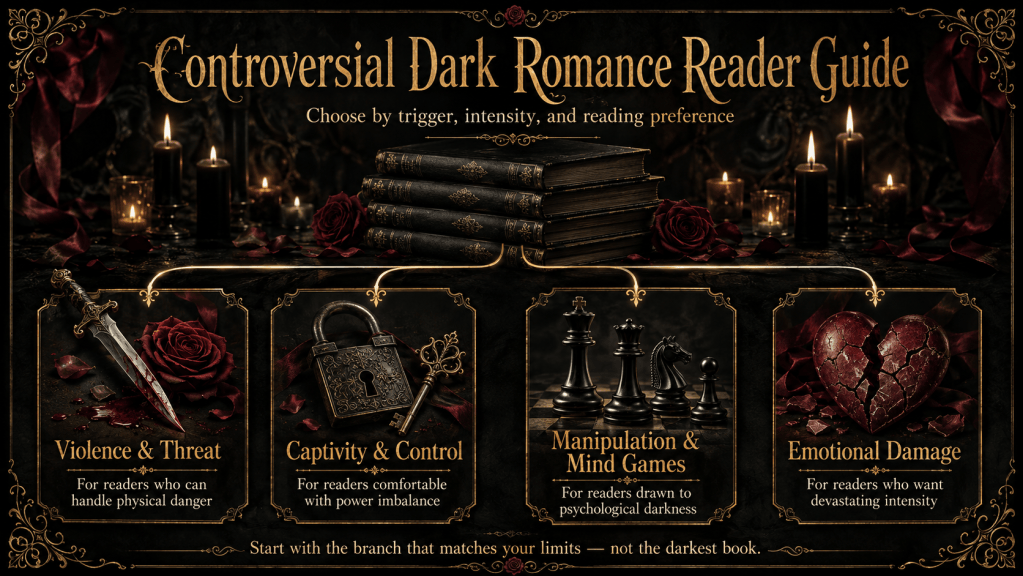
Reader Decision Guide
| You Want… | Start With |
| Psychological killer romance | Empathy |
| Violent antihero | Mr. X |
| Tortured characters + strong romance | Destroyed |
| Rockstar romance with extreme darkness | Beneath the Burn |
| Unusual captivity and control | Big Sky |
| Fantasy-vs-reality consent conflict | Abduction |
| Captor attachment | Screaming in the Silence |
| Heavy M/M trauma | The Darker Side of Trey Grey |
| Extreme emotional destruction | Quintessentially Q |
| Captor/captive moral conflict | Seduced in the Dark |
| Psychological conditioning | Her Master’s Courtesan |
| Maximum sustained trigger intensity | Enslaved |
If You Loved One Type of Controversial Dark Romance, Read This Next
If psychological manipulation fascinated you more than the violence:
Go from Destroyed → Empathy → Her Master’s Courtesan.
If captivity is the primary appeal:
Try Big Sky → Screaming in the Silence → Abduction.
If emotional devastation matters as much as sexual darkness:
Try Beneath the Burn → Quintessentially Q.
If dangerous men are the attraction but extreme victimization is not:
Stay closer to Mr. X and Destroyed rather than jumping directly to Enslaved.
If your real interest is obsessive men rather than extreme non-consent:
You will probably get more useful recommendations from 25 Dark Romance Books With Jealous Possessive Heroes or Dark Romance Books Where He’s Obsessed With Her Immediately.
That distinction can save you from choosing a book much darker than you actually wanted.
Books People Think Belong on a “Controversial Dark Romance” List—but Don’t
This is one of the biggest problems with dark-romance recommendation pages: any disturbing novel involving sex gets labeled dark romance.
That is inaccurate.
My Dark Vanessa by Kate Elizabeth Russell
This is psychologically disturbing fiction examining a relationship between a teenage girl and an older teacher and the way she interprets that relationship later in life. It is generally categorized as literary/contemporary fiction rather than genre romance.
It may appeal to readers interested in psychological power imbalance.
That does not make it dark romance.
Tampa by Alissa Nutting
Also no.
The novel follows an adult teacher who sexually preys upon a fourteen-year-old student; it is presented as transgressive fiction/thriller territory rather than a romance novel.
Disturbing sexual subject matter does not automatically equal romance.
Fifty Shades of Grey by E.L. James
This one is more complicated.
It is unquestionably erotic romance and historically important to mainstream interest in BDSM-inflected romance.
But for a page specifically promising the most controversial dark romance books, I would not use one of the limited recommendation slots on it.
Its cultural controversy was enormous.
Its content intensity compared with genuinely extreme modern dark romance is another question entirely.
That difference—culturally controversial versus content-extreme—is something most lists never distinguish.
Common Misconceptions About Controversial Dark Romance
“The Darkest Book Is Automatically the Best Recommendation”
No.
A darkness score measures intensity.
It does not measure prose quality, character development, romantic satisfaction, originality, or whether you will enjoy the book.
That is why Eerie Efficiency also scores Overall Recommendation separately.
“If I Can Read Graphic Violence, I Can Read Anything”
Not necessarily.
Violence is only one axis.
A reader may comfortably read fictional murder yet find degradation, non-consent, captivity, pregnancy-related material, psychological conditioning, or emotional abuse unbearable.
“Dubious Consent and Non-Consent Are Basically the Same”
They should not be treated as interchangeable.
The amount of meaningful choice available to a character matters.
The context matters.
The characters’ understanding matters.
And consensual roleplay is yet another category.
See Every Dark Romance Trigger Warning Explained if those boundaries determine what you can safely enjoy.
“A Redemption Arc Makes Earlier Behavior Less Dark”
Not on this site.
If a hero commits a 10/10 act in Chapter 10 and becomes devoted in Chapter 40, Chapter 10 still happened.
The rating reflects the material the reader experiences.
“Reading These Books Means Endorsing the Relationships”
No.
Fiction allows readers to explore fear, obsession, violence, submission, control, taboo, and impossible power dynamics without requesting those things in real life.
You can also dislike the relationship morally and still find the book fascinating.
Those positions are not contradictory.
A Better Way to Choose Dark Romance Than Asking “How Dark Is It?”
Before choosing any book rated 9 or 10 for darkness, ask four separate questions:
1. Who Causes the Darkness?
An outside villain?
The romantic lead?
Both?
This may be the single most useful question in dark romance.
2. Does the Heroine Have Meaningful Choice?
Forced proximity and captivity are not the same thing.
Neither are coercion and consensual submission.
3. Is the Darkness Physical or Psychological?
Some readers tolerate one far better than the other.
4. Does the Book Offer Emotional Safety Eventually?
Some readers need that.
Others specifically do not want it.
Neither preference makes someone a more “serious” dark-romance reader.
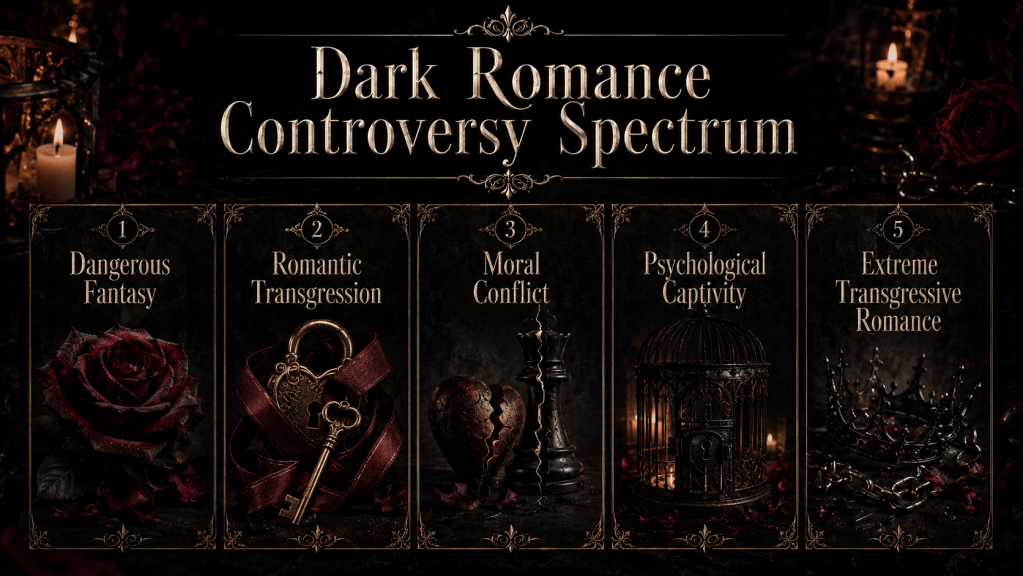
Eerie Efficiency Expertise: The Controversy Spectrum
After rating enough dark romance, I think readers need a better vocabulary than mild, dark, darker, darkest.
I use this instead:
Level One: Dangerous Fantasy
The character is frightening to everyone except the love interest.
The fantasy feels dangerous.
The relationship usually feels safe.
Level Two: Romantic Transgression
The hero crosses meaningful boundaries with the love interest.
Manipulation, stalking, coercion, or serious control may appear.
Level Three: Moral Conflict
The hero does something that makes readers genuinely question whether they want the relationship to succeed.
Level Four: Psychological Captivity
Freedom, consent, dependence, identity, or emotional perception becomes compromised.
Level Five: Extreme Transgressive Romance
The romantic framework itself contains material many readers would ordinarily classify exclusively as abuse, horror, exploitation, or trauma.
Most “dark romance” lists combine all five levels.
That is why one reader asks for something “really dark,” receives a recommendation, and comes back horrified that it was nothing like the books they previously enjoyed.
They were speaking different languages.
My goal with the Eerie Efficiency rating system is to make that less likely.
When You Want Obsession but Not This Much Darkness
You do not need to keep escalating.
If what you actually love is the emotional intensity of a man who cannot leave a woman alone—not sexual violence or captivity—you have much better options.
Explore:
Dark Romance Books Where He’s Obsessed With Her Immediately
Dark Romance Books Where He Watches Her
25 Dark Romance Books With Jealous Possessive Heroes
Dark Romance Books With Manipulative Male Leads
Or explore the boundaries between different categories in The Complete Guide to Dark Romance Subgenres.
Want Dark Fiction Without Gambling on an Unknown Trigger List?
Eerie Efficiency also publishes original fiction.
What Breaks You is an age-gap slow-burn romance built around forbidden attraction, emotional tension, and a relationship that develops gradually rather than the extreme captivity dynamics on this list.
He Was My Brother’s Best Friend First leans into forbidden history, attraction, jealousy, and emotional complications.
Neither is included here as a “most controversial” recommendation.
That would be forced self-promotion.
They make more sense as alternatives for readers who reach this point and realize:
I want complicated and forbidden. I don’t actually want 10/10 trigger intensity.
That is an important distinction.
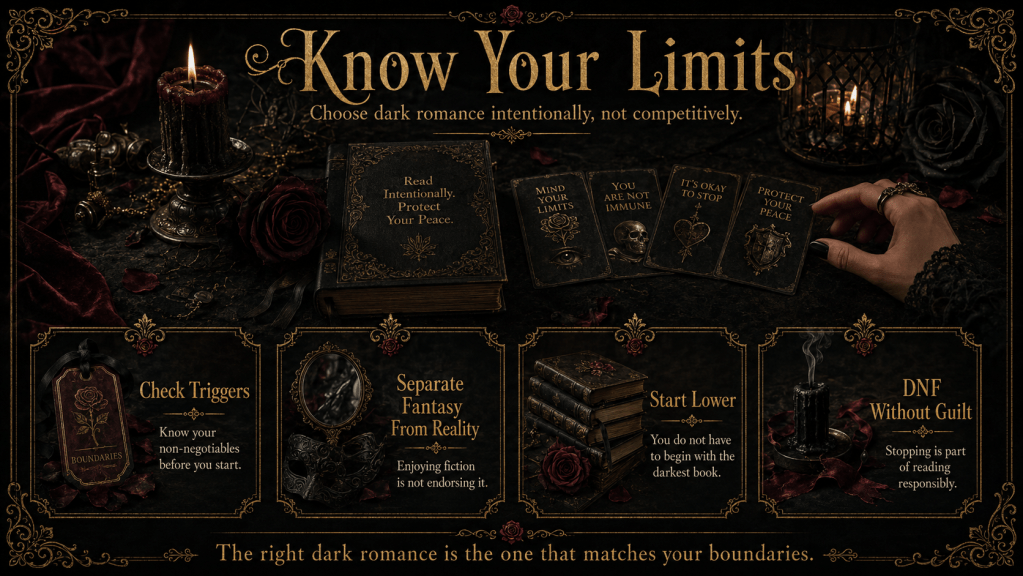
Frequently Asked Questions
What Is the Most Disturbing Dark Romance Book on This List?
By the Eerie Efficiency system, Enslaved and Her Master’s Courtesan sit at the highest overall intensity because multiple categories reach or approach 10/10 simultaneously.
But “most disturbing” depends heavily on the reader.
Psychological conditioning may disturb one person more than physical violence.
Sexual violence may be an absolute boundary for another.
Which Book Has the Highest Psychological Intensity?
Enslaved, Her Master’s Courtesan, Seduced in the Dark, Quintessentially Q, Screaming in the Silence, The Darker Side of Trey Grey, and Empathy all reach 10/10 psychologically for different reasons.
That does not mean they contain identical triggers.
Which One Should a Dark Romance Beginner Read?
None of the 10/10 books.
Start with Destroyed or possibly Empathy if you already consume dark thrillers comfortably.
Better yet, begin with the broader Best Dark Romance Books of All Time and establish your preferences first.
Which Book Is Best If I Want an Irredeemable or Genuinely Dangerous Hero?
Mr. X is a better entry point for readers seeking a violent antihero.
Her Master’s Courtesan moves substantially further into psychologically disturbing territory.
Which Is Best for Captor Romance?
That depends on what part of captivity interests you.
For unusual erotic control: Big Sky.
For psychological attachment to a captor: Screaming in the Silence.
For the fantasy-versus-reality problem: Abduction.
For extreme conditioning: Her Master’s Courtesan.
Those are radically different reading experiences despite sharing a broad captivity label.
Are Controversial Dark Romance Books the Same as Taboo Romance?
No.
A taboo romance usually centers on a socially, ethically, relationally, or culturally prohibited relationship or desire.
A controversial dark romance may instead become controversial because of consent, violence, captivity, degradation, exploitation, or the hero’s actions.
There is substantial overlap, but they are not synonyms.
For the taboo-specific side, read Taboo Dark Romance Books You Shouldn’t Read (But Will).
Do Dark Romance Books Need an HEA?
Genre-romance expectations traditionally place enormous importance on an HEA or HFN, but books marketed, shelved, and discussed as dark romance do not always follow those expectations cleanly.
That is one reason category confusion happens so often.
When an ending requirement matters to you, verify the individual book instead of assuming “dark romance” guarantees the same emotional contract as a conventional contemporary romance.
Why Are Some Older Books More Disturbing Than Newer Viral Dark Romance?
Because modern popularity and content extremity are not the same thing.
Some older dark erotic romances were published before today’s highly recognizable trope language existed and therefore feel less packaged around familiar promises like “touch her and die,” masked stalker, possessive psychopath, or morally gray mafia hero.
That unpredictability can make them feel harsher.
Final Verdict: Controversial Does Not Mean Universally Recommendable
The most useful thing I can tell you about controversial dark romance is this:
You do not graduate into it.
There is no achievement unlocked when you can tolerate increasingly extreme content.
You can love obsession and hate captivity.
Love non-consent fantasies but hate humiliation.
Love serial-killer romance and refuse anything involving psychological conditioning.
Love 10/10 violence but need a 3/10 trigger score in every other category.
That is exactly why Eerie Efficiency rates these dimensions separately.
If you want the most accessible starting point from this page, choose Destroyed.
If you primarily want dangerous psychology, choose Empathy.
If you want a genuinely violent antihero, choose Mr. X.
If you already know that extreme captor romance works for you, move toward Screaming in the Silence, Abduction, or the 10/10 tier.
And if you are staring at Enslaved thinking, “I have no idea whether that is too far for me,” that uncertainty is useful information.
Pick something lower first.
The best dark romance recommendation is not the book that proves how much darkness you can handle.
It is the book whose particular darkness you actually want to read.