Disclosure: This post may contain affiliate links. As an Amazon Associate, I earn from qualifying purchases at no extra cost to you.
Phantasma and The Ritual both put their heroines inside dangerous worlds controlled by powerful men, secrets, rules, and consequences—but they deliver very different kinds of darkness.
Choose Phantasma by Kaylie Smith if you want: gothic atmosphere, supernatural danger, a deadly competition, a charming morally gray MMC, fantasy-world suspense, substantial romance, and darkness that comes primarily from the setting and survival stakes.
Choose The Ritual by Shantel Tessier if you want: a possessive and controlling MMC, secret-society power, sexual boundary-pushing, coercion, surveillance, manipulation, graphic violence, and a relationship that is itself a major source of the darkness.
The simplest distinction is this:
In Phantasma, the world is more dangerous than the romance. In The Ritual, the romance and the world are both dangerous.
That makes Phantasma the easier recommendation for romantasy and newer dark-romance readers. The Ritual is the better match for readers specifically looking for extreme contemporary dark romance and an MMC whose obsessive behavior would be a reason to run in real life.
Phantasma vs The Ritual: Quick Comparison
| Category | Phantasma — Kaylie Smith | The Ritual — Shantel Tessier |
|---|---|---|
| Overall vibe | Gothic supernatural survival game | Elite secret society dark romance |
| Setting | Haunted mansion and deadly fantasy competition | Barrington University and the Lords’ hidden world |
| MMC | Blackwell — charming, mysterious, morally gray phantom | Ryat Archer — controlling, possessive, manipulative Lord |
| Relationship dynamic | Dangerous alliance that develops into intimacy | Ownership, control, manipulation, obsession and desire |
| Main source of darkness | Competition, monsters, gore, supernatural threats | Relationship power imbalance, secret society, sexual content and violence |
| Obsession style | Attachment and protective devotion | Possessiveness, control, surveillance and claiming |
| Spice | 3/5 | 5/5 |
| Psychological intensity | Moderate-high | High |
| Violence | High fantasy/horror violence | Graphic interpersonal and organized violence |
| Gothic atmosphere | Extremely strong | Minimal |
| Romance focus | Strong | Very strong |
| Plot engine | Nine deadly challenges | Lords conspiracy, relationship control and survival |
| Beginner accessibility | Relatively accessible | Poor choice for most beginners |
| Best for | Gothic romantasy readers | Experienced extreme dark-romance readers |
Why Are Phantasma and The Ritual Being Compared?
At first glance, these books seem like an unusual pairing. One contains necromancy, demons, a haunted mansion and a supernatural competition. The other is a contemporary dark college romance centered on a powerful secret society.
But the overlap makes sense.
Both stories introduce a heroine to a dangerous system she does not completely understand. Both worlds operate according to hidden rules. Both feature powerful male love interests whose knowledge exceeds the heroine’s. Both mix sexual attraction with genuine threats. And both use increasingly dangerous situations to push the central relationship forward.
The publisher describes Phantasma as a deadly contest in a haunted mansion where Ophelia must survive nine challenges while navigating an alliance with Blackwell, a phantom who offers to help her for a price. (hachettebookgroup.com)
Shantel Tessier describes The Ritual as a dark standalone romance built around the Lords, a powerful secret society whose members devote themselves to violence in exchange for power, with Ryat drawing the heroine into that world under circumstances involving deliberate manipulation. (shanteltessier.com)
That creates the biggest difference between them:
Blackwell helps Ophelia navigate the dangerous system. Ryat is part of the dangerous system.
That single distinction changes almost everything about the romance.
If you specifically want more books built around secret societies, rituals and powerful men operating behind closed doors, see 15 Dark Romance Books Like The Ritual for Readers Who Want Secret Societies, Dangerous Men, and Twisted Initiations.
How These Books Are Rated
How these books are rated: Spice is scored from 1–5. Darkness, obsession, psychological intensity, violence, emotional damage, trigger intensity, romance focus, and overall recommendation are scored from 1–10. Ratings reflect content intensity, not literary quality. Read our complete Dark Romance Rating Methodology for detailed definitions.
These scores compare content intensity, not prose quality or how much an individual reader will enjoy either book.
Phantasma by Kaylie Smith
Spice: 3/5
Darkness: 6/10
Obsession: 5/10
Psychological Intensity: 7/10
Violence: 7/10
Emotional Damage: 6/10
Trigger Intensity: 7/10
Romance Focus: 8/10
Overall Recommendation: 9/10
Why those scores? The publisher confirms a lethal competition, monsters, increasingly dangerous challenges, supernatural threats and a steamy central romance, while reader-reported content warnings consistently include blood, gore, death, violence, body horror, grief and mental-health-related content. (hachettebookgroup.com)
The Ritual by Shantel Tessier
Spice: 5/5
Darkness: 9/10
Obsession: 9/10
Psychological Intensity: 9/10
Violence: 9/10
Emotional Damage: 8/10
Trigger Intensity: 10/10
Romance Focus: 9/10
Overall Recommendation: 8/10
The high trigger and darkness scores are not based on vague reputation. Tessier’s own current content-warning page specifically lists graphic violence, non/dub-con, branding, forced-sex fantasy, drug and alcohol use, masks, breath play, bondage, kidnapping, anal sex and praise kink for The Ritual. (shanteltessier.com)
That makes The Ritual substantially more intense where consent, sexual power and interpersonal behavior are concerned.
Which Has the Better MMC?
This is probably the category most likely to determine which book you prefer.
Blackwell and Ryat are both dangerous men, but they satisfy almost opposite versions of the fantasy.
Blackwell Is the Better MMC If You Want Charm With the Danger
Blackwell enters Phantasma knowing more about the deadly game than Ophelia does. He’s arrogant, mysterious, flirtatious and clearly not someone she should blindly trust.
But his appeal isn’t primarily built around dominating her.
Their relationship develops through an alliance. Ophelia needs information and guidance; Blackwell wants something in return. Their tension comes from uncertainty, attraction, secrets and the question of whether trusting him is a terrible idea.
Kaylie Smith has discussed Blackwell as a counterpart to Ophelia who both challenges her and gives her something she needs emotionally. The publisher’s discussion material also emphasizes that Ophelia can survive challenges independently rather than functioning solely as someone Blackwell must rescue. (portfolio-tools.s3.eu-west-2.amazonaws.com)
That distinction matters.
Blackwell is dangerous-romantic.
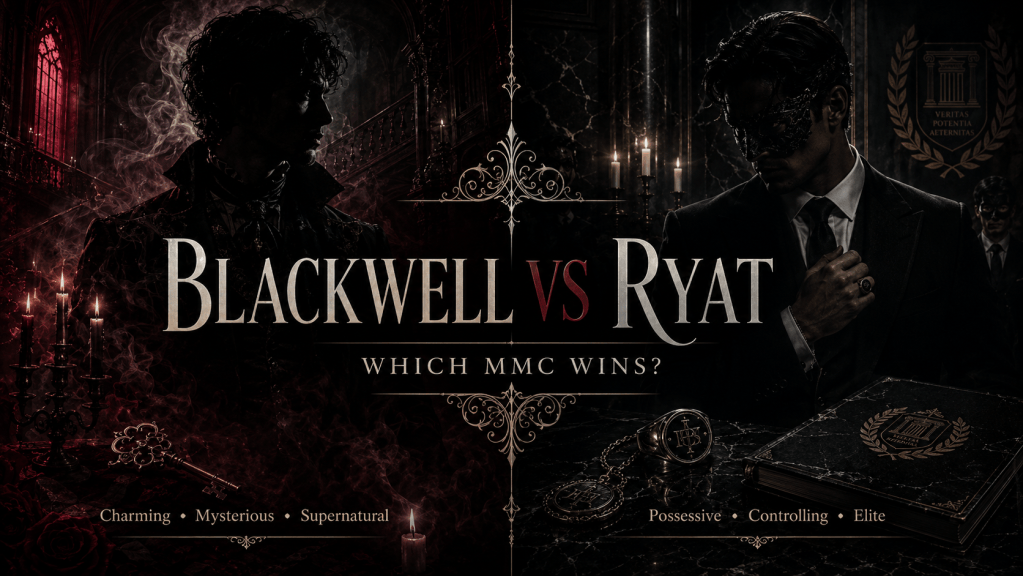
Ryat Is the Better MMC If You Want Control, Possession and Red Flags
Ryat is a different fantasy entirely.
His appeal depends heavily on things that would make him unacceptable to readers who need healthy boundaries inside the central relationship.
He manipulates.
He controls.
He withholds information.
He operates within an institution built around male power.
And his attachment to the heroine has a much stronger you are mine quality than Blackwell’s relationship with Ophelia.
The official synopsis doesn’t pretend otherwise: what initially appears to offer the heroine freedom becomes another method through which the Lords manipulate her. (shanteltessier.com)
For readers specifically seeking the jealous, possessive MMC archetype, Ryat wins easily. Blackwell can be protective and morally gray, but Phantasma isn’t structured around male ownership in the same way.
If Ryat’s brand of possessiveness is what you are actually shopping for, you’ll get more mileage from 25 Dark Romance Books With Jealous Possessive Heroes or Dark Romance Books With Unhinged Heroes.
MMC winner for charming danger: Phantasma.
MMC winner for obsessive possession: The Ritual.
Which Romance Is Stronger?
This depends entirely on what you mean by “stronger.”
If stronger means emotional compatibility, vulnerability and the sense that the couple becomes meaningful beyond physical attraction, I would give the advantage to Phantasma.
Ophelia and Blackwell’s romance develops while they navigate the competition, and their connection becomes a counterweight to everything frightening around them. Kaylie Smith’s own discussion of the story emphasizes the idea of finding something loving inside a terrible environment. (hachettebookgroup.com)
If stronger means intensity, possession, sexual chemistry and a relationship that dominates your experience of the book, The Ritual wins.
Ryat and his heroine do not have a conventional healthy-romance arc. Control, manipulation and power are part of the erotic framework rather than obstacles that disappear once the relationship becomes serious.
That is exactly why the romance works for some dark-romance readers and absolutely will not work for others.
So:
For romantic intimacy: Phantasma.
For dark relationship intensity: The Ritual.
Which Book Is Darker?
The Ritual is darker overall.
But Phantasma can actually be surprisingly gruesome for readers who see the ornate cover and expect mostly atmospheric romantasy.
The difference is where the darkness lives.
Phantasma‘s Darkness Is Gothic, Supernatural and Survival-Based
Phantasma puts Ophelia into a haunted mansion filled with lethal challenges, supernatural creatures and competitors willing to eliminate one another.
The publisher explicitly describes escalating challenges, monsters and a competition in which survival is never guaranteed. (hachettebookgroup.com)
Its darkness therefore comes from:
- death
- gore
- body horror
- supernatural threats
- psychological fear
- grief
- confinement
- survival pressure
- dangerous temptation
There are frightening and violent elements, but Blackwell himself is not usually the most frightening thing happening to Ophelia.
The Ritual‘s Darkness Is Interpersonal
The Ritual includes violence, murder, kidnapping and the institutional brutality surrounding the Lords.
But its most significant distinction is that sexual and relationship power contribute directly to the darkness.
The author’s warnings include non/dub-con, forced-sex fantasy, bondage, kidnapping, branding and breath play alongside graphic violence. (shanteltessier.com)
That makes it psychologically different from Phantasma.
You aren’t merely asking:
Will these characters survive the danger?
You’re also repeatedly confronting:
How much control can one character exercise over another before desire and autonomy become impossible to separate?
For readers who distinguish dark fantasy from dark romance, this is crucial.
Darkest overall: The Ritual.
Gothic/horror darkness: Phantasma.
Relationship darkness: The Ritual, by a wide margin.
For a broader explanation of how these different elements fit within the genre, see The Complete Guide to Dark Romance Subgenres.
Which Is Spicier?
And this isn’t particularly close.
Phantasma: 3/5 Spice
Phantasma contains explicit romance and substantial sexual tension, but the sexual content shares the stage with the competition, gothic setting, supernatural world and external plot.
The attraction between Ophelia and Blackwell is important, but the book still functions as a fantasy story even when they aren’t together.
The Ritual: 5/5 Spice
Sexual power is much more embedded into The Ritual‘s relationship structure.
The author’s own content warnings identify multiple explicit sexual elements and kink dynamics, including breath play, bondage, forced-sex fantasy, non/dub-con and anal sex. (shanteltessier.com)
It isn’t simply that The Ritual contains explicit scenes.
The sexual dynamic is one of the primary ways Ryat’s control and the couple’s relationship are expressed.
Spice winner: The Ritual.
Readers trying to distinguish simple explicitness from the intensity of sexual content can use The Dark Romance Spice Scale: Every Level Explained.
Which Has the Better Plot?
This is another category where “better” needs to be separated from “more.”
Phantasma Has the Cleaner External Plot Engine
Phantasma gives the reader an extremely clear objective.
Ophelia enters Phantasma to save her sister.
She must survive nine increasingly dangerous challenges.
She needs to win.
That competition creates natural forward momentum because every stage introduces a new obstacle while the mysteries involving Blackwell and Phantasma itself develop alongside it.
The haunted mansion is also doing enormous narrative work. Rooms, challenges, supernatural rules and shifting threats constantly change what Ophelia is confronting.
For readers who prefer romance plus a strong non-romance plot, Phantasma wins.
The Ritual Makes the Relationship Part of the Plot
The Ritual has conspiracies, violence, secret-society politics, hidden motives and threats.
But separating “romance plot” from “external plot” is much harder because Ryat’s relationship with the heroine is tangled directly into the Lords’ system.
His decisions are plot.
His manipulation is plot.
Their sexual relationship is plot.
The secrets surrounding the Lords are plot.
That makes the story feel more concentrated around the couple even while larger forces operate around them.
Best for competition, fantasy mystery and external stakes: Phantasma.
Best for secret-society intrigue intertwined with the central relationship: The Ritual.
Which Is More Obsessive?
The more interesting question is why.
Blackwell’s Obsession Is Attachment-Based
Blackwell’s relationship with Ophelia becomes increasingly protective and emotionally important, but Phantasma does not revolve around surveillance or systematically stripping away her independence.
His attraction grows into devotion.
That can still satisfy readers who enjoy protective, morally gray men—but it is not the most extreme version of the obsessive-MMC trope.
Ryat’s Obsession Is Possession-Based
Ryat sits much closer to Eerie Efficiency’s controlling-obsession category.
His fixation is connected to:
- possession
- surveillance
- manipulation
- sexual control
- secrecy
- claiming behavior
- extreme protectiveness
- decisions made on the heroine’s behalf
Third-party content-warning databases also consistently identify stalking or nonconsensual surveillance alongside the author’s own extensive warnings. (triggerwarningdatabase.com)
If what you loved in another dark romance was the sensation that the MMC has crossed from interested to completely consumed, Ryat is much closer to that fantasy.
Obsession winner: The Ritual.
For even more books organized around this exact distinction, see Dark Romance Books Where He Becomes Obsessed With Her and Dark Romance Books Where He’s Obsessed With Her Immediately.

Which Is More Emotionally Damaging?
This one is closer than the darkness scores suggest.
The Ritual puts its heroine through more extreme violations of control and safety, which gives it the higher Emotional Damage score.
But Phantasma has significant emotional material underneath its spectacle.
Ophelia is dealing with grief, responsibility, fear and her own mental-health struggles while trying to save someone she loves. The publisher specifically identifies OCD representation as part of the novel, and Kaylie Smith has discussed Blackwell’s refusal to treat Ophelia as someone who needs to be “fixed” before she can be loved. (hachettebookgroup.com)
That gives Phantasma more emotional tenderness than its death-game premise might suggest.
The Ritual creates a different response: tension comes from uncertainty over who holds power, what information is being withheld and how much of the heroine’s perceived freedom is real.
For grief, vulnerability and emotional comfort: Phantasma.
For emotional destabilization and relationship-based psychological pressure: The Ritual.
Which Has the Better Atmosphere?
Phantasma, decisively.
If “gothic” is the word that got you to this comparison, this is the book you want.
The haunted mansion isn’t background decoration. Twisting corridors, lavish rooms, supernatural inhabitants, deadly challenges, necromancy and a trapped phantom are fundamental to the story. The publisher itself positions the mansion and its monsters at the center of the premise. (hachettebookgroup.com)
The Ritual has its own aesthetic—elite university, masked men, secret ceremonies, wealth, exclusivity and institutional menace—but it is not gothic in the same way.
For more of that specific atmosphere, see Gothic Dark Romance Books With Haunted Houses, Secrets, and Dangerous Love.
Atmosphere winner: Phantasma.
Triggers and Content Differences
This is the section that should probably determine your choice if you have strong content boundaries.
Phantasma Requires Greater Tolerance for:
- gore
- blood
- death
- supernatural horror
- monsters
- body horror
- grief
- mental-health-related distress
- dangerous competition scenarios
- confinement and survival threats
The StoryGraph currently does not list author-submitted warnings for Phantasma, but its large set of reader-reported warnings consistently highlights blood, death, violence, gore, mental illness, murder, body horror, grief and related horror content. (app.thestorygraph.com)
The Ritual Requires Greater Tolerance for:
- non-consent and dubious-consent material
- forced-sex fantasy
- controlling relationship behavior
- graphic violence
- branding
- kidnapping
- bondage
- breath play
- drug and alcohol use
- intense sexual content
- extreme power imbalance
Those are not inferred warnings; several are listed directly by Shantel Tessier. (shanteltessier.com)
If consent terminology itself is confusing, read Every Dark Romance Trigger Warning Explained before deciding whether The Ritual falls within your boundaries.
Always check the author’s current warnings before reading, particularly because third-party lists can be incomplete or use different terminology.
Which Should a Dark Romance Beginner Read First?
Especially if your existing reading history is primarily fantasy romance, paranormal romance or gothic romance.
It gives you several things commonly associated with darker romance—morally gray attraction, danger, explicit scenes, violence and disturbing imagery—without immediately jumping to one of the hardest content categories in contemporary dark romance.
That makes it a useful bridge.
A reader can discover:
I like dangerous fictional men.
without simultaneously having to discover:
How do I feel about non/dub-con, forced-sex fantasy, kidnapping, branding and extreme relationship control?
The Ritual asks those questions very quickly.
It is therefore not the book I would use to determine whether you enjoy dark romance at all.
That doesn’t make it “too dark” in an objective sense. It means its central appeal depends on content that many romance readers deliberately avoid.
Beginner winner: Phantasma.
If you are still figuring out what kind of darkness actually works for you, Every Dark Romance Trope Explained and Dark Romance Hero and Character Archetypes can help you separate morally gray, possessive, protective and genuinely controlling MMCs.
Head-to-Head Winners
| Category | Winner | Why |
| Best charming MMC | Phantasma | Blackwell combines danger, humor and vulnerability |
| Most possessive MMC | The Ritual | Ryat’s control is central to the relationship |
| Strongest emotional romance | Phantasma | More emphasis on connection and emotional acceptance |
| Most intense romance | The Ritual | Sex, possession and power dominate the relationship |
| Darkest | The Ritual | Relationship darkness plus graphic external violence |
| Best gothic darkness | Phantasma | Haunted mansion, necromancy and supernatural horror |
| Most obsessive | The Ritual | Stronger surveillance, possession and control |
| Spiciest | The Ritual | More explicit and more sexually extreme |
| Best atmosphere | Phantasma | The setting is one of the book’s defining strengths |
| Best external plot | Phantasma | The nine-stage survival competition drives the story |
| Best secret-society plot | The Ritual | The Lords influence nearly every part of the story |
| Most emotionally destabilizing | The Ritual | Greater relationship-based psychological pressure |
| Best for beginners | Phantasma | Lower consent-related trigger barrier |
| Best for romantasy readers | Phantasma | Fantasy plot and romance receive substantial attention |
| Best for extreme dark-romance readers | The Ritual | More transgressive relationship dynamics |
| Overall | Depends entirely on what you want | These books satisfy different reading cravings |
Which One Should You Read?
Read Phantasma If You Want…
- a genuinely gothic setting rather than simply a dark aesthetic
- a deadly supernatural competition
- fantasy and romance carrying roughly equal importance
- a morally gray MMC who is dangerous without making relationship control the primary fantasy
- explicit romance without extreme consent-related content dominating the book
- mystery, trials, monsters and escalating survival stakes
If you have been reading romantasy and want to move slightly darker, this is the easier transition.
Read The Ritual If You Want…
- an intensely possessive MMC
- a secret society controlling people’s lives behind the scenes
- relationship dynamics that deliberately cross conventional romantic boundaries
- extreme sexual content
- manipulation, surveillance and ownership themes
- contemporary rather than supernatural darkness
If the phrase “he would be terrifying in real life, but that’s exactly why I’m reading it” describes your taste, Ryat is far more likely to deliver what you’re looking for.
Readers who want more MMCs at that end of the spectrum should also see 20 Dark Romance Books With Morally Grey Heroes and 15 Dark Romance Books Like God of Malice.
Should You Read Both?
Yes—if you’re interested in seeing how two very different genres use danger to intensify romance.
I would not recommend reading both because they’re substitutes for one another.
They aren’t.
Phantasma scratches the haunted-house + deadly-games + supernatural-romance itch.
The Ritual scratches the secret-society + obsessive-man + sexual-control + elite-power itch.
Reading Phantasma and then picking up The Ritual expecting another atmospheric gothic competition is likely to be jarring.
Reading The Ritual and then starting Phantasma because you want another Ryat-style MMC could leave you wondering where all the controlling obsession went.
But if you like seeing different versions of morally dangerous romance, they’re different enough to justify reading both.
For a larger cross-section of the genre rather than another direct comparison, Best Dark Romance Books of All Time is the better next stop.
What If You Like the Obsession but Want a Different Relationship Dynamic?
Not every obsessive romance has to involve Ryat-level control.
That’s an important distinction because readers sometimes search for “obsessive MMC” when what they actually want is one particular component: jealousy, possessiveness, protectiveness, instant fixation or emotional dependence.
If you want obsession with a more enemies-to-lovers-style push and pull, Enemies to Lovers Dark Romance Books You Won’t Be Able to Put Down is a better direction.
And if you’d rather read obsession in an original story instead of another recommendation guide, Eerie Efficiency also publishes fiction. He Was My Brother’s Best Friend First leans into slow-burning tension and complicated attraction, while What Breaks You offers another way to explore darker emotional dynamics through fiction rather than a book list.
They are different experiences from both Phantasma and The Ritual, which is exactly the point: “dark” and “obsessive” do not describe one universal relationship structure.
FAQ
Is Phantasma darker than The Ritual?
No. Phantasma contains gore, death, supernatural horror and serious psychological pressure, but The Ritual adds much more extreme sexual and relationship-based darkness, including non/dub-con content, forced-sex fantasy, kidnapping, branding and other content specifically identified by the author. (shanteltessier.com)
Is The Ritual spicier than Phantasma?
Yes. Eerie Efficiency rates Phantasma 3/5 for spice and The Ritual 5/5. The Ritual also incorporates sexual power and kink much more heavily into its central relationship.
Which has the more obsessive MMC?
The Ritual. Ryat’s obsession is more possessive, controlling and surveillance-oriented. Blackwell is devoted and protective, but his relationship with Ophelia is not built around the same degree of ownership.
Is Phantasma actually a dark romance?
It sits more comfortably in dark romantasy/gothic fantasy romance than in the extreme contemporary dark-romance category represented by The Ritual. The publisher categorizes Phantasma within fantasy romance/romance and describes the supernatural competition and romance as dual components of the story. (hachettebookgroup.com)
Are Phantasma and The Ritual standalones?
The Ritual is officially described by Shantel Tessier as a dark standalone romance, although it belongs to the larger interconnected Lords world. (shanteltessier.com)
Phantasma is part of Kaylie Smith’s Wicked Games series. Hachette lists Phantasma and Enchantra within the series, with the related books structured around different romantic stories. (hachettebookgroup.com)
Should I read Phantasma or The Ritual first?
Start with Phantasma if you’re newer to dark romance or normally read romantasy. Start with The Ritual only if you already know that extreme possessiveness, dub/non-con material, coercive sexual themes and morally disturbing relationship behavior fall within your reading boundaries.
Which book has more romance?
Both place significant weight on romance, but they use it differently. Phantasma balances its romance against a major fantasy competition plot. The Ritual integrates the romantic and sexual relationship so deeply into its power structure that separating “romance plot” from “dark plot” becomes difficult.

Final Verdict: Phantasma or The Ritual?
There isn’t a meaningful universal winner here because these books are trying to satisfy two different versions of the dark-romance reading experience.
Read Phantasma if you prioritize gothic atmosphere, fantasy adventure, emotional connection, a supernatural competition and a dangerous MMC who does not make extreme relationship control the central attraction.
Read The Ritual if you prioritize obsession, possession, explicit sexual intensity, secret societies, morally extreme behavior and a relationship where control itself is part of the fantasy.
For most readers—including romantasy readers entering darker territory—I would recommend Phantasma first. It is easier to approach, has an unusually strong atmosphere, gives the romance plenty of room to develop and still delivers significant gore, danger and psychological tension.
For an experienced dark-romance reader specifically hunting for an obsessive, controlling MMC?
The Ritual is the stronger match, and it isn’t close.
The real question isn’t gothic competition or secret society romance?
It’s this:
Do you want the heroine to fall in love while surviving the dangerous world—or do you want the man she falls for to be one of the most dangerous things in it?
That answer tells you which book to pick.