Disclosure: This post may contain affiliate links. As an Amazon Associate, I earn from qualifying purchases at no extra cost to you.
A dangerous male lead is easy to find in dark romance.
A woman who is genuinely the most dangerous person in the relationship? Much rarer.
The best dark romance books with female serial killers do more than give the heroine a knife and call her morally gray. The killing has to matter. It should shape how she sees herself, how the love interest sees her, and what kind of relationship can survive once he realizes exactly who he has fallen for.
That distinction eliminates a lot of books that get recommended for this trope.
For this guide, I prioritized heroines who intentionally kill multiple people, have an established pattern of killing, operate as vigilantes or practiced criminals, or otherwise have a killer identity central enough to the plot that removing it would fundamentally change the story.
And because “she kills people” still doesn’t tell you what the book feels like, every recommendation is also judged by the more useful questions:
Who does she kill? Why? Does she have rules? Does the MMC know? And is he horrified by her—or exactly the kind of man who sees the blood and falls harder?
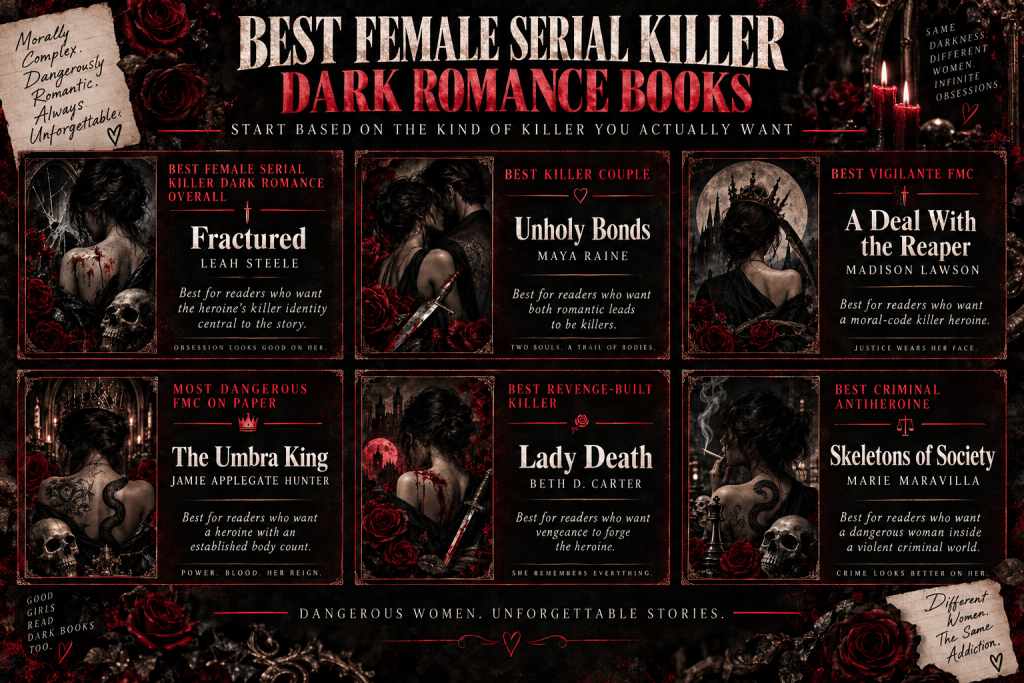
The Best Female Killer Dark Romances to Start With
If you want the short version before getting into the deeper comparisons:
| What You Want | Start Here | Why |
|---|---|---|
| Best Female Serial Killer Dark Romance Overall | Fractured by Leah Steele | Raven’s progression into repeated killing is central to both her character arc and the romantic tension |
| Best Killer Couple | Unholy Bonds by Maya Raine | Both leads are killers, and murder is inseparable from their attraction |
| Best Vigilante FMC | A Deal With the Reaper by Madison Lawson | June deliberately hunts abusive men |
| Best “she may actually be more dangerous than him” dynamic | The Umbra King by Jamie Applegate Hunter | The heroine enters the romance after already being convicted of thirteen murders |
| Best crime-romance killer heroine | Skeletons of Society by Marie Maravilla | Her violence is tied to cartel survival, power, and criminal pragmatism |
| Best revenge-trained killer | Lady Death by Beth D. Carter | Vengeance transforms Keres into a deliberate and practiced killer |
The distinction between these books matters. Fractured is my strongest overall recommendation if your priority is specifically a female serial-killer FMC because Raven’s developing relationship with killing is central to her character arc. Unholy Bonds is the stronger choice if what you really want is a killer couple where neither romantic lead serves as the safe moral counterweight.
A Deal With the Reaper is much more vigilante-coded. Skeletons of Society is criminal violence rather than serial murder for pleasure. Lady Death is revenge and assassin-adjacent.
That is exactly why I would rather give you six defensible recommendations than fifteen women who happen to stab someone.
What Actually Counts as a Female Serial Killer Romance?
For this article, a heroine can qualify when she:
- deliberately kills multiple people
- develops or already has an established killing pattern
- repeatedly hunts particular types of victims
- operates as a vigilante
- kills as part of a sustained revenge campaign
- has a practiced criminal or assassin-like identity
- displays serial-killer-coded behavior that materially drives the plot
A heroine does not automatically qualify because she kills someone in self-defense, participates in one revenge killing, works for a criminal family, or is simply more violent than the average romance protagonist.
That distinction sounds obvious until you start searching for female serial killer romance books. Plenty of recommendation lists quietly substitute “strong FMC,” “mafia woman,” “morally gray heroine,” and “serial killer” as though those are interchangeable character types.
They are not.
Eerie Efficiency’s broader guide to dark romance hero and character archetypes goes deeper into those distinctions. A heroine can be dangerous, morally gray, obsessive, villainous, or criminal without being a repeat murderer.
Serial Killer vs Vigilante vs Assassin: The Difference Matters
I’m using these as literary categories, not clinical or legal diagnoses.
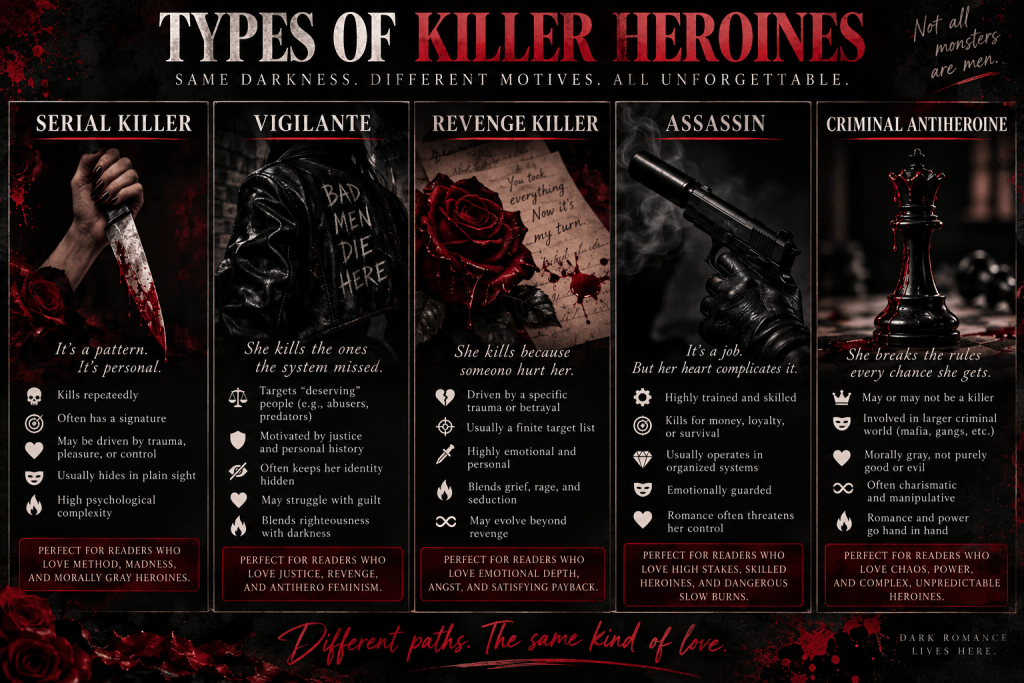
Serial-killer-coded heroine
The FMC intentionally kills repeatedly and the pattern itself is central to her character.
Her motive may be revenge, compulsion, pleasure, punishment, or something more complicated.
Fractured and Unholy Bonds are the strongest examples here.
Vigilante killer
She has a moral framework—however questionable—and selects victims because she believes they deserve punishment.
June in A Deal With the Reaper is the cleanest example in this guide. The author’s own description identifies her as a therapist who secretly hunts abusive men.
Revenge killer
Her violence is tied to a specific wrong, group, or long-term vengeance campaign.
The killing may be repeated without being indiscriminate.
Assassin or professional killer
Killing functions partly as work, underworld skill, or practiced criminal activity.
The motive may have less to do with personal gratification and more to do with contracts, survival, loyalty, or power.
Criminal antiheroine
She kills because criminal life requires it.
That can produce a high body count without producing what most readers mean when they search for a “female serial killer FMC.”
Skeletons of Society sits closer to this category.
Knowing the difference prevents one of the most frustrating recommendation-list problems: picking up a supposed serial-killer romance and discovering the heroine kills exactly one villain near the climax.
Why Female-Killer Romance Feels Different
A murderous FMC changes the usual danger hierarchy.
Instead of the MMC functioning as both love interest and threat, he may be the person slowly realizing that she was never the one who needed protection.
That opens relationship dynamics that standard dangerous-MMC romance rarely gets to use.
He can underestimate her.
He can investigate her.
He can become fascinated with her.
He can discover that the woman he wants has done things he cannot morally excuse.
He can decide that he doesn’t want to excuse them.
Or—and this is where killer-couple romance becomes its own experience—he can look at what she does and recognize something disturbingly familiar.
If you normally gravitate toward dangerous men, compare that reversal with Eerie Efficiency’s guide to alpha vs. morally gray heroes. Female-killer romance shifts the question from Can she survive him? to What happens when he realizes she may be worse?
How These Books Are Rated
How these books are rated: Spice is scored from 1–5. Darkness, obsession, psychological intensity, violence, emotional damage, trigger intensity, romance focus, and overall recommendation are scored from 1–10. Ratings reflect content intensity, not literary quality. Read our complete Dark Romance Rating Methodology for detailed definitions.
One important note for this particular list: Violence and Darkness are not the same score.
A book can contain several murders and still feel emotionally lighter than a story with fewer deaths but prolonged coercion, trauma, manipulation, or psychological deterioration.
That distinction becomes especially important with killer heroines.
The Women Who Kill Because They Want To
Fractured by Leah Steele
If your request is specifically “Give me a heroine who actually becomes a serial killer”, start here.
Remington—also called Raven—is not merely someone forced to kill because danger arrives on her doorstep. The series begins with killings that can initially be rationalized: self-defense, accident, opportunity. What changes is her reaction.
She discovers that she wants the feeling again.
Then someone begins feeding that darkness by leaving her information about people deemed deserving of death.
The author’s description is unusually explicit about the progression: Raven becomes a serial killer, targets bad people, and is guided through her kills by a mysterious stalker known as the Ravenmaster. The author also lists assault, attempted sexual assault, blood, gore, murder, stalking, torture, and violence among the content warnings.
That makes Fractured useful for readers who don’t merely want an already-established assassin. You get the psychological threshold-crossing.
Why She Qualifies: Raven doesn’t stop after killing. She actively begins seeking the next opportunity and develops an ongoing pattern.
What makes the romance interesting: Her secret doesn’t exist separately from her romantic life. Attraction, stalking, secrecy, voyeuristic fascination, and violence begin bleeding into one another.
Best for: Readers who want the FMC’s relationship with killing to develop on-page rather than arriving as backstory.
Skip it if: You dislike why-choose romance, extremely high spice, stalking dynamics, or violence becoming part of erotic tension.
Content warnings: Murder, blood, gore, stalking, torture, assault and attempted sexual assault, violence.
Eerie Efficiency Rating
- Spice: 5/5
- Darkness: 9/10
- Obsession: 9/10
- Psychological Intensity: 9/10
- Violence: 9/10
- Emotional Damage: 7/10
- Trigger Intensity: 9/10
- Romance Focus: 8/10
- Overall Recommendation: 9/10
The unusual strength here isn’t the body count. It is the fact that the story examines a heroine discovering that killing fits a part of herself she has been hiding.
Killer Couples: When He Isn’t Her Moral Counterweight
Unholy Bonds by Maya Raine
Some killer romances pair a homicidal FMC with a comparatively normal man.
Unholy Bonds does not give you that safety rail.
Yara West works as a medical examiner by day and kills at night. Ryden Sinclair is an investigative journalist—and a killer himself.
Their meeting therefore isn’t “innocent man discovers girlfriend’s terrible secret.”
It is predator recognizing predator.
The official description frames Yara as a masked killer pursuing targets and Ryden as someone who delivers his own violent form of judgment after losing faith in conventional justice. Their attraction becomes tangled with stalking, discovery, obsession, and mutual darkness.
Why She Qualifies: Yara has an established secret identity built around repeated intentional killing. This is not one revenge scene or a heroine who only kills when cornered.
What makes the romance interesting: Neither lead gets to occupy uncomplicated moral high ground. Ryden discovering Yara’s darkness does not create the standard “monster and innocent” structure because he is hiding lethal behavior of his own.
That changes the central romantic question.
It isn’t Will he still love her when he knows?
It is closer to What happens when two people who should probably run from one another instead become more interested?
Best for: Readers specifically seeking killer couple romance rather than a dangerous-woman/normal-man contrast.
Skip it if: You need one romantic lead to provide a strong moral center or you dislike graphic murder content.
Content warnings: Murder, violence, gore, stalking, psychologically disturbing behavior.
Eerie Efficiency Rating
- Spice: 4/5
- Darkness: 9/10
- Obsession: 9/10
- Psychological Intensity: 9/10
- Violence: 9/10
- Emotional Damage: 7/10
- Trigger Intensity: 9/10
- Romance Focus: 8/10
- Overall Recommendation: 9/10
If you are specifically chasing the “we are both terrible ideas, unfortunately together” version of this trope, this is one of the cleanest matches in the guide.
The Vigilantes: Murder With Rules
A Deal With the Reaper by Madison Lawson
June Graves is a therapist.
She also hunts abusive men.
That combination immediately gives A Deal With the Reaper a different psychological texture from a heroine who kills indiscriminately. June has built a justification system around her violence.
Then she selects the wrong target.
Theo Zervas, president of the Saints of Purgatory motorcycle club, realizes she is coming for him and turns the situation back on her. Rather than immediately exposing her, he gives her a choice involving a month inside his world.
This is where the romance becomes more interesting than the premise alone.
Theo isn’t discovering a delicate woman’s secret darkness after falling in love with her. He encounters June as a threat.
The power struggle begins before conventional trust has any chance to exist.
Why She Qualifies: June intentionally and repeatedly targets abusive men. She is best classified as a vigilante killer rather than an indiscriminate serial killer.
Victim morality: Targeted.
She believes there is a reason each person deserves to die.
Whether the reader accepts that logic is part of the appeal.
Best for: Readers who want a killer FMC but prefer a moral framework behind her violence.
Skip it if: Vigilante justice feels too morally tidy for what you want. If you want a heroine whose victim selection is genuinely disturbing, June may be too understandable.
Content warnings: Murder, abuse-related subject matter, criminal violence and dark relationship dynamics. Readers with firm limits should consult the author’s current warning list before starting.
Eerie Efficiency Rating
- Spice: 4/5
- Darkness: 8/10
- Obsession: 7/10
- Psychological Intensity: 8/10
- Violence: 8/10
- Emotional Damage: 8/10
- Trigger Intensity: 8/10
- Romance Focus: 8/10
- Overall Recommendation: 9/10
The biggest reason to pick this over a conventional serial-killer story is moral tension: June thinks she knows who deserves death. Theo forces her to confront what happens when her judgment may be wrong.
The Revenge-Driven Killers
Lady Death by Beth D. Carter
Keres becomes lethal because something horrific is done to her world.
Her answer is not healing first and revenge later.
It is transformation.
She trains, hunts, and begins eliminating the people connected to what happened. That brings her into conflict with Ronin, another killer who notices someone has been taking out targets before he can reach them.
The publisher describes Keres’s driving force plainly: savage violence creates her demand for vengeance, and she becomes increasingly dangerous in order to hunt the people responsible.
That places Lady Death closer to revenge-killer and assassin territory than traditional serial murder.
But the repeated intentional killing is important enough to her identity—and to the romance—that she belongs here.
Why She Qualifies: Keres deliberately becomes a practiced killer and repeatedly hunts targets as part of a sustained vengeance campaign.
What makes the romance interesting: Ronin isn’t introduced as someone who has to teach her how darkness works. He notices her because she is already interfering with his own lethal business.
That gives the relationship a rare balance.
He can be dangerous without automatically being her source of danger.
Best for: Readers who want revenge, action, criminal-world romance, and an FMC whose lethality is earned through training rather than treated as an aesthetic.
Skip it if: You want predatory or thrill-based killing. Keres’s violence has a specific revenge architecture.
Content warnings: Murder, revenge violence, traumatic violence, criminal violence. The publisher additionally flags explicit sexual content.
Eerie Efficiency Rating
- Spice: 3/5
- Darkness: 8/10
- Obsession: 6/10
- Psychological Intensity: 8/10
- Violence: 9/10
- Emotional Damage: 9/10
- Trigger Intensity: 9/10
- Romance Focus: 8/10
- Overall Recommendation: 8/10
This is the better choice when you want the story to ask what a woman is willing to turn herself into for revenge, rather than simply introducing her after she has already become the monster.
She Has Already Been Convicted of Thirteen Murders
The Umbra King by Jamie Applegate Hunter
This one changes subgenre completely.
The Umbra King is dark fantasy romance rather than contemporary crime romance, but Aurora “Rory” Raven is too strong a fit to ignore.
After her twin sister is murdered, Rory spends years becoming a vigilante killer. By the time the main story moves her into Vincula—the prison realm—she has been convicted of thirteen murders.
There is no ambiguity about whether she qualifies as a repeat killer.
What is different is the framework surrounding that violence.
Her killings are connected to retribution, supernatural worldbuilding, grief, punishment, and the search for the person responsible for her sister’s death.
Then she meets Caius, the Umbra King, who has his own history with punishment and vengeance.
Why She Qualifies: Thirteen murder convictions and years spent operating as a vigilante killer put Rory comfortably beyond “violent heroine” territory.
What makes the romance interesting: Caius has the title, the realm, the reputation, and the monstrous image.
Rory walks into his world with her own body count.
If you specifically enjoy romances where the male character appears to be the obvious danger until the woman’s history is revealed, this dynamic delivers that inversion well.
Best for: Readers who want a dangerous heroine but would rather have prison realms and supernatural power than FBI files and crime scenes.
Skip it if: You want realistic serial-killer suspense or a standalone. The author’s site identifies this as a dark fantasy romance duology that should be read in order.
Content warnings: Murder, violent revenge, grief, death, imprisonment, fantasy violence and trauma-related material.
Eerie Efficiency Rating
- Spice: 3/5
- Darkness: 8/10
- Obsession: 7/10
- Psychological Intensity: 8/10
- Violence: 8/10
- Emotional Damage: 8/10
- Trigger Intensity: 8/10
- Romance Focus: 7/10
- Overall Recommendation: 9/10
This is my pick for readers who keep asking for dark romance with a dangerous heroine where she feels genuinely formidable beside the MMC rather than formidable only until he walks into the room.
The Criminal Pragmatists
Skeletons of Society by Marie Maravilla
Ryan operates inside the Los Muertos cartel.
She is not a civilian who suddenly snaps.
She has survived by making herself indispensable inside an organization where usefulness, violence, loyalty, and power are connected.
Her own description frames her hands as destined to be covered in the blood of guilty men, while the story positions her as an arms dealer forced to work alongside Gunner, the Sergeant at Arms of a motorcycle club.
This is why I would not call Ryan a textbook serial killer.
She is a criminal antiheroine whose repeated violence makes her strongly adjacent to the search intent.
That distinction actually makes her more useful on this list.
Not every reader asking for a murderous FMC wants ritualized serial murder. Some want a woman who can operate credibly inside a violent criminal world without becoming passive the second the MMC appears.
Ryan is that reader’s recommendation.
Why She Qualifies: She has an established history of lethal criminal violence, but she is more accurately described as a cartel killer/criminal antiheroine than a traditional serial killer.
What makes the romance interesting: Gunner does not need to domesticate her darkness. The attraction works in part because he doesn’t flinch from it.
Best for: Readers who want mafia/MC energy with a woman who participates in the violence rather than watching dangerous men handle it.
If that is your preferred lane, Eerie Efficiency’s Books Like Nero and Books Like The Predator move back toward dangerous male-led mafia romance.
Skip it if: You specifically require a secret serial-killer identity or stalking-and-hunting structure.
Content warnings: Graphic torture/death, sex-trafficking subject matter, references to sexual assault, manipulation, abuse, explicit sexual content and criminal violence.
Eerie Efficiency Rating
- Spice: 4/5
- Darkness: 8/10
- Obsession: 6/10
- Psychological Intensity: 7/10
- Violence: 9/10
- Emotional Damage: 7/10
- Trigger Intensity: 9/10
- Romance Focus: 8/10
- Overall Recommendation: 8/10
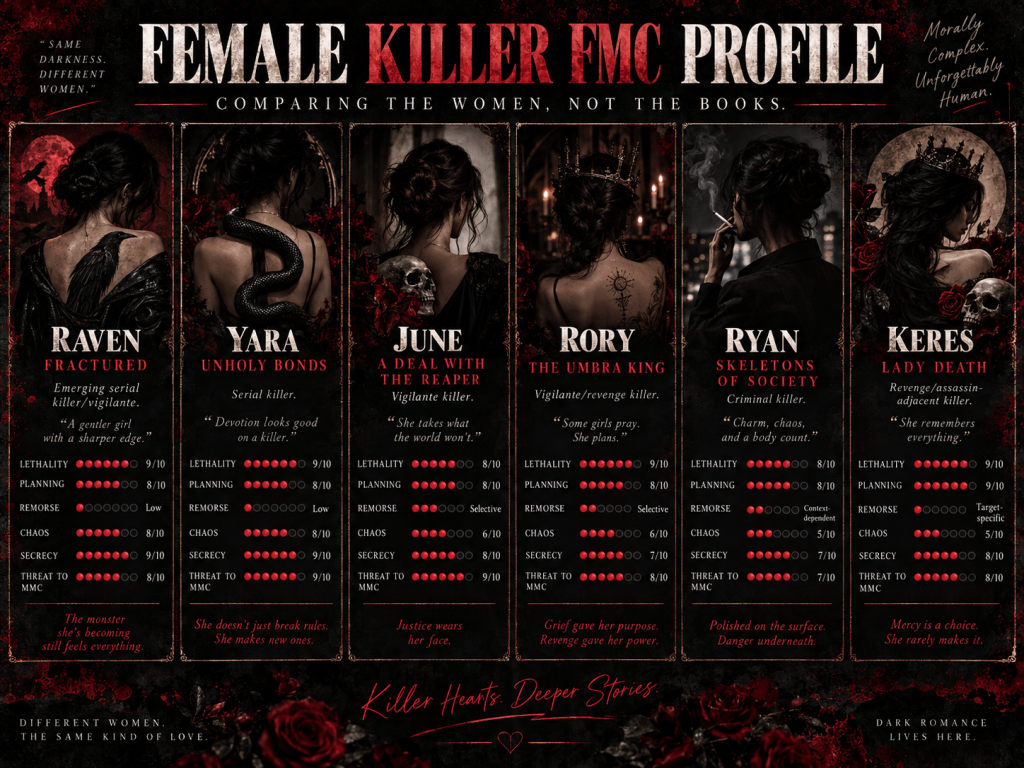
Female Killer Profile: Comparing the Women, Not the Books
The standard Eerie Efficiency ratings above measure the book’s content intensity.
This next system does something different.
It compares the FMCs strictly as fictional killer characters.
It is not a psychological assessment, and it is not intended to diagnose anyone.
| FMC | Killer Type | Lethality | Planning | Remorse | Chaos | Secrecy | Threat to MMC |
|---|---|---|---|---|---|---|---|
| Raven — Fractured | Emerging serial killer/vigilante | 9/10 | 8/10 | Low | 8/10 | 9/10 | 8/10 |
| Yara — Unholy Bonds | Serial killer | 9/10 | 8/10 | Low | 8/10 | 9/10 | 9/10 |
| June — A Deal With the Reaper | Vigilante killer | 8/10 | 8/10 | Selective | 6/10 | 8/10 | 9/10 |
| Rory — The Umbra King | Vigilante/revenge killer | 9/10 | 8/10 | Selective | 6/10 | 7/10 | 8/10 |
| Ryan — Skeletons of Society | Criminal killer | 8/10 | 8/10 | Context-dependent | 5/10 | 7/10 | 7/10 |
| Keres — Lady Death | Revenge/assassin-adjacent killer | 9/10 | 9/10 | Target-specific | 5/10 | 8/10 | 8/10 |
The most revealing column isn’t lethality.
It’s remorse structure.
A woman who kills only people she believes deserve it creates a fundamentally different reader experience from one who increasingly enjoys the act itself.
That is why “female serial killer” is too broad to function as the only recommendation label.
Most Dangerous Female Killer Ranking
Most Lethal: Rory and Keres
Both have extensive violence built into their identities rather than one isolated event.
Rory’s thirteen murder convictions give The Umbra King one of the clearest established body-count indicators in this group.
Keres is more methodically revenge-trained.
Most Calculated: Keres
Her violence is goal-driven rather than primarily impulsive.
Most Psychologically Dangerous: Raven
The transition is what makes her fascinating.
She doesn’t simply reveal that she has always killed.
She begins discovering pleasure and identity inside the behavior.
Most Morally Structured: June
She targets abusive men.
That doesn’t make her behavior morally uncomplicated. It means she has built the clearest victim-selection code.
Best Overall Female Serial Killer FMC: Raven
Raven earns the overall distinction because Fractured does more than reveal that its heroine kills. Her progression into repeated murder becomes part of the story’s psychological and romantic architecture.
Best True Killer Couple: Yara and Ryden
Unholy Bonds wins this category because both romantic leads carry independent killer identities into the relationship.
Most Likely to Make You Forget the MMC Was Supposed to Be the Dangerous One: Rory
The Umbra King may own the realm.
Rory arrives with thirteen murder convictions.
Fair fight.
Does She Kill “Bad People”—or Whoever Gets in Her Way?
This is one of the most important distinctions in the entire trope.
Vigilante morality
June — A Deal With the Reaper
Her victims are selected according to a perceived moral code.
This is the easiest type of killer FMC for many readers to emotionally accept because the story gives her violence a justice framework.
Revenge morality
Keres — Lady Death
She kills because identifiable people created the need for vengeance.
The violence is personal.
Retribution and vigilante morality
Rory — The Umbra King
Her history of violence grows out of loss, punishment, and the search for justice surrounding her sister.
Criminal pragmatism
Ryan — Skeletons of Society
Violence is part of surviving and holding power inside a cartel environment.
That feels very different from hunting strangers according to a personal moral code.
Increasing appetite for killing
Raven — Fractured
Raven is the important outlier because the act itself increasingly matters to her.
That makes her psychologically darker even when the targets may be framed as deserving.
And this is exactly why high Violence does not automatically mean the heroine feels equally dark.
Motive changes everything.
Who Is More Dangerous: Her or Him?
This trope becomes especially satisfying when the answer is not automatically “him.”
Fractured
The men surrounding Raven are dangerous, but Raven’s developing appetite for killing prevents her from becoming merely the woman standing beside them.
Unholy Bonds
This is the closest match to equally dangerous.
Yara and Ryden are both capable of hunting, hiding and killing.
The relationship doesn’t neutralize either character.
A Deal With the Reaper
Theo has the criminal infrastructure.
June has the intent to kill him.
He may possess more organizational power; she begins the relationship as the direct predator.
The Umbra King
Caius has supernatural authority and reputation.
Rory has already proven she can repeatedly kill before arriving in his world.
He may have more power.
She has less reason to be impressed by danger.
Skeletons of Society
Ryan and Gunner both understand violent criminal systems.
His role doesn’t erase hers.
Lady Death
Ronin is already a killer.
Keres attracts his attention because she keeps interfering with his targets.
That is about as close as dark romance gets to a murderous meet-cute without actually calling it one.
What Happens When the MMC Finds Out?
This is often more important than the killing itself.
A disappointing female-killer romance can make her lethal for 70% of the book and then suddenly soften her so the male lead can become the dominant danger.
The stronger books let his reaction expose his morality instead.
Does he recoil?
Does he admire her?
Does he become complicit?
Does discovering what she is make him less attracted—or much more?
Unholy Bonds is strongest for mutual recognition.
A Deal With the Reaper is strongest for a man who recognizes her as a threat early enough that the romance grows around that fact.
Lady Death works because Keres’s violence is what initially puts her on Ronin’s radar.
The Umbra King works because Rory enters Caius’s world already convicted. Her violence is not a late-act personality reveal.
That difference matters.
The fantasy is not always “Will he love her despite what she is?”
Sometimes it is:
Will he finally be the first person who understands exactly what she is and doesn’t ask her to become smaller?
Killer Couple vs Dangerous FMC + More Normal MMC
These produce two completely different reading experiences.
Killer couple
Both characters understand violence firsthand.
The tension becomes:
- mutual complicity
- competition
- fascination
- shared secrets
- escalating danger
- whether love makes them better or simply more efficient
Unholy Bonds is the strongest match in this guide.
Dangerous FMC + comparatively grounded partner
This structure makes the role reversal sharper.
The heroine’s secret can destabilize the relationship because the MMC doesn’t automatically operate according to her rules.
A lighter romantic-suspense example is A Killer Getaway by Sienna Sharpe, in which Lily repeatedly returns to a resort where mysterious deaths occur while Daniel begins investigating what is happening. Sourcebooks classifies the novel as romance/suspense and thriller rather than dark romance, which is why I consider it an adjacent recommendation rather than one of the core six.
That distinction is worth protecting.
A book does not become dark romance solely because the heroine kills people.
Dark Comedy vs Serious Darkness
Female-killer fiction increasingly crosses between romance, horror, suspense, black comedy and crime fiction.
The tone can change how dark identical behavior feels.
A graphic killing surrounded by banter and absurdity can register as less psychologically oppressive than a comparatively bloodless story built around fear, coercion and trauma.
That is why someone who loved the humor-versus-darkness balance in serial-killer romance may want something completely different from a reader who wants revenge trauma.
If tonal differences are what you are trying to identify, the same principle appears in Eerie Efficiency’s comparison of Lights Out vs. Butcher & Blackbird: premise alone never tells you the actual emotional experience of reading the book.
Violence Does Not Automatically Equal Darkness
This deserves its own section because recommendation lists regularly get it wrong.
Imagine two books.
Book A
- Violence: 10/10
- Psychological Intensity: 6/10
- Emotional Damage: 5/10
- Romance Focus: 9/10
Book B
- Violence: 6/10
- Psychological Intensity: 10/10
- Emotional Damage: 10/10
- Romance Focus: 6/10
Book A contains more blood.
Book B may still feel substantially darker.
This is why Eerie Efficiency separates Darkness, Violence, Psychological Intensity, Emotional Damage and Trigger Intensity rather than collapsing them into a single “how messed up is it?” score.
It also explains why a revenge killer can feel easier to read than a manipulative romantic lead who barely kills anyone.
If coercion or consent is your actual limit rather than murder, read Dub-Con vs. Non-Con: What’s the Difference in Dark Romance? before choosing based on a generic darkness score.

Reader Decision Guide: Which One Should You Read?
If you want the best overall female serial-killer FMC → Fractured
If you want both romantic leads to be killers → Unholy Bonds
If you want vigilante justice → A Deal With the Reaper
If you want revenge to create the killer → Lady Death
If you want dark fantasy instead of contemporary crime → The Umbra King
If you want cartel/MC criminal romance → Skeletons of Society
If you want the FMC’s relationship with killing explored psychologically → Fractured
If you want high spice → Fractured
If you want maximum mutual obsession → Unholy Bonds
If you want her dangerous before the MMC ever enters the picture → The Umbra King
If you want a heroine with an understandable victim-selection code → A Deal With the Reaper
If you want him to encounter her as the threat rather than transform her into one → A Deal With the Reaper or Lady Death
Most Obsessive Female Killers
A high Obsession rating does not automatically mean she is obsessed with the MMC.
That distinction matters.
Raven: obsession with killing, secrecy and the person watching her
Her fixation grows in several directions at once.
Yara: attraction becomes predatory curiosity
The relationship works because obsession and investigation blur.
June: mission-focused obsession
Her fixation is more closely connected to targets and judgment than romantic stalking.
Keres: revenge fixation
Her emotional energy is organized around vengeance.
None of those are the same psychological pattern.
This is another reason I wouldn’t label every woman here “unhinged.” Observable behavior tells us much more.
Female Serial Killer Does Not Mean “Mentally Ill Woman”
A violent female character does not need an armchair diagnosis.
Terms such as psychopath, sociopath, psychotic, bipolar, narcissist, or simply crazy are often thrown around in book discussions as shortcuts for “this person behaves violently.”
That is poor character analysis and poor mental-health framing.
Unless a book explicitly gives a diagnosis and that diagnosis is relevant, it is more useful to describe what the character actually does:
- calculated
- remorseless
- impulsive
- manipulative
- obsessive
- revenge-driven
- emotionally detached
- thrill-seeking
- methodical
- violent
- protective
- controlling
Mental illness does not equal violence.
And a fictional murderer’s body count is not a diagnostic tool.
Books People Think Belong Here—but Don’t
This is where the list gets much shorter.
How I’ll Kill You by Ren DeStefano
This is an excellent match for the female serial killer part of the search—but not a clean dark-romance classification.
Sissy comes from a family of sisters who seduce and murder men. She is expected to murder Edison after making him fall for her, only to develop genuine feelings for him. Penguin Random House categorizes the book as a thriller, and even the publisher’s quoted critical material describes it as a thriller with romance rather than straightforward genre romance.
Verdict: Read it if the killer-FMC element matters more to you than the book being conventional dark romance.
Matchmaking for Psychopaths by Tasha Coryell
Great title for this search.
Wrong protagonist profile.
Lexie is a matchmaker surrounded by potentially dangerous clients and escalating murder rather than the clean “female serial killer FMC dark romance” setup this article promises. Penguin Random House categorizes it primarily as suspense/thriller crime fiction.
Verdict: Thriller-adjacent recommendation, not a core female-killer dark romance.
Any book where she kills once in self-defense
No.
Any book where the heroine is “feisty” while the MMC commits every actual murder
Also no.
Any mafia romance where she orders someone’s death once
Still no.
A narrow list that delivers the requested trope is more useful than a large one that gradually stops answering the search query.
Common Misconceptions About Murderous FMC Romance
“The woman has to kill innocent people to count.”
No.
A repeat vigilante killer can still be serial-killer-coded fictionally, provided the book clearly establishes an ongoing pattern.
The important thing is labeling her accurately.
“If she kills bad people, the book isn’t dark.”
Also false.
Victim selection may make the violence easier for some readers to morally process, but darkness can come from trauma, torture, stalking, obsession, gore, coercion or psychological deterioration.
“Killer FMC means reverse gender roles.”
Not necessarily.
A woman can be the murderer while the MMC still controls the relationship socially, sexually, financially or criminally.
“More bodies equals a darker romance.”
Not reliably.
That is exactly why Darkness and Violence are separate Eerie Efficiency ratings.
Content Warnings Matter More Than the Trope Label
The phrase female serial killer romance tells you almost nothing about how the violence appears.
Depending on the book, you may encounter:
- murder
- torture
- gore
- stalking
- revenge violence
- abuse
- sexual-assault references
- trafficking themes
- traumatic death
- criminal violence
- kidnapping
- psychologically disturbing behavior
If any of those are hard limits rather than “depends how it’s handled” subjects, check the author’s current content-warning page before reading.
A three-word trope label is not a substitute for meaningful warning information.
If You Like Dangerous Women but Don’t Need a Killer FMC
The best next category depends on which part of this list attracted you.
If you want dangerous male obsession instead, try Dark Romance Books Where He Has Been Obsessed With Her for Years.
If you want mafia capture and enemies-to-lovers pressure, try Books Like Twisted Pride.
If you want bikers and brutal devotion, continue with Books Like Sicko.
If you want to move from dangerous heroines back into the books dark-romance readers argue about most, see Most Controversial Dark Romance Books.
For secret societies, Shantel Tessier Books in Order gives you the cleanest reading path.
For something supernatural, Dark Witch Romance Books With Forbidden Magic moves the danger into fantasy.
And if your interests run specifically toward taboo sexual content rather than murder, Dark Romance Books With Somnophilia Kink is a completely separate intensity lane.
Want Something Darker That Isn’t a Recommendation List?
Eerie Efficiency also publishes original adult fiction.
What Breaks You leans into age-gap, forbidden attraction and emotional damage.
He Was My Brother’s Best Friend First goes in a different direction with brother’s-best-friend tension and enemies-to-lovers energy.
Neither is being presented as a female-serial-killer story. They’re here because sometimes the thing you’re actually chasing after a dark recommendation list isn’t another killer—it is tension.
Frequently Asked Questions
Are there actually dark romance books with female serial killers?
Yes, although the category is smaller than recommendation lists often make it appear.
Fractured and Unholy Bonds are among the clearest matches in this guide because repeated killing is integral to the FMC’s identity rather than a single act of self-defense or revenge.
What is the best dark romance with a female serial killer?
For the strongest overall female serial-killer FMC experience, start with Fractured by Leah Steele. Raven’s developing relationship with killing is part of the story itself rather than merely established backstory.
If what you specifically want is a romance where both leads are killers, choose Unholy Bonds by Maya Raine instead.
Are there dark romances where both characters are serial killers?
Yes.
Unholy Bonds is the strongest example here. Yara and Ryden both have independent relationships with murder before the romance fully develops.
Which book has the most dangerous FMC?
For demonstrated history, The Umbra King is difficult to ignore: Rory enters the story after being convicted of thirteen murders.
For psychological danger, I would choose Raven in Fractured because her growing desire to kill becomes part of the character arc.
Are female killer romances always extremely violent?
No.
And violence level doesn’t automatically predict emotional darkness.
Some stories foreground murder and gore. Others care more about secrets, moral tension or the romantic consequences of being discovered.
Are there female vigilante dark romances?
Yes.
A Deal With the Reaper is one of the cleaner examples because June deliberately targets abusive men rather than killing indiscriminately.
Which book should I read if I want her more dangerous than him?
Start with The Umbra King if you like dark fantasy.
Start with A Deal With the Reaper if you want contemporary criminal romance.
In both cases, the heroine enters the romantic dynamic with lethal agency of her own.
Which book should I choose if I want revenge instead of thrill killing?
Keres’s violence grows out of vengeance, training and a deliberate campaign against the people connected to what happened to her.
Final Verdict: Start Based on the Kind of Killer You Actually Want
“Female serial killer romance” sounds like one trope.
It isn’t.
The woman hunting abusive men and the woman discovering that she enjoys killing do not produce the same fantasy.
The cartel killer and the revenge-trained assassin do not create the same romantic power balance.
And the story where both lovers are murderers operates by completely different rules from the one where the MMC suddenly discovers what his girlfriend does when nobody is watching.
So my final choices are:
Best Female Serial Killer Dark Romance Overall: Fractured by Leah Steele
Choose this when you want the heroine’s killer identity to be one of the central forces shaping both her character arc and the romance.
Best Killer Couple: Unholy Bonds by Maya Raine
Choose this when you want two established killers whose attraction grows through recognition, obsession, and mutual darkness.
Best Vigilante FMC: A Deal With the Reaper by Madison Lawson
Choose this when victim selection and moral justification matter to you.
Most Dangerous FMC on Paper: The Umbra King by Jamie Applegate Hunter
Thirteen murder convictions before the romance has even finished introducing its world makes a compelling case.
Best Revenge-Built Killer: Lady Death by Beth D. Carter
Choose this when you want to watch vengeance forge the heroine into something lethal.
Best Criminal Antiheroine: Skeletons of Society by Marie Maravilla
Choose this when your real request is less “serial killer” and more woman who can stand inside a vicious criminal world without surrendering the dangerous role to the hero.
That is the difference a useful female-killer romance guide should make.
Not just does she kill?
But:
Why does she kill—and what kind of love story is possible because she does?